Pages

Subscribe Twitter

Thursday, February 28, 2008

Lucky Soldier Wins $1 Million

Though He Hit the Jackpot, Sergeant Plans to Return to Iraq for a 3rd Tour


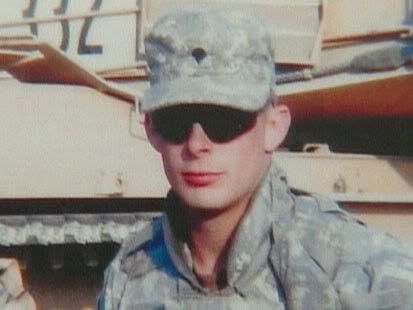
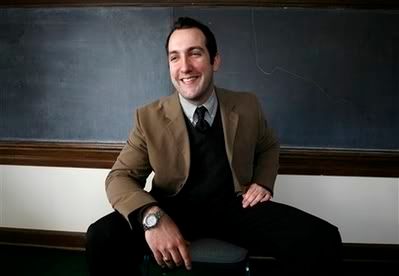
After completing two tours in Iraq, Sgt. Wayne Leyde won $1 million from a scratch-and-win lotto ticket on Tuesday.

Now that he's won, Leyde, a 26-year-old member of the Washington National Guard, says he's still going to volunteer to go back to Iraq for a third tour and won't spend any of the money in the meantime.

Leyde was driving near his home in Mead, Washington when he stopped at a store on the side of the road and bought a ticket.

"I decided to walk into a local Zip Trip. I got a Coke and beef jerky and walked up to the counter and thought I'd pick up a few scratch tickets and try my luck. I was on my way out when the lady said, 'Do you have a lucky scratch coin?'

"I said 'no, you gave me a dime and nickel back.'"

"She said 'no, try this,'" handing Leyde a penny. "On my way home I started scratching tickets. They were losers. I'm thinking, boy, that lady didn't know what she was talking about."

Leyde couldn't believe it when he scratched a winning ticket, but he still plans to return to Iraq.

"It was a commitment I made about three months ago. I'm going to stick to it," Leyde said about his decision.

The sergeant says rents have gone sky high where he and his parents live in the Mount Spokane area of Washington and that, for now, he's not going to spend any of the money.

"For right now, I'm going to hold off [spending] and let reality sink back to earth. This is a true blessing. I'm going to turn it around and see if I can bless other people with this," Leyde said.

AhmadineWHACKJOB: Iran "number one world power"

Iran 'number one world power': Ahmadinejad
Believe.

Listen to the words of this crazy buffoon...

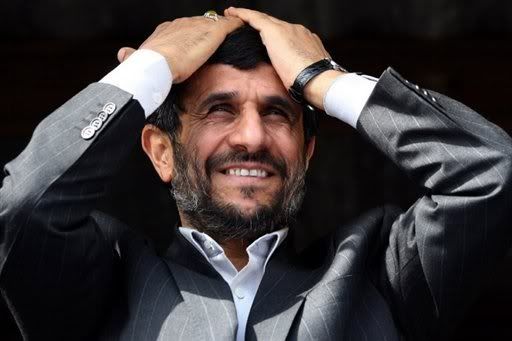
President Mahmoud Ahmadinejad declared on Thursday that Iran was the world's "number one" power, as he launched a bitter new assault on domestic critics he accused of siding with the enemy.

"Everybody has understood that Iran is the number one power in the world," Ahmadinejad said in a speech to families who lost loved ones in the 1980-1988 Iran-Iraq war.

"Today the name of Iran means a firm punch in the teeth of the powerful and it puts them in their place," he added in the address broadcast live on state television.

Ahmadinejad's comments come amid renewed Western efforts on the UN Security Council to agree a third package of sanctions against Tehran over its refusal to suspend sensitive nuclear activities.

They also came a day after former top nuclear negotiator Hassan Rowhani launched an unprecedented attack on Ahmadinejad's foreign policy, accusing him of using "coarse slogans and grandstanding".

"You can see how some people here... try to materialise the plans of the enemies and by showing that Iran is small and the enemy is big," added Ahmadinejad.

"These are the people who put the enemies of humanity in the place of God," said the deeply religious president.

He also told the families of the "martyrs" of the war that their loss was not in vain as the message of the Islamic revolution of 1979 that ousted the pro-US shah was spreading all over the world.

"Today the message of your revolution is being heard in South America, East Asia, in the heart of Europe and even in the United States itself," he said.

Ahmadinejad said he talked with people everywhere he travelled in the world and "it is like I am in district 17 in Tehran", referring to the low-income area in the south of the Iranian capital where he was giving his speech.

Ahmadinejad is due to travel to Iraq on Sunday in the first visit by a president of the Islamic republic to its western neighbour.

Ha, this is the same guy those hippies from Columbia University had an orgasm over.

U.S. Navy ships move closer to Lebanon

U.S. Navy makes move amid a political standoff over Lebanon's presidency

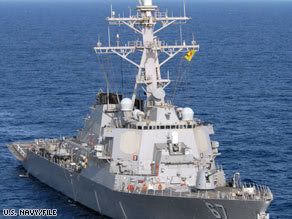
WASHINGTON (CNN) -- The U.S. Navy has moved the guided-missile destroyer USS Cole and other ships to the eastern Mediterranean Sea off Lebanon, Pentagon officials said Thursday.

The deployment comes amid a political standoff over Lebanon's presidency, but the Navy would not say whether the events are linked.

"It's a group of ships that will operate in the vicinity for a while and as the ships in our Navy do, the presence is important," Adm. Mike Mullen, the chairman of the Joint Chiefs of Staff, said Thursday.

"It isn't meant to send any stronger signal than that," he said. "But it does signal that we're engaged and we are going to be in the vicinity, and that's a very important part of the world."

The Cole was badly damaged by an al Qaeda bombing during a port call in Yemen in 2000, killing 17 sailors. It returned to service in 2002.

The destroyer and two support ships are close to Lebanon but out of visual range of the coast, Pentagon officials said. Another six vessels, led by the amphibious assault ship USS Nassau, are close to Italy and steaming toward the other three, the officials said.

Mullen would not say whether the deployment has anything to do with the upcoming Lebanese parliamentary vote on a new president, which was postponed for a 15th time earlier this week. But he said the vote was "important," and Washington was waiting for it to take place.

And a Bush administration official told CNN the decision to move ships to the region was a message to neighboringSyria that "the U.S. is concerned about the situation in Lebanon, and we want to see the situation resolved."

"We are sending a clear message for the need for stability," said the official, who was not authorized to speak for publication. The ships "should be there a while," the official added.

Lebanon's pro-Western majority in parliament and the pro-Syrian opposition have battled for power over the last three years. The country has been without a president since November, when pro-Syrian leader Emile Lahoud's term expired and parliament was unable to agree on a replacement.

Despite general agreement among the factions to award the post to army chief Gen. Michel Suleiman, disagreements over how to share power in a future Cabinet have kept the issue from coming up for a vote.

Parliament speaker Nabih Berri's office announced Tuesday that the next planned session has been pushed back to March 11. Berri's office said the Arab League needed more time to break the deadlock.

Lebanon has been wracked by a sometimes-violent power struggle since the 2005 assassination of former Prime Minister Rafik Hariri, whose supporters blamed Damascus for his killing. The resulting outcry eventually drove Syrian forces out of Lebanon, where they had been stationed since the 1970s.

Other news:
Geldof and Bush: Diary From the Road
It's not exactly a positive article, but it's pretty interesting.

Here is an excerpt from Bob Geldorf's article:

You forget that Bush has an M.B.A. He thinks like a businessman in terms of the bottom line. Results. Profit and loss. There is an empiricism to a lot of his furthest-reaching policies on Africa. Correctly, he's big on trade. "A 1% increase in trade from Africa," he says, "will mean more money than all the aid put together annually." He's proud that he twice reauthorized the African Growth and Opportunity Act (AGOA), a modestly revolutionary Clinton Administration initiative that enabled previously heavily taxed exports to enter the U.S. tax-free. Even though oil still accounts for the vast amount of African exports to the U.S., the beneficial impact of AGOA on such places as the tiny country of Lesotho, and its growing textile industry, has been startling.

AGOA represents precisely the sort of coherent thinking that will change things for Africa. But we talk of how the little that Africa does export to other parts of the world is still greater than the amount that it trades within the continent. I say that's because there are more landlocked countries in Africa than anywhere else in the world. "So they can't get their stuff to market?" he asks quickly. "Exactly," I say. "You have to pay so many tariffs at each border that by the time you get to the coast, you're overpriced." "You gotta dismantle borders, then." He's curious and quick.

He is also, I feel, an emotional man. But sometimes he's a sentimentalist, and that's different. He is in love with America. Not the idea of America, but rather an inchoate notion of a space — a glorious metaphysical entity. But it is clear that since its mendacious beginnings, this war has thrown up a series of abuses that disgrace the U.S.'s central proposition. In the need to find morally neutralizing euphemisms to describe torture and abuse, the language itself became tortured and abused. Rendition, waterboarding, Guantánamo, Abu Ghraib — all are codes for what America is not. America has mortally compromised its own essential values of civil liberty while imposing its own idea of freedom on others who may not want it. The Bush regime has been divisive — but not in Africa. I read it has been incompetent — but not in Africa. It has created bitterness — but not here in Africa. Here, his administration has saved millions of lives...


London’s edge over New York eroded

London is losing its status as the world’s leading financial centre and being overtaken by New York, according to a global survey of finance professionals.

The collapse of Northern Rock and the proposed tax crackdown on non-domiciled residents are making the UK less attractive to overseas businesses, according to the City of London Corporation, which commissioned the survey.

A separate survey, also commissioned by the City, said the UK tax system had lost its competitive edge over other financial centres. The UK had become increasingly unpredictable and uncertain, complex and unnecessarily aggressive in its approach to taxpayers, it found.

...The Global Financial Services Index, compiled from questionnaires completed by 1,200 financial services workers around the world, said London was still the leading financial centre.

The index rates cities on factors such as property costs, regulation, taxation, the supply of skilled staff, the responsiveness of government to business needs and the quality of life.

However, its lead over New York had halved over the last six months – and questionnaires returned since the second index was published in September showed New York outstripping Londonn.London was rated top based on all returns since the survey began 18 months ago, with 795 points to New York’s 786. However, the 411 responses since the September index showed New York’s score as 46 points higher.

...The second survey on tax competitiveness found that business leaders in London believed the UK’s tax framework has become less competitive at a time when many other countries were reducing their tax rates.

Angelina Jolie: Staying to Help in Iraq


Staying to Help in Iraq
We have finally reached a point where humanitarian assistance, from us and others, can have an impact.

By Angelina Jolie
Thursday, February 28, 2008; 1:15 PM

The request is familiar to American ears: "Bring them home."

But in Iraq, where I've just met with American and Iraqi leaders, the phrase carries a different meaning. It does not refer to the departure of U.S. troops, but to the return of the millions of innocent Iraqis who have been driven out of their homes and, in many cases, out of the country.

In the six months since my previous visit to Iraq with the United Nations High Commissioner for Refugees, this humanitarian crisis has not improved. However, during the last week, the United States, UNHCR and the Iraqi government have begun to work together in new and important ways.

We still don't know exactly how many Iraqis have fled their homes, where they've all gone, or how they're managing to survive. Here is what we do know: More than 2 million people are refugees inside their own country -- without homes, jobs and, to a terrible degree, without medicine, food or clean water. Ethnic cleansing and other acts of unspeakable violence have driven them into a vast and very dangerous no-man's land. Many of the survivors huddle in mosques, in abandoned buildings with no electricity, in tents or in one-room huts made of straw and mud. Fifty-eight percent of these internally displaced people are younger than 12 years old.

An additional 2.5 million Iraqis have sought refuge outside Iraq, mainly in Syria and Jordan. But those host countries have reached their limits. Overwhelmed by the refugees they already have, these countries have essentially closed their borders until the international community provides support.

I'm not a security expert, but it doesn't take one to see that Syria and Jordan are carrying an unsustainable burden. They have been excellent hosts, but we can't expect them to care for millions of poor Iraqis indefinitely and without assistance from the U.S. or others. One-sixth of Jordan's population today is Iraqi refugees. The large burden is already causing tension internally.

The Iraqi families I've met on my trips to the region are proud and resilient. They don't want anything from us other than the chance to return to their homes -- or, where those homes have been bombed to the ground or occupied by squatters, to build new ones and get back to their lives. One thing is certain: It will be quite a while before Iraq is ready to absorb more than 4 million refugees and displaced people. But it is not too early to start working on solutions. And last week, there were signs of progress.

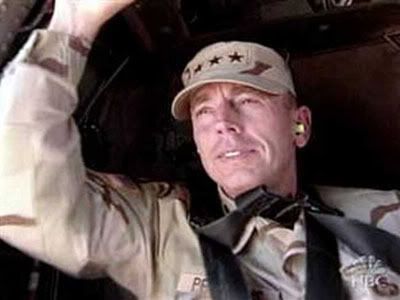
In Baghdad, I spoke with Army Gen. David Petraeus about UNHCR's need for security information and protection for its staff as they re-enter Iraq, and I am pleased that he has offered that support. General Petraeus also told me he would support new efforts to address the humanitarian crisis "to the maximum extent possible" -- which leaves me hopeful that more progress can be made.

UNHCR is certainly committed to that. Last week while in Iraq, High Commissioner António Guterres pledged to increase UNHCR's presence there and to work closely with the Iraqi government, both in assessing the conditions required for return and in providing humanitarian relief.

During my trip I also met with Iraqi Prime Minister Nouri al-Maliki, who has announced the creation of a new committee to oversee issues related to internally displaced people, and a pledge of $40 million to support the effort.

My visit left me even more deeply convinced that we not only have a moral obligation to help displaced Iraqi families, but also a serious, long-term, national security interest in ending this crisis.

Today's humanitarian crisis in Iraq -- and the potential consequences for our national security -- are great. Can the United States afford to gamble that 4 million or more poor and displaced people, in the heart of Middle East, won't explode in violent desperation, sending the whole region into further disorder?

What we cannot afford, in my view, is to squander the progress that has been made. In fact, we should step up our financial and material assistance. UNHCR has appealed for $261 million this year to provide for refugees and internally displaced persons. That is not a small amount of money -- but it is less than the U.S. spends each day to fight the war in Iraq. I would like to call on each of the presidential candidates and congressional leaders to announce a comprehensive refugee plan with a specific timeline and budget as part of their Iraq strategy.

As for the question of whether the surge is working, I can only state what I witnessed: U.N. staff and those of non-governmental organizations seem to feel they have the right set of circumstances to attempt to scale up their programs. And when I asked the troops if they wanted to go home as soon as possible, they said that they miss home but feel invested in Iraq. They have lost many friends and want to be a part of the humanitarian progress they now feel is possible.

It seems to me that now is the moment to address the humanitarian side of this situation. Without the right support, we could miss an opportunity to do some of the good we always stated we intended to do.

Princess Diana would be proud!

Prince Harry in Afghanistan


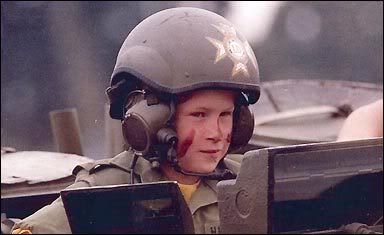
Boy soldier ... Harry, 8, in 1993

PRINCE Harry received a heart-wrenching letter in the front line from brother William telling him: “You’re making mum proud.”

It was among a treasure chest of personal messages sent to the Royal as he took on the Taliban in Afghanistan.
Fellow Blues and Royals officer William reminded his younger brother of Princess Diana to provide a vital boost, after hearing from other soldiers in the regiment how tough life was in Helmand Province.

Harry said: “Hopefully, she would be proud. She would be looking down having a giggle about the stupid things that I’ve been doing, like going left when I should have gone right, finding myself in an awkward position earlier today.

“William sent me a letter saying how proud he reckons that she would be.”

It was during a visit with Princess Diana to the Light Dragoons Bergen-Hohne barracks in Germany in 1993, that a now-famous photograph was taken of an eight-year-old Harry peering from the turret of a tank.

Years later when he joined the Army, he chose the Household Cavalry as his regiment — and trained as a Scimitar armoured vehicle troop leader.


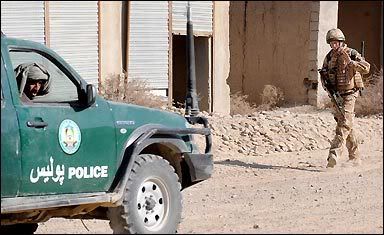
On patrol ... passing police unrecognised in Garmsir

He was 12 when she died in Paris in 1997. Last night a senior Royal source told The Sun: “William just wanted to let Harry know how much he admired his brother.

“He knows that his status as a future king means William will never see action in this way. But William is well aware that their mother would have been watching over Harry as he served his country.”

But Harry admitted: “I suppose it’s just the way it is — there are other people out here who’ve lost one of their parents, I’m sure it’s the same for them.”

Harry joked that William — now learning how to fly with the RAF — was jealous of his Afghan posting.

He said: “Well, he does know where I am. He’s jealous anyway because I’ve got one of the best jobs in the Army. I think there’s a lot of people who disagree with that but there’s a lot of people who’d agree.”

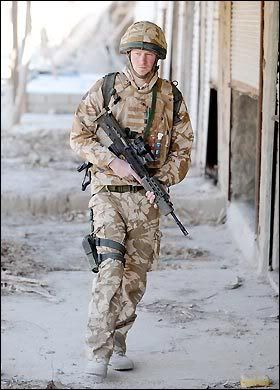
Harry said he was exhilarated by service in Afghanistan — and proud of his Gurkha comrades. He doesn’t attract a second glance from locals or even Afghan police as he patrols the bombed-out streets of Garmsir.

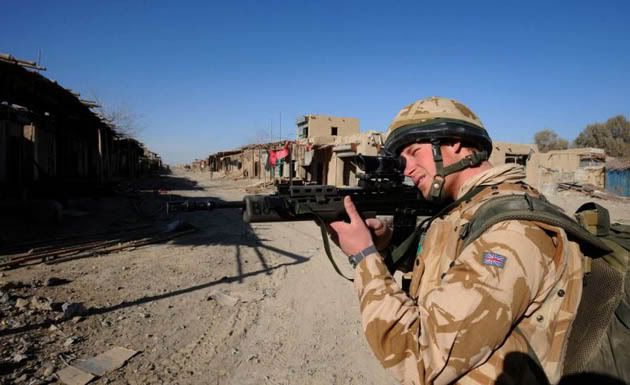
He also manned a .50 calibre Heavy Machine Gun from a fortified observation point on high ground just outside of Garmsir.

Harry said: “Delhi (his base) is fantastic. I’d asked the commanding officer if I could spend Christmas with the Gurkhas there because I had spent some time with them in England on exercise on Salisbury.

“Everyone is really well looked after here by the Gurkhas. The food is fantastic, goat curries, chicken curries — yeah, it’s really good fun and, yeah, we’re really well looked after. It was just something I wanted to do, just to be with them.

“They don’t celebrate Christmas much but we had some fantastic games which we played in the yard there. Christmas is over-rated anyway. And you know, when you’re with the Gurkhas there’s no safer place to be really.

“But what’s hard for anyone to understand, especially if you’ve been out here for three months already, is the fact that, yes, you can be up at (base) Dwyer safe and sound but it just drags on when nothing is going on and it’s so boring.

“So it’s nice to get down here and be part of it and actually help. As a soldier, this is what it’s all about, being here with the guys rather than in a room with officers.”

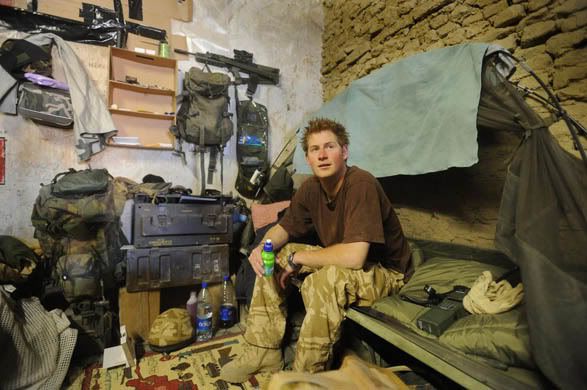
Home now is a bunker — a million miles from the palaces and stately homes he is used to. His bed has been knocked up from a stretcher and a tent, with a mosquito net wrapped around the supports, wedged against a dusty brick wall.

Instead of a mattress, he has lightweight green sleeping bag and a pillow. Basic toiletries of toothpaste, razors, shaving foam and aftershave hang in webbing from the stone wall. There is no basin or bathroom.

Military equipment is strewn around the room. On the floor is a locally-bought rug, but Harry — pictured holding a bottled fruit drink — has some comforts such as an MP3 player.

Harry said: “We’ve got light, we’ve got food, we’ve got drink. No, I don’t miss booze. It’s nice just to be here with the guys and mucking in as one of the lads.”

Harry admitted his comrades aren’t the least bit fazed by having a Royal in the ranks.

He said: “I’ve been mocked. We have a good laugh every day and Mark (Major Milford) blows smoke up my ass by saying that the Gurkhas love the fact I’m down here, especially with this company because my father is the Colonel-in-Chief. I hope I’ve got that right.

“They think it’s fantastic and I love them because they just make me laugh so much and we’ve been having a really good time. I don’t think there’s any words to describe exactly how it is. It’s just really nice to be out here.”

I've always thought he was cuter than William!

Prince Harry battles with terrorists!!!


Here's a video of Prince Harry in action, courtesy of PatDollard.Com!

Army commanders were making frantic arrangements last night to bring Prince Harry back from Afghanistan after an American website disclosed that he had been serving with other British troops fighting the Taliban.

The prince, who is 10 weeks into a 14-week tour, was believed to still be in the country last night among British soldiers in the southern Helmand province.

The lid was blown on Harry’s deployment yesterday afternoon by the Drudge Report, a US political blog, ending a voluntary agreement by the British media to keep it secret until he had returned. His job in Afghanistan was to monitor Taliban fighters’ movements transmitted on to screens nicknamed ‘Kill TV’.

The MoD had held a series of meetings with senior editors from all UK newspapers and broadcasters over the last three months where it had been agreed that Harry and his colleagues would have been put in greater danger had details of his presence been made public.

Commanders are now expected to activate their contingency plan to fly the prince out of Afghanistan as quickly as possible amid fears that the Taliban will step up attacks on British bases.

Emergency plans to extract Prince Harry from Afghanistan were being drawn up last night after the news leaked that he had been on a secret combat tour in Helmand province since before Christmas.

After being denied the chance to serve with his unit in Iraq, the third in line to the throne was deployed in Afghanistan in mid-December. He has been working in Helmand province as a Forward Air Controller – responsible for providing cover for frontline troops – and has been personally involved in clashes with Taleban guerrillas.

His four-month deployment had been kept secret because of a Ministry of Defence agreement with news organisations, including The Times, but the details can now be made public after the news leaked out overseas and on the internet.

One Australian news magazine, New Idea, reported Harry’s deployment a month ago, but it was not until it was carried yesterday on the Drudge Report, a major American website, that the news embargo was lifted.

The leak means the full details of Prince Harry’s mission in Helmand province can now be revealed.


— He was involved in a frontline fire-fight with the Taleban fighting alongside Gurkha troops just 500 metres from enemy positions.

— He expressed his fear that he could be a “bullet magnet” for the enemy and that extremists would be “trying to slot me” on his return to England.

— On New Year’s Eve, working as a battlefield air controller known only to pilots as “Widow Six Seven”, he called fighter bomber strikes on Taleban positions.

— He was first told that he was going to Afghanistan by the Queen, his grandmother, and said that he would have had to “bow out” of the Army if he had not been allowed to go.

Defence officials confirmed this evening that Harry, 23, a lieutenant in the Blues and Royals, was still in Afghanistan. They released a range of photographs of the Prince on the first combat deployment of a royal since his uncle, Prince Andrew, served as a helicopter pilot in the Falklands in 1982.

“His conduct on operations in Afghanistan has been exemplary,” General Sir Richard Dannatt, Chief of the General Staff, said. “He has been fully involved in operations and has run the same risks as everyone else in his battle group.”

Gordon Brown said: “The whole of Britain will be proud of the outstanding service he is giving.”

General Dannatt said he was “very disappointed” that the story had leaked out. Harry has been moved for his own safety but the Ministry of Defence said that no decision had been made on whether it was safe for Harry to remain in Afghanistan. A spokesman said: “The operational chain of command is now looking at a variety of options.”

Harry, or Cornet Wales, was due to complete a four-month tour, without the standard two-week R&R break other soldiers enjoy, in April.

He was serving with the Household Cavalry battle group, attached to 52 Brigade, in remote parts of Helmand in a potentially dangerous role coordinating all types of aircraft from US F15s and British Harrier GR9 ground-attack bombers to Apache attack helicopters and Hercules transport planes.

The Prince admitted just last week, in a media interview due to be reported on his safe return, that he could be a target for Taleban-supporting extremists in the UK.

“Once this film comes out there’ll probably be every single person, every single person that supports them, trying to slot me,” he said. “Now that you come to think about it it’s quite worrying.”

He also revealed that he often wished that he was not a prince and said that his Afghan experience was “about as normal as I’m ever going to get”. He said that he hoped that he had made his mother Diana, Princess of Wales “proud”

The Prince had been due to serve in Iraq after his graduation from Sandhurst, leading an armoured reconnaissance unit, but it was decided last May that he would present too great a target for insurgents despite his pledge not to “sit on my arse back home while my boys are out fighting for their country”.

In a pooled interview shortly before his departure for Afghanistan, the Prince said that he had accepted the decision not to send him to Iraq. But he had continued to push to be sent to Afghanistan, where almost 8,000 British troops are serving, and was finally told that he would be going by his grandmother, the Queen.

Asked whether he had thought of quitting the Army over the Iraq decision, Harry said: “I wouldn’t use the word ‘quitting’, it was a case of: ‘I very much feel like if I’m going to cause this much chaos to a lot of people then maybe I should bow out’ and not just for my own sake, for everyone else’s sake.

“It was something that I thought about but at the same time I was very keen to make this happen – or hope for the opportunity to arise, and luckily it has.”

Of his tour of duty in Afghanistan, where 88 British troops have been killed since the Taleban were ousted in 2001, he said: “It won’t be risk-free but then I didn’t join the Army thinking that I was never going to go on operations.”

The Prince flew out on December 14 and spent several weeks working in Garmsir, in the far south of Helmand province, operating just 500m from front-line Taleban positions. He has since left Garmsir to work in another part of Helmand.

As a Forward Air Controller (FAC) – or, in American military parlance, JTAC (Joint Terminal Attack Controller) – Harry has had the lives of his colleagues in his hands. During the heat of battle it was he who would call in and give final clearance for air strikes on Taleban targets, although the job also involved long hours scrutinising minute details of surveillance footage beamed from aircraft flying over enemy positions to a laptop terminal, dubbed “Taleban TV” or “Kill TV”.

This could involve pictures from drones such as the British Desert Hawk – little larger than a standard model aeroplane – to full-sized manned reconnaissance aircraft which are able to watch the ground undetected by the Taleban because of their altitude.

The Prince was also able to make use of sophisticated equipment on jets to study the area below, for instance using heat sensors to pinpoint hidden Taleban bunkers and trench systems.

“Terry Taleban and his mates, as soon as they hear air they go to ground, which makes life a little bit tricky,” he explained to a British reporter in the field.

“So having something that gives you a visual feedback from way up means that they can carry on with their normal pattern of life and we can follow them.”


As part of his battlegroup’s Fire Planning Cell, one of his most important responsibilities was to prevent accidents such as planes being hit by mortars and artillery shells or even friendly fire tragedies. This entailed controlling a key “bubble” of airspace known as a ROZ or Restricted Operating Zone, giving jets permission to enter when safe to do so.

Although Harry’s work saw him spend hours on end speaking with pilots from many countries over the radio, they knew him only by his call sign Widow Six Seven. Other colleagues were sworn to secrecy.

News of his deployment was greeted with excitement on arrse.co.uk, the Army Rumour Service website, although users were warned not to give away any operational details.

“That explains the tabloids’ sudden lack of stories about him!” wrote one poster. Another asked: “Does anybody else feel just a tad proud knowing that our Queen’s own grandson has been putting/calling down ordnance on Terry [Taleban]?”

In another pooled interview given from Helmand province Harry, who has established a reputation for enjoying London’s night-life, was asked what he missed most from his life in Britain.

“Erm, I don’t know actually. Nothing really,” he replied. “It’s bizarre, I’m out here now, haven’t really had a shower for four days, haven’t washed my clothes for a week and everything seems completely normal.

“So, yeah, I honestly don’t know what I miss at all. Music, we’ve got music. We’ve got light, we’ve got food, we’ve got drink.

“No, I don’t miss booze, if that’s the next question. It’s nice just to be here with all the guys and just mucking in as one of the lads.”

Other news:

Prince Harry has 30 kills!! Great job!!

George W. Bush: Loved by few, feared by many, respected by all.

The President


"I had made it clear to the world that either you're with us or you're with the enemy, and that doctrine still stands."

Obama ain't sexy. What's up with that!

I'm so pissed! Obama wants to cuddle up to dictators and make 'em feel all mushy inside! Gosh!!! Now just read what GWB has to say 'bout that, 'cause you know he makes so much more sense than Hussein!!

Bush attacks Obama foreign policy plan
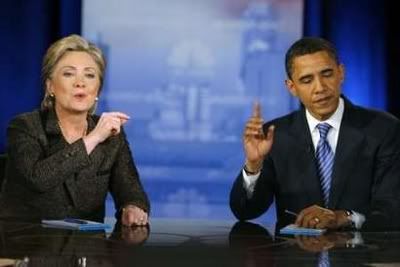
President Bush attacked a key foreign policy stance of Sen. Barack Obama (D-Ill.), contending heatedly at a news conference Thursday morning that talking to dictators without preconditions can be dangerous and counterproductive.

Obama’s argument that the president “should never fear to negotiate” with America’s enemies — including Cuba’s new leader, Raul Castro — is one of his clearest differences with his rival for the presidential nomination, Sen. Hillary Rodham Clinton (D-N.Y.).

At a news conference where Bush showed unusual passion for a president in his waning months, he said “now is not the time” to talk with Castro.

“What’s lost … by embracing a tyrant who puts his people in prison because of their political beliefs?” he said. “What’s lost is, it’ll send the wrong message. It’ll send a discouraging message to those who wonder whether America will continue to work for the freedom of prisoners. It’ll give great status to those … who have suppressed human rights and human dignity.

“The idea of embracing a leader who’s done this, without any attempt on his part to … release prisoners and free their society, would be counterproductive and send the wrong signal.”

Warming to the subject, Bush continued: “Sitting down at the table, having your picture taken with a tyrant such as Raul Castro, for example, lends the status of the office and the status of our country to him. He gains a lot from it by saying, ‘Look at me. I’m now recognized by the president of the United States.’”

Obama responded in a statement: “The American people aren’t looking for more of a do-nothing Cuba policy that has failed to secure the release of dissidents, failed to bring democracy to the island, and failed to advance freedom for fifty years, because they know we need to pursue new opportunities to achieve liberty for the Cuban people. If I am the Democratic nominee, I will offer the clearest contrast to John McCain’s call for four more years of George Bush’s policies, because I want to fundamentally change our foreign policy to secure the American people and restore our standing in the world.”

Obama has argued that the U.S. must “rediscover the power of diplomacy,” declaring at an event in Youngstown, Ohio, last week that “strong presidents and strong countries … talk to their adversaries.”

“Very early in this campaign, I said I would meet not just with our friends but also with our enemies, not just with leaders we like but leaders we don’t,” Obama said. “Washington, when I said this, they said, ‘Oh, you can’t do that.’ I said, ‘Watch me; I will.’”

Bush has said he will avoid getting enmeshed in the presidential race during the primaries, but he made it clear that he’ll eventually speak up. In a prelude to question, John McKinnon of The Wall Street Journal noted, “It doesn’t seem that you want to discuss the prospects of Republican candidates on the campaign trail this year.”

Bush declined to repeat his prediction that Clinton will be the Democratic nominee, saying with a smile: “I’m not talking about politics.”

Earlier, Bush had been asked about Obama’s statement in Tuesday night’s debate, when asked about conditions under which he would go back into Iraq after withdrawing sizable forces: “If Al Qaeda is forming a base in Iraq, then we will have to act in a way that secures the American homeland and our interests abroad.”

Sen. John McCain (R-Ariz.), the likely Republican nominee, ridiculed that comment on Wednesday, although Obama later said he knew that the terrorist network was already in Iraq.

Bush said: “It’s an interesting comment. If Al Qaeda is securing an Al Qaeda base? Yes, well, that’s exactly what they’ve been trying to do for the past four years.”

Asked later if the comment was naive, Bush said: “I believe Sen. Obama better stay focused on his campaign with Sen. Clinton, neither of whom has secured their party’s nomination yet.”

Then he caught himself. “My party’s hasn’t been decided yet, either,” he added. “So there will be ample time to discuss whoever their candidate — the positions of whoever their candidate is.”

Bush also said he “hadn’t heard” that analysts were saying gas prices could rise to $4 a gallon by spring, although that fact was in the first paragraph of a front-page story in The New York Times on Wednesday.

On the topic of his presidential library, planned for Southern Methodist University in Dallas, Bush said he will “probably take some foreign money” and had not yet made a decision about disclosing the names of donors.

“Some people … like to give and don’t particularly want their names disclosed, whether it be for this foundation or any other foundation,” he said. “And so we’ll take that into consideration.”

About the people’s right to know, he said: “You know, we’re weighing, taking a look. Taking consideration — giving it serious consideration.”

Wednesday, February 27, 2008

Funny Video!


300 Mexicans push through the US border.

Tuesday, February 26, 2008

Clinton vs. Obama vs. McCain

Obama Surges Past Clinton, Trails McCain on Security, Poll Says


Barack Obama has surged ahead of Hillary Clinton in the battle for the Democratic presidential nomination, though he would face a tough general election against Republican John McCain, who enjoys a huge advantage on national-security issues.

A new Bloomberg/Los Angeles Times survey shows Obama is preferred by Democratic primary voters 48 percent to 42 percent, the first time he has overtaken Clinton in a Bloomberg/Times poll. In a general-election match-up among registered voters, McCain is 2 points ahead of Obama, within the margin of error; he beats Clinton by 6 points.

McCain runs ahead of Obama on every issue except health care. The Arizona senator has a 13-point advantage on Iraq and a 37-point lead on terrorism. He also does better on managing the economy. One area where Obama has a clear edge is on the question of who would bring the most change in Washington; the Illinois senator has an almost 3-to-1 lead.

``Obama has moved decisively ahead of Clinton, but as a general-election candidate he has a tougher road to travel in a campaign against John McCain,'' says Susan Pinkus, the Los Angeles Times polling director. McCain is seen as having the right experience and is ``the person people think could be the strongest leader.''

General Election

Clinton's 9-point lead over Obama in January has vanished. Obama, 46, is increasingly viewed as the Democrat best equipped to beat McCain, 71, in the general election, leading Clinton, a New York senator, by an 18-point margin on that question among Democratic primary voters.

Obama appears to have garnered some of the voters who supported former North Carolina Senator John Edwards, who dropped out of the Democratic race last month, Pinkus says.

By a more than 2-to-1 margin, registered voters say they favor Obama's plan to use tax credits and a fund for refinancing to address the subprime-mortgage crisis. Only 20 percent support Clinton's proposal to impose a moratorium on foreclosures, when informed of Obama's criticism that the plan would raise interest rates.

Democrats

Clinton splits the vote with Obama among registered Democrats, while in January she had a 10-point advantage with this group. Independents support Obama 52 percent to Clinton's 31 percent.

Her base of support with women, less-educated and lower- income voters is also ebbing. Last month, she had a 12-point lead with women, compared with a 1-point advantage in the latest survey.

``I'm a woman and I'm a Democrat, but I don't automatically support women,'' says Cathy Dobbs, a 52-year-old real-estate agent from Covington, Georgia, who voted for Obama in her state's Feb. 5 primary. ``I'm tired of the establishment, and I don't look at him as the establishment.''

Clinton also had a 10-point lead last month with voters who don't have a college education. That has narrowed to a 1- point lead in this survey. Obama has solid support from male voters, at 52 percent, compared with 40 percent for Clinton.

Woman Question

Clinton, 60, would face a tougher road than Obama as her party's nominee, with almost a third of voters saying the nation isn't ready to elect a female president. That compares with just 20 percent who say the country isn't ready to elect an African-American.

At the same time, Clinton leads McCain on the issues where the Republican has an advantage over Obama, including the economy and illegal immigration, and she beats McCain by a wider margin than Obama on health care.

When it comes to who has the right experience to lead the nation, McCain has a 12-point lead over Clinton, compared with a 31-point advantage over Obama. Clinton leads McCain 45 percent to 23 percent when it comes to the question of who will change Washington, while Obama leads McCain 55 percent to 20 percent on that issue.

Jim Gallo, a 61-year-old business owner from Santa Clarita, California, says he was initially ``entranced'' by Obama's oratory on the stump.

Now, says Gallo, an independent voter, ``I question strongly his credentials, his experience.''

``The direction McCain wants to take this country will be far outlasting,'' he adds.

The poll of 1,246 registered voters was conducted Feb. 21- 25 and has a margin of sampling error of 3 percentage points. For the Democratic primary voters, the margin is 5 points.

Republican Satisfaction

In another sign of strength for McCain, more than half of Republican voters say they are happy with him as their nominee, including a majority of conservatives.

Still, just one in 10 says they are enthusiastic about the Arizona senator. Almost 3 in 10 conservatives and almost 40 percent who say they belong to the religious right say McCain isn't a true conservative.

Among Republican voters who say they aren't happy with McCain, half say they would either stay home or vote for another candidate. A plurality of Republicans, 42 percent, says Obama would be the more difficult Democratic candidate for McCain to beat in November, compared with 14 percent who choose Clinton.

Independents appear to be a significant problem for Clinton in a general election. While she has strong favorable ratings from Democrats, at 82 percent, just 48 percent of independents agree. Obama has a 63 percent favorable rating among independents, while McCain has a 65 percent positive rating.

Those preferences buttress Obama's more competitive position against McCain in a general election.

The poll also shows some potential signs of trouble for McCain, who has closely aligned himself with President George W. Bush on the Iraq war.

Just 35 percent of U.S. voters approve of the job Bush is doing as president, with only 16 percent strongly approving; 46 percent say they disapprove strongly. Three-fifths of voters say the situation in Iraq wasn't worth going to war over.

FASHION: Silk pleated Grecian dress


I'm IN LOVE!!!! From Net-A-Porter: Citron silk pleated Grecian dress with boned bodice. 3.1 Phillip Lim dress has asymmetric pleated crossover straps, pleating on the bodice, intentionally raw pleating at the waistline, a full skirt, a contrast zip fastening on side and falls just above the knee.

Blackwater rocks the world.

Blackwater Facts: Abbas Considers Blackwater Protection


The World Tribune reports that Mahmoud Abbas, chairman of the Palestinian Authority, wants Blackwater to train his bodyguards. It is unclear if the deal - which appears to be just talk at this point - will go through; Blackwater does nothing abroad without explicit U.S. government approval.

However, some interesting points have come out of this story. One Western security source explained:

Abbas likes the U.S. approach to VIP security, which is unobtrusive, quiet and highly professional.

A source within the Palestinian Authority echoed these sentiments:

Abu Mazen [Abbas] was very impressed by the security around President [George] Bush during his visit to Ramallah [in January 2008].... Abbas has already discussed this with senior U.S. officials.

As it turns out, the United States already funds the training of the PA security detail. The World Tribune writes,

The United States, as part of an $86 million program, has been financing the training and equipping of PA forces. In January, a battalion of PA National Security Force officers was sent for training to a U.S.-financed police center outside Amman. The center trained more than 30,000 Iraqi police officers from 2004 through 2007.

Abbas is opposed by several members of his own Fatah movement and does not trust Force 17, one of the units responsible for his protection. One source said,

Force 17 has no loyalty to Abbas.... They are all Arafat's people and this makes Abbas uncomfortable. He does not feel they will protect him.

Only time will tell if Blackwater gets a contract to train the PA guards. However, the US officials responsible for enhancing PA security are said to support Blackwater as a means of significantly bolstering PA capabilities.

***

Other news: Taiwan wants a piece of Blackwater!

Security agencies around the world have taken notice of Blackwater's professionalism and expertise. Defense News reports that the Special Protection Service of Taiwan's National Security Bureau (NSB) has begun training with the North Carolina-based security contractor.

"An NSB source stated that training began in 2007 and was conducted at Blackwater facilities in the United States. The source stated the NSB was satisfied with the training, and further training programs are being considered."

Defense News cites a former US official as saying that “the key thing would be to have special operations training for Army, Marines and Reserve units in Taiwan.”

In addition to special protective service, the National Security Bureau is also responsible for national intelligence work and unified cryptography in Taiwan.

General Petraeus' Congressman

From AmericanThinker.Com

All politics are local. But sometimes, local politics are a national bellwether.

Much has been said about the mendacious, full-page advertisement MoveOn.org ran in the New York Times this week referring to Gen. David Petraeus as "General Betray Us." Democrats in Congress orchestrated the piece, and most have refused to condemn this baseless attack on a man who has devoted more than three decades to defending the people of the United States.

Incredibly, even Petraeus' own Congressman refused to defend him. Let's be clear: General Petraeus was born and raised in Cornwall, New York and he is a graduate of the U.S. Military Academy at West Point. Both Petraeus' hometown and alma mater fall within New York's 19th Congressional District in the Hudson River Valley. The district is represented by Rep. John Hall, an anti-war Democrat who has been in office for nine months.

One might wonder what kind of Congressman could sit back and watch in silence as his own District's favorite son is slandered by the cretins at MoveOn. But let's not be surprised by John Hall anymore.

Some background: Before eking out a victory in the historically conservative 19th District in 2006, John Hall was a singer with the 1970's band Orleans. By the early 1980's, he was establishing himself as a reliable leftwing shill, making an anti-Nuke propaganda film with a repugnant gaggle of leftists and celebrities, including Jane Fonda herself. In 1991, he was a county legislator and voted to defeat a resolution declaring support for our troops during Operation Desert Storm. But Hall didn't stop there. By the late 1990's, he'd sailed his yacht to Cuba (an act that contravenes U.S. law, which Hall still hasn't explained). He enjoyed his trip to the dictatorship so much he wrote a song about it .

After years of leftist antics, Hall must have been proud when the New York Times patted him on the back in 2006, calling him a "veteran liberal activist."

The beat goes on. As a candidate in 2006, Hall was endorsed by Dennis Kucinich's mouthpiece, the Progressive Democrats of America as well as people like Tim Robbins and dozens of other leftist celebrities, all of whom funded Hall's campaign in New York's 19th .

In fact, Hall has a video endorsement from the communist folk singer Pete Seeger proudly displayed on his campaign website. Still, Hall needed MoveOn.org to put him over the top because Republicans outnumber Dems in the district. So Hall's donors funneled money through MoveOn.org to Hall's campaign .

And MoveOn.org, whose support of Hall speaks volumes about him, mobilized an army of tie-dyed liberals from outside the district to support Hall. Cynical as it was, though, Hall's plan worked, and he defeated the Republican incumbent Sue Kelly.

With MoveOn's support, Hall was swept into office by a perfect storm of anti-Republican sentiment, a weak incumbent and a neglectful media that failed to report on his radical ideals. But he needed a different plan to defend the seat, so despite his anti-military resume, he's pinned his re-election hopes on winning support from military veterans - because he knows we make up nearly one-fifth of the district's electorate. The DNC has played along, and Democrats put Hall on the House Veterans Committee; Nancy Pelosi even got him on to the Board of Visitors of West Point.

Today, Hall's public persona is a carefully crafted masquerade -- at every opportunity, Hall sings the "supporting veterans" song, yet he's done nothing useful for us. He saw national attention after promising to withhold the bonuses of the Veterans Administration brass until the backlog of veteran's claims was reduced. But after the spotlight waned, so did Hall's interest in helping vets, and he quickly broke this promise.

The real John Hall has devoted his term to a U.S. defeat in Iraq. The real John Hall chose not to defend General Petraeus for the simple reason that he feared retribution from MoveOn.org and the far left, which he knew are the lifeblood of his re-election campaign.

In 2008 Hall needs the votes of veterans, money and volunteers from MoveOn and the media to look the other way so the people in the district don't find out about the whole charade.

The local press has responded to Hall's bold hypocrisy with, as one might predict, virtual silence. For this reason, people in the 19th C.D. never learned of Hall's vote against funding to build and ship mine-resistant humvees to the war front (despite the fact that 70% of U.S. casualties come from roadside attacks on American vehicles).

Of the free pass the press has given Hall on his anti-military votes, one local editor remarked to me that "We don't run a story every time a local Congressman hiccups." (Hall's Hiccups don't get coverage but his leisurely stroll to work does. Early this month the New York Journal News ran a front page above the fold piece in the Sunday edition praising Hall as a pillar of environmental virtue for walking from his apartment in DC to work "most Tuesdays through Fridays." The exact story was run eight days earlier on the cover of another daily in the district the Poughkeepsie Journal.)

With the media in their corner, Hall and his ilk are busily feigning support for the military and for veterans while at the same time carrying out the left's marching orders in Washington with one destructive anti-military vote after another. John Hall's disingenuousness reveals quite a bit about the DNC's plan to retain their majority in Congress in November 2008. If Hall allows a genuinely great military man with four stars from his own district to be viciously disparaged by his allies, those of us who were privates, sergeants and lieutenants don't stand a chance once he and MoveOn's other minions are fully entrenched in Washington.

PRO-FREEDOM Iraq Vets runnin' for Congress!


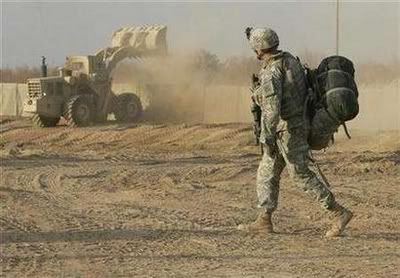
Scott Radcliffe, 28, from Perrysburg, Ohio takes a break during campaign brunch at Nazareth Hall in Grand Rapids, Ohio, Saturday Feb. 23, 2008. After two tours of duty in Iraq, Radcliffe believes he has what it takes to serve in Congress. As a platoon commander, he helped spearhead economic development, built citizen coalitions and made lots of tough decisions — all amid enemy fire. He's among the dozen young Iraq Vets for Congress from across the country who are helping each other campaign, in a pro-war backlash to the anti-war veterans whose campaigns drew attention in 2006.
(AP Photo/Madalyn Ruggiero)


Veterans become pro-war freedom candidates

Scott Radcliffe believes two tours of duty in Iraq gave him the stuff to serve in Congress. As a platoon commander, he helped spearhead economic development, built citizen coalitions and made many tough decisions, often amid enemy fire.

"I would be putting all I learned in that pressure-filled environment into practice. So it really cuts through metal," said Radcliffe, 28, who seeks to unseat a newly elected Republican in northwest Ohio.

He's among the dozen or so Republicans from across the country helping each other campaign under the banner of Iraq Veterans for Congress, cross-promoting each other and directing donors to a shared Web site. It's a response to the anti-war veterans whose campaigns drew attention in 2006, among them Patrick Murphy of Philadelphia, the lone Iraq war vet serving in Congress.

The platform of Iraq Vets for Congress grew out of the attitudes of the previous election: They believe in victory in Iraq, staying on the offense in the war on terror and taking care of all veterans, said founder Kieran Lalor, who's running for a seat in New York.

Lalor's pro-war band of brothers includes California's Eric Egland, a military intelligence officer who gained national attention for his book "The Troops Need You, America" and a charity of the same name. Other members of the group hail from Pennsylvania, North Carolina, Florida, Indiana and Maine.

"Most people say we (Republicans) lost the Congress last time because of the war," said Lalor, 32, of Wappingers Falls, N.Y. "I put my life on the line there, I lost friends there, and if I didn't believe American national security was at stake, I would be the first to say so.

"We as messengers are as important as the message."

The warrior returned from battle to serve in public life is as ancient as the Roman hero Cincinnatus and as familiar as five-star general-turned-President Dwight Eisenhower. Political scientist Costas Panagopoulos, director of Fordham University's graduate program in Elections and Campaign Management, said combat experience resonates with voters, especially during wartime.

"It doesn't surprise me that we're seeing this development in the current election cycle," Panagopoulos said. "We're a country facing major national security and international issues and ... that experience will grab attention on the campaign trail."

Both parties have recruited veterans in some of the nation's most competitive congressional districts. Democratic state Sen. John Boccieri, an Air Force reservist who's served in Iraq, is seeking the northeastern Ohio district being vacated by 18-term Republican Rep. Ralph Regula.

And in Maine's 1st District, where six-term Democratic Rep. Tom Allen is running for Senate, Republican Charlie Summers is seeking Allen's seat while serving in Iraq as a Navy reservist.

Despite the war's unpopularity, Americans still support their troops, and facing a veteran on the campaign trail can be difficult, said Michael Dejak, campaign manager for Summers' challenger in the Republican primary, Dean Scontras.

"It gives a candidate an unfair disadvantage because you're just kind of campaigning in a vacuum, but your opponent is draped in this ...," Dejak said, without finishing his sentence. "He's untouchable, almost."

Many veterans cite the military as essentially their only qualification for office.

"After you've been in combat and you survived it, you've got this real energized sense that, 'I can accomplish anything,' and you view your country differently," said Ohio Democrat Paul Hackett, among the notable anti-war candidates in 2006.

Hackett dropped out of a U.S. Senate race that year when Congressman Sherrod Brown, a star among Ohio Democrats, decided to run. But he gained attention a year earlier for nearly beating Cincinnati-area Congresswoman Jean Schmidt with an outspoken anti-war campaign in a heavily Republican district.

J. Ashwin Madia, a former Marine running in Minnesota's 3rd Congressional District, is among anti-war veterans whom Hackett has endorsed this year. He's also part of VoteVets.org, a counterpart to Iraq Vets for Congress that has created Internet ads for anti-war veterans seeking office.

Madia, 29, who opposed the U.S. entry into Iraq and now favors orderly withdrawal, said the war remains a focus of his campaign.

"Certainly there are other issues weighing on people's minds — the economy, health care, education — but the war is central to the campaign because people realize it's all related," he said.

Iraq Vets For Congress!!

I love dirty tricks!

I'm still a little sick but there's nothing a little rest and a movie marathon can't do! Yeah, I'm about to OD on Walt Disney classics but they sure make me feel good. Anywayyyyyy........

Senate advances bill to cut troop funding

In an about-face, Senate Republicans on Tuesday agreed with Democrats to advance an anti-war bill because they said the debate would give them time to hail progress in Iraq.

The change of heart came after months of blocking similar measures. But unlike most of last year, security conditions in Iraq have improved, and Republicans say they now feel they have the upper hand on the debate.

"We welcome a discussion about Iraq," Senate Republican leader Mitch McConnell declared.

The measure, by Democratic Sens. Russ Feingold of Wisconsin and Majority Leader Harry Reid of Nevada, would cut off money for combat after 120 days. It had been expected to fall short of the 60 votes needed to overcome a procedural hurdle and move ahead.

But after Republicans agreed in a private meeting that the debate could help make their case, the Senate voted 70-24 to begin debating it in earnest.

Aides said a final vote could come later this week, but may be pushed into next week.

The White House said the president would veto such a measure.

"This legislation would substitute the political judgment of legislators for the considered professional military judgment of our military commanders," the administration said in a statement.

Democrats said they welcomed the debate, although they accused Republicans of stalling on plans to debate other issues, namely the nation's housing crisis.

Reid said "a civil war rages" in Iraq and shouldn't be the responsibility of U.S. taxpayers.

"Americans need to start taking care of Americans," he said. "We cannot spend a half billion dollars every day in Iraq."

In recent months, violence in Iraq has subsided significantly and the Baghdad government has made small steps toward political reconciliation, including plans to hold provincial elections on Oct. 1.

While Democratic voters remain largely against the war, polls have shown, the security improvement has helped to cool anxiety among Republicans and turned voters' focus to economic problems at home.

Still, Republicans say they have more convincing to do if they are to control the White House next year.

Sen. John McCain, the GOP's likely presidential nominee, said this week that to win the White House he must convince a war-weary country that U.S. policy in Iraq in succeeding.

If he can't, "then I lose. I lose," the Arizona Republican said. He quickly backed off the remark.

McCain was not expected to return to Washington for the debate. But he said he opposes the bill.

"If ever there was a case for precipitous withdrawal from Iraq — and I believe there never was — now is the last time anyone should consider such a step," he said in a statement.

Tuesday's Senate vote came as the Army's top general said he wants to reduce combat tours for soldiers in Iraq from 15 months to 12 months this summer.

Gen. George Casey, the Army chief of staff, told the Senate Armed Services Committee that he would not embrace going back to the longer tours even if Bush decided to suspend troop reductions for the second half of the year. The Army is under serious strain from years of war-fighting, he testified, and must reduce the length of combat tours as soon as possible.

"The cumulative effects of the last six-plus years at war have left our Army out of balance, consumed by the current fight and unable to do the things we know we need to do to properly sustain our all-volunteer force and restore our flexibility for an uncertain future," Casey said.

Casey, who was the top U.S. commander in Iraq before taking the chief of staff job last spring, told the committee that cutting the time soldiers spend in combat is an integral part of reducing the stress on the force.

He said he anticipates the service can cut combat tours back to 12 months this summer as long as the president reduces the number of active-duty Army brigades in Iraq and Afghanistan to 15 units by July, as planned.

The committee chairman, Sen. Carl Levin, D-Mich., pressed Casey on whether he could keep tour lengths at 12 months if Bush decides to suspend the troop reductions after reaching 15 brigades in July.

"We believe it will still be possible, even with the pause," Casey replied. When asked by Levin if that would hold true "regardless of the length of the pause," Casey, replied, "Yes."

However, the number of soldiers retained under the service's "stop loss" policy — which forces some soldiers to stay on beyond their retirement or re-enlistment dates — is unlikely to be reduced substantially.

"We are consuming readiness now as quickly as we're building it," said Army Secretary Pete Geren, who also testified.

Geren urged Congress to pass a $100 billion war spending bill this spring, contending that the Army will run out of money by July.

According to the nonpartisan Congressional Research Service, the Army could probably last until August or September by transferring money from less urgent accounts. Army officials counter that this approach is inefficient and can cause major program disruptions.

Sunday, February 24, 2008

Sons of Iraq turn over deadly weapons.

Long War Journal: Sons of Iraq members turn over anti-aircraft weapons

The Sons of Iraq program in southern Arab Jabour is managed by troops from 5th Squadron of the 7th Cavalry Regiment, 1st Brigade Combat Team, 3rd Infantry Division, the 5/7 Cav. The villagers of southern Arab Jabour, around the towns of Sayafiyah and Al Sur, were trying to start a Sons of Iraq program before Coalition forces even secured their village. The Sons of Iraq program got under way almost immediately, and has paid constant dividends, as Sons of Iraq members continue to report improvised explosive devices, al Qaeda in Iraq members, and weapons caches.

Feb. 16 was another day in a string of big days for cooperation between US troops and the Sons of Iraq. Sons of Iraq members turned over a cache that included seven heavy machine guns. As recently as January, some of these weapons were almost certainly used to shoot at American helicopters. As al Qaeda fled the area, they left most of their heavy weapons behind. Sons of Iraq are prohibited under their contract to keep or use heavy weapons, and so these were turned over to the 5/7 Cav.

Turning over weapons, as the Sons of Iraq have done, is significant. American troops have a difficult time locating caches. Most are buried, and there is a lot of dirt to cover and few men. The Sons of Iraq would have had no trouble hiding weapons and storing them against the eventual departure of Coalition forces, to use against whoever tried to take their land.

Other news:
Coalition forces capture Iranian-backed Special Groups facilitator, detain seven suspects (Suwayrah)

Coalition forces captured a suspected Iranian-backed Special Groups finance facilitator and detained six other suspected criminals early Sunday in the Suwayrah area, south of Baghdad.

The targeted individual was reportedly a finance leader for Iranian-affiliated Special Groups criminals and militias in Iraq’s southern provinces to include Najaf, Karbala, Babil, Wasit and Qadisiyah. He was also allegedly a mortar and rocket specialist who had trained in Iran. Reports indicate he was an associate of several other senior-level Special Groups criminal element leaders involved in attacks on Iraqi Security Forces and Coalition forces.

Intelligence led ground forces to the target area where they captured the wanted individual and the six other suspected criminals without incident. During the operation, Coalition forces also discovered large amounts of American currency.

“There has been substantial progress in the fight for a stable Iraq, but there is still much work to be done,” said Navy Capt. Vic Beck, MNF-I spokesman. “We welcome al-Sayyid Muqtada al-Sadr’s extended cease fire pledge, and we will work with those who honor it to ensure security in their neighborhoods.”

Thursday, February 21, 2008

FASHION: Marchesa


From Net-A-Porter:
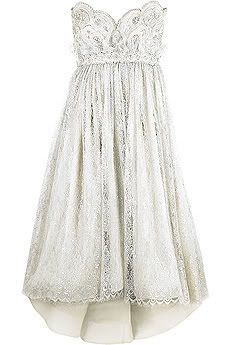
Strapless embroidered dress
$5,445.00

Dove silk blend strapless dress with a swirl piping bead embroidered bodice. Marchesa dress has a delicate lace overlay, a raw edge at the empire line, a boned bodice, is lined with tulle and has a zip at the back to fasten.


It's so pretty.

VIDEO: George Bush tribute!


Greatest president ever.

Sunday, February 17, 2008

Stanford Review:

The Stanford Review:
Should America Employ Mercenaries? You Bet!
by Chris Seck
World News Editor


On January 16, the New York Times reported that Justice Department officials have informed Congress of “serious legal difficulties” in prosecuting Blackwater security guards involved in a September shooting that left at least 17 Iraqis dead.

There has been much controversy over America’s use of private military companies to provide security services. Renae Merle of the Washington Post reports that as of December 2007, there are at least 100,000 “contractors” working in Iraq. During a 2007 radio interview, journalist Jeremy Scahill went so far as to call Blackwater “the official mercenary company of the US government” because it hired “Colombian soldiers [and] Chilean soldiers” to serve in Iraq.

It is unfortunate that in our modern lexicon, “mercenary” is generally seen as a pejorative term, although this article will use it in a neutral sense. If we define mercenaries as people who “wage war for profit” (to borrow a line from the liberal blog Daily Kos), it is still arguable that that waging war for private gain is not always a bad thing. Making the assumption that private military companies are indeed mercenary companies, it is arguable that mercenaries are vital if America is to continue her current foreign policy of making the world safe for democracy.

Consider: when fighting a war, there are generally three ways to raise an army.

First, people may volunteer to fight if they perceive that a cause is just. After the horrific September 11 attacks, football player Pat Tillman rejected a $3.6 million sports contract in order to fight in Afghanistan. Indeed, people like Tillman would probably have made the same decision even if the football contract were worth a billion dollars. With America under attack, many people saw the War on Terrorism as a good cause, and were hence willing not just to fight for freedom, but quite possibly to fight for free.

However, there are only so many people who would join the U.S. military for purely patriotic reasons. This leads us to our second option: pay Americans to fight. By offering a good salary (or a college education), it becomes relatively easy to persuade large numbers of young people to fight for America. Indeed, by utilizing the power of free choice and free markets, the U.S. military—comprised entirely of well-paid, professional, and highly-motivated troops—has become the finest force in the world. If you can’t get people to volunteer for purely patriotic reasons, you might be able to get them to fight not just for freedom, but for both freedom and a fee. We are a commercial nation, and the volunteer military is a fine American tradition, as American as apple pie.

However, it is not easy to persuade many Americans to enlist in the war effort, because modern life is simply too fun for most people. We are reluctant to sacrifice our iPods, our Facebook, our McDonalds burgers, and our Desperate Housewives. Just as the Baby Boomer generation dodged drafts, seized university exemptions, and protested against the Vietnam War, this generation is reluctant to sacrifice their careers and civilian comforts to fight in Iraq.

This leads us to our third option: hire mercenaries. Unlike U.S. troops who fight for both freedom and a fee, mercenaries fight only for the fee. Yet, for all their faults and mistakes, these mercenaries play an important role—like illegal immigrants, they do jobs that most Americans won’t do. Most importantly, because they are motivated by the base, but effective profit motive, they tend to do a very good job—Blackwater guards have done a remarkable job of protecting U.S. diplomats and the U.S. embassy in Baghdad. When was the last time you heard about a top U.S. official being killed while on tour in Iraq?

America’s mercenaries are highly-trained, highly-motivated, and highly-paid. According to the New York Times, Blackwater’s training facility in North Carolina is so well-equipped that even U.S. Navy Seals sometimes use it for specialized military training. Quite simply, the profit motive allows the development of world-class mercenary units—the finest private armies in the world.
Despite the controversy over the morality of hiring mercenaries, it is arguable that the pursuit of self-interest leads to the general (i.e. America’s) gain. As classical economist Adam Smith once wrote of the average person, “By pursuing his own interest he frequently promotes that of the society more effectually than when he really intends to promote it.”

It is true that mercenaries have committed excesses in Iraq, and it is certainly arguable that these excesses ought to be punished. However, on the whole, our nation’s use of mercenaries has more benefits than costs. If it weren’t for the 100,000 military “contractors” from companies like Blackwater, CACI, and Aegis Defense Services, more young American men and women would be dying in Iraq rather than surfing Facebook, listening to iTunes, and playing football. Between having a military draft and hiring mercenaries, most of America’s young, judging by their actions, would prefer the latter.

Making the world safe for democracy requires that America maintain large military commitments overseas. Unfortunately, few Americans are willing to serve in sufficiently large numbers to maintain all these overseas commitments. Therefore, this leaves us with a choice—either we adopt a humbler foreign policy that allows us to maintain a smaller army with fewer commitments, or we hire mercenaries to help fight the wars that our foreign policy requires, but which too few Americans will risk life and limb for.

***

Poland decorates Blackwater men for saving ambassador's life.

"Fairy Tales are more than true; not because they tell us that dragons exist, but because they tell us that dragons can be beaten.”

G.K.Chesterton

Bush gives Tanzania president Shaq's basketball shoes


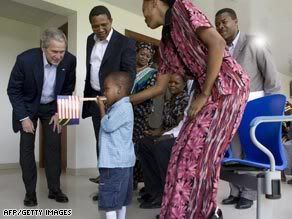
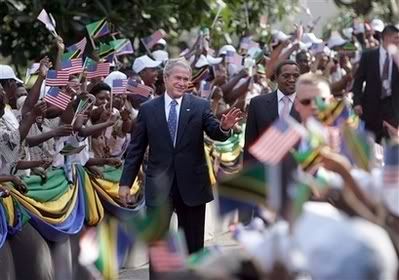
DAR ES SALAAM, Tanzania (CNN) -- President Bush gave Tanzania's president, who played basketball as a youth, a pair of Shaquille O'Neal's shoes Sunday, along with millions of dollars to help combat disease and poverty in the east African country.

President Jakaya Kikwete, next to President Bush, looks on as Bush greets a boy at a Tanzanian hospital Sunday.

The gift of the American basketball icon's size-23 hightops spoke to the lighter side of Bush's visit. President Jakaya Kikwete presented gifts, too -- a stuffed leopard and lion, a Zebra skin and a wood carving for the American president who was enthusiastically welcomed on the second stop of his five-nation African tour.

The Tanzanian president later artfully dodged a reporter's question on the potential that the U.S. might elect a black president, Sen. Barack Obama, whose father is Kenyan.

Kikwete looked at Bush before demonstrating his political deftness, saying, "Let him be as good a friend of Africa as President Bush has been."

But there was plenty of serious business to tend to as well, namely the signing of a compact under which the U.S. is to provide a $698 million grant to Tanzania. Video Watch how Bush explained what African nations are candidates for U.S. aid »

U.S. funding is intended to help African governments buy mosquito netting and insecticide to prevent the spread of malaria.

"It breaks my heart to know that little children are dying needlessly because of a mosquito bite," Bush said.

Bush also attended a roundtable on the President's Emergency Plan for AIDS Relief, or PEPFAR, program, which Kikwete said is saving lives and helping the African continent avert a health disaster.

Bush said he has requested $30 billion over the next five years for the program.

Though PEPFAR has helped increase accessibility to anti-viral drugs, the program is controversial because there is little focus on distributing condoms -- a staple of the program under President Clinton -- or on sex education, said Joel Barkan, a senior associate for the Center for Strategic and International Studies.

The program is "largely pursued through faith-based initiatives," he said, adding that it's not clear whether the AIDS-prevalence rates are going down.

After their visit to Tanzania, the president and first lady Laura Bush will travel to Rwanda to meet with President Paul Kagame. Video Watch why Bush looks to Africa as part of his legacy »

The U.S. has provided nearly 7,000 Rwandan troops with training, and spent more than $17 million to equip the troops and send them to Sudan, according to National Security adviser Stephen Hadley.

Ethnic and tribal violence has raged for years in Sudan's western Darfur region, leaving about 200,000 dead and more than 2 million displaced. Arab militias, said to be backed by the Sudanese government, have wantonly attacked Africans, and numerous rebel groups have attacked government targets.

"In Darfur, the U.S. will continue to call the killing what it is -- genocide," Bush said last week.

The Bushes will go to Ghana then Liberia after visiting Rwanda. Secretary of State Condoleezza Rice, who is on the Africa trip, will head to Kenya on Monday to support efforts to reach political conciliation there.

The country erupted in ethnic violence after a December presidential vote, in which President Mwai Kibaki kept his post. Opposition leader Raila Odinga blasted the results, saying the election was rigged. He and his supporters declined to recognize the election results.

Violence has declined some since former U.N. Secretary-General Kofi Annan began mediating between the two groups.

Bush's first stop on the six-day tour was Benin, where he arrived Saturday.

There, President Thomas Yayi Boni inducted Bush into the National Order of Benin and gave the American president a sash, cross medallion and lapel pin. He also thanked Bush for U.S. aid aimed at fighting poverty, malaria and HIV/AIDS, and he asked for help for Benin's struggling cotton exports.

Boni said it was tough for Benin to compete with Asian cotton producers because of their superior infrastructure and with U.S. cotton growers because of government subsidies.

Bush responded that the U.S. is willing to make concessions, but suggested that Benin might be better served to develop a cotton-products industry rather than trying to export raw cotton.

Boni said Benin needs international help bolstering its electricity, water, communication and transportation systems before expanding its manufacturing sector.

Bush said he chose Benin to start his African tour because its leaders were determined to fight corruption and were careful to make sure U.S. aid dollars were properly spent.

"The United States wants to partner with leaders and their people, but we're not going to do so with people who steal money, pure and simple," Bush said.

The United States has given Benin $307 million in a five-year grant to fight poverty, part of Bush's Millennium Challenge Account, which provides aid to countries that practice democratic principles and sound economic policy.

Bush's trip to Africa is "basically an effort to celebrate successes," said Joel Barkan of the Center for Strategic and International Studies. Most Americans picture Africa as the "continent of gloom and doom," but the president is saying the bigger picture is one of "making progress."

Barkan added, "The question might be asked why he's not going to a number of countries," in particular the regional powers of Kenya, South Africa and Nigeria.
advertisement

"If the election in Kenya had gone well," the analyst said, "I'm sure Kenya would have been included. That's not possible now."

The trip marks Bush's second to the continent and his wife's fifth.

Bush AIDS policy draws praise- as it should! =p


Friggin' liberals keep trying to stop Bush's AIDS relief program from getting renewed. What a bunch of self-absorbed idiots.

DAR ES SALAAM, Tanzania - President Bush rejected proposed Democratic changes to his prized AIDS relief program, issuing a challenge Sunday to Congress to "stop the squabbling" and renew it as is. Tanzanian leader Jakaya Kikwete made an impassioned appeal for the same thing, saying thousands in his country would orphan their children if U.S. lawmakers do not act.

There is broad support in the Democratic-controlled Congress for the anti-AIDS spending that has become the largest-ever international health initiative devoted to one disease, so there is not much danger of failing to continue it.

But with the program expiring this year, a political and ideological showdown is brewing in Washington over the initiative's terms and size. Bush hopes that putting real, grateful faces on the program — moms and dads controlling the disease and children who were born HIV-free to infected mothers, all because of U.S.-funded treatment — would strengthen his hand in the debate.

The president's three-night stay in this vast East Africa nation takes him to a part of the continent that is important in the U.S. fight against terrorism. The bombed-out former U.S. Embassy in Dar es Salaam still stands as a stark reminder of deadly attacks in Tanzania and Nairobi, Kenya, in 1998.

The visit to Tanzania is the longest of Bush's six-day African trip and longer than usual for the president anywhere. The stay and the celebration of a new five-year $698 million U.S. aid pact were intended as goodwill messages to Tanzania's large Muslim population.

It seemed to work. In contrast to the protests that often greet him at home and abroad, Bush repeatedly received enthusiastic receptions in Tanzania.

Thousands of people lined his motorcade route from the airport Saturday night. A large and spirited crowd waved U.S. and Tanzanian flags Sunday as he walked into the graceful, oceanfront State House for meetings with President Kikwete.

Thousands more people crowded along Dar es Salaam's dusty and rutted streets as Bush went from event to event. Special local cloth was woven in honor of Bush's visit; his picture was emblazoned across ever-present shirts and sarongs.

A billboard advertisement in downtown for a Kilimanjaro Casino poker tournament offered a coincidental but telling message: "A little bit of Texas in Dar," it said.

"Different people may have different views about you and your administration and your legacy," said a grateful Kikwete after he and Bush signed the aid deal. "But we in Tanzania, if we are to speak for ourselves and for Africa, we know for sure that you, Mr. President, and your administration, have been good friends of our country and have been good friends of Africa."

Democratic presidential candidate Barack Obama, who is black and whose father was Kenyan, is a sensation in Africa. Africans say they avidly follow Obama's campaign to succeed Bush.

But Bush seemed surprised that Obama's name would come up during this victory-lap journey that is celebrating some of his only foreign policies that make him popular.

"It seemed like there was a lot of excitement for me, wait a minute. Maybe you missed it," he joked during a news conference, speculating that a question about Obama was put to Kikwete instead of him because it was well known that "I wouldn't answer."

Kikwete appeared to get the hint, declining at Bush's side even to discuss the prospect of a man with African roots becoming president of the United States.

"I don't think I can venture into that territory, either," Kikwete said. "The U.S. is going to get a new president, whoever that one is. For us, the most important thing is, let him be as good friend of Africa as President Bush has been." Bush's term ends next January.

The President's Emergency Plan for AIDS Relief, known as PEPFAR, has raised the number of Africans on anti-retroviral treatments from 50,000 to 1.2 million.

Democrats want to strip requirements that one-third of the money go to abstinence-until-marriage programs and that some groups sign anti-prostitution pledges.

Some Democrats also say that Bush's request for $30 billion over the next five years, twice his original commitment of $15 billion, is too little, and would merely continue the program at the current year's ramped-up levels. Congress has put nearly $19 billion into the program so far.

Republican leaders say the Democratic changes could derail renewal of the program, and Bush made clear he agrees.

"I understand there's voices on both ends of the political spectrum trying to alter the program. I would ask Congress to listen to leaders on the continent of Africa, analyze what works, stop the squabbling and get the program reauthorized," the president said, the caws of peacocks occasionally punctuating remarks delivered in the blazing sun. "I happen to think the current policy is reasonable. After all, it's working."

Later, Bush said that Amana Hospital was the best exhibit he could imagine for his argument. Strolling through the complex of low-slung buildings and sun-drenched courtyards, Bush met HIV-positive patients and doctors in the facility's AIDS treatment wing, funded in part with money from his AIDS program.

"I'm very lucky," said Tatu Msangi, who was tested for HIV while pregnant, received treatment and delivered a healthy baby, Faith, who sat in her lap while she spoke. "Me and Faith have a bright future ahead."

Later, after separate events in Dar es Salaam to promote the program, first lady Laura Bush sounded less worried than her husband about its legislative future. "I don't think there will be a problem," she told reporters.

Kikwete said the program has allowed thousands of children such as Faith to avoid suffering the deaths of parents. "My passionate appeal is for PEPFAR to continue," he said.

Though Tanzania is one of the poorest countries in the world, it is gaining international investors, has among the best growth rates in sub-Saharan Africa and, as the home to striking Mount Kilimanjaro and the Serengeti National Park, is seeing tourism rise. There is little internal strife, though there are some worries about the political ambitions of semiautonomous Zanzibar, and Tanzania also is absorbing refugees from the postelection fighting in Kenya.

The U.S. aid deal, approved in September and signed in a ceremony Sunday, is through the Millennium Challenge Corporation. That Bush initiative limits U.S. development assistance to nations that embrace democracy and free markets, fight corruption and invest in education and health. The Tanzanian deal is the largest so far in the program and is focused on helping to build roads, make electricity more reliable, and increase access to safe drinking water.

"Our trip here has exceeded my expectations," Bush said in a dinner toast at the State House. On the lawn afterward, the leaders were treated to an energetic, whooping performance by traditional African dancers with feathers, bells, drums and flutes.

Monday, February 11, 2008

Biggest Failures: Reid & Pelosi

The Chicken Doves
Elected to end the war, Democrats have surrendered to Bush on Iraq and betrayed the peace movement for their own political ends
MATT TAIBBI


The awesome twosome.

Quietly, while Hillary Clinton and Barack Obama have been inspiring Democrats everywhere with their rolling bitchfest, congressional superduo Harry Reid and Nancy Pelosi have completed one of the most awesome political collapses since Neville Chamberlain. At long last, the Democratic leaders of Congress have publicly surrendered on the Iraq War, just one year after being swept into power with a firm mandate to end it.

Solidifying his reputation as one of the biggest pussies in U.S. political history, Reid explained his decision to refocus his party's energies on topics other than ending the war by saying he just couldn't fit Iraq into his busy schedule. "We have the presidential election," Reid said recently. "Our time is really squeezed."

There was much public shedding of tears among the Democratic leadership, as Reid, Pelosi and other congressional heavyweights expressed deep sadness that their valiant charge up the hill of change had been thwarted by circumstances beyond their control — that, as much as they would love to continue trying to end the catastrophic Iraq deal, they would now have to wait until, oh, 2009 to try again. "We'll have a new president," said Pelosi. "And I do think at that time we'll take a fresh look at it."

Pelosi seemed especially broken up about having to surrender on Iraq, sounding like an NFL coach in a postgame presser, trying with a straight face to explain why he punted on first-and-goal. "We just didn't have any plays we liked down there," said the coach of the 0-15 Dems. "Sometimes you just have to play the field-position game...."

In reality, though, Pelosi and the Democrats were actually engaged in some serious point-shaving. Working behind the scenes, the Democrats have systematically taken over the anti-war movement, packing the nation's leading group with party consultants more interested in attacking the GOP than ending the war. "Our focus is on the Republicans," one Democratic apparatchik in charge of the anti-war coalition declared. "How can we juice up attacks on them?"

The story of how the Democrats finally betrayed the voters who handed them both houses of Congress a year ago is a depressing preview of what's to come if they win the White House. And if we don't pay attention to this sorry tale now, while there's still time to change our minds about whom to nominate, we might be stuck with this same bunch of spineless creeps for four more years. With no one but ourselves to blame.

The controversy over the Democratic "strategy" to end the war basically comes down to whom you believe. According to the Reid-Pelosi version of history, the Democrats tried hard to force President Bush's hand by repeatedly attempting to tie funding for the war to a scheduled withdrawal. Last spring they tried to get him to eat a timeline and failed to get the votes to override a presidential veto. Then they retreated and gave Bush his money, with the aim of trying again after the summer to convince a sufficient number of Republicans to cross the aisle in support of a timeline.

But in September, Gen. David Petraeus reported that Bush's "surge" in Iraq was working, giving Republicans who might otherwise have flipped sufficient cover to continue supporting the war. The Democrats had no choice, the legend goes, but to wait until 2009, in the hopes that things would be different under a Democratic president.

Democrats insist that the reason they can't cut off the money for the war, despite their majority in both houses, is purely political. "George Bush would be on TV every five minutes saying that the Democrats betrayed the troops," says Sen. Bernie Sanders of Vermont. Then he glumly adds another reason. "Also, it just wasn't going to happen."

Why it "just wasn't going to happen" is the controversy. In and around the halls of Congress, the notion that the Democrats made a sincere effort to end the war meets with, at best, derisive laughter. Though few congressional aides would think of saying so on the record, in private many dismiss their party's lame anti-war effort as an absurd dog-and-pony show, a calculated attempt to score political points without ever being serious about bringing the troops home.

"Yeah, the amount of expletives that flew in our office alone was unbelievable," says an aide to one staunchly anti-war House member. "It was all about the public show. Reid and Pelosi would say they were taking this tough stand against Bush, but if you actually looked at what they were sending to a vote, it was like Swiss cheese. Full of holes."

In the House, some seventy Democrats joined the Out of Iraq caucus and repeatedly butted heads with Reid and Pelosi, arguing passionately for tougher measures to end the war. The fight left some caucus members bitter about the party's failure. Rep. Barbara Lee of California was one of the first to submit an amendment to cut off funding unless it was tied to an immediate withdrawal. "I couldn't even get it through the Rules Committee in the spring," Lee says.

Rep. Lynn Woolsey, a fellow caucus member, says Democrats should have refused from the beginning to approve any funding that wasn't tied to a withdrawal. "If we'd been bold the minute we got control of the House — and that's why we got the majority, because the people of this country wanted us out of Iraq — if we'd been bold, even if we lost the votes, we would have gained our voice."

An honest attempt to end the war, say Democrats like Woolsey and Lee, would have involved forcing Bush to execute his veto and allowing the Republicans to filibuster all they wanted. Force a showdown, in other words, and use any means necessary to get the bloodshed ended.

"Can you imagine Tom DeLay and Denny Hastert taking no for an answer the way Reid and Pelosi did on Iraq?" asks the House aide in the expletive-filled office. "They'd find a way to get the votes. They'd get it done somehow."

But any suggestion that the Democrats had an obligation to fight this good fight infuriates the bund of hedging careerists in charge of the party. In fact, nothing sums up the current Democratic leadership better than its vitriolic criticisms of those recalcitrant party members who insist on interpreting their 2006 mandate as a command to actually end the war. Rep. David Obey, chair of the House Appropriations Committee and a key Pelosi-Reid ally, lambasted anti-war Democrats who "didn't want to get specks on those white robes of theirs." Obey even berated a soldier's mother who begged him to cut off funds for the war, accusing her and her friends of "smoking something illegal."

Rather than use the vast power they had to end the war, Democrats devoted their energy to making sure that "anti-war activism" became synonymous with "electing Democrats." Capitalizing on America's desire to end the war, they hijacked the anti-war movement itself, filling the ranks of peace groups with loyal party hacks. Anti-war organizations essentially became a political tool for the Democrats — one operated from inside the Beltway and devoted primarily to targeting Republicans.

This supposedly grass-roots "anti-war coalition" met regularly on K Street, the very capital of top-down Beltway politics. At the forefront of the groups are Thomas Matzzie and Brad Woodhouse of Americans Against the Escalation in Iraq, the leader of the anti-war lobby. Along with other K Street crusaders, the two have received iconic treatment from The Washington Post and The New York Times, both of which depicted the anti-war warriors as young idealist-progressives in shirtsleeves, riding a mirthful spirit into political combat — changing the world is fun!

But what exactly are these young idealists campaigning for? At its most recent meeting, the group eerily echoed the Reid-Pelosi "squeezed for time" mantra: Retreat from any attempt to end the war and focus on electing Democrats. "There was a lot of agreement that we can draw distinctions between anti-war Democrats and pro-war Republicans," a spokeswoman for Americans Against the Escalation in Iraq announced.

What the Post and the Times failed to note is that much of the anti-war group's leadership hails from a consulting firm called Hildebrand Tewes — whose partners, Steve Hildebrand and Paul Tewes, served as staffers for the Democratic Senatorial Campaign Committee (DSCC). In addition, these anti-war leaders continue to consult for many of the same U.S. senators whom they need to pressure in order to end the war. This is the kind of conflict of interest that would normally be an embarrassment in the activist community.

Worst of all is the case of Woodhouse, who came to Hildebrand Tewes after years of working as the chief mouthpiece for the DSCC, where he campaigned actively to re-elect Democratic senators who supported the Iraq War in the first place. Anyone bothering to look — and clearly the Post and the Times did not before penning their ardent bios of Woodhouse — would have found the youthful idealist bragging to newspapers before the Iraq invasion about the pro-war credentials of North Carolina candidate Erskine Bowles. "No one has been stronger in this race in supporting President Bush in the War on Terror and his efforts to effect a regime change in Iraq," boasted the future "anti-war" activist Woodhouse.

With guys like this in charge of the anti-war movement, much of what has passed for peace activism in the past year was little more than a thinly veiled scheme to use popular discontent over the war to unseat vulnerable Republicans up for re-election in 2008. David Sirota, a former congressional staffer whose new book, The Uprising, excoriates the Democrats for their failure to end the war, expresses disgust at the strategy of targeting only Republicans. "The whole idea is based on this insane fiction that there is no such thing as a pro-war Democrat," he says. "Their strategy allows Democrats to take credit for being against the war without doing anything to stop it. It's crazy."

Justin Raimondo, the uncompromising editorial director of Antiwar.com, regrets contributing twenty dollars to Americans Against the Escalation in Iraq. "Not only did they use it to target Republicans," he says, "they went after the ones who were on the fence about Iraq." The most notorious case involved Lincoln Chafee, a moderate from Rhode Island who lost his Senate seat in 2006. Since then, Chafee has taken shots at Democrats like Reid, Hillary Clinton and Chuck Schumer, all of whom campaigned against him despite having voted for the war themselves.

"Look, I understand partisan politics," says Chafee, who now concedes that voters were correct to punish him for his war vote. "I just find it amusing that those who helped get us into this mess now say we need to change the Senate — because we're in a mess."

The really tragic thing about the Democratic surrender on Iraq is that it's now all but guaranteed that the war will be off the table during the presidential campaign. Once again — it happened in 2002, 2004 and 2006 — the Democrats have essentially decided to rely on the voters to give them credit for being anti-war, despite the fact that, for all the noise they've made to the contrary, in the end they've done nothing but vote for war and cough up every dime they've been asked to give, every step of the way.

Even beyond the war, the Democrats have repeatedly gone limp-dick every time the Bush administration so much as raises its voice. Most recently, twelve Democrats crossed the aisle to grant immunity to phone companies who participated in Bush's notorious wiretapping program. Before that, Democrats caved in and confirmed Mike Mukasey as attorney general after he kept his middle finger extended and refused to condemn waterboarding as torture. Democrats fattened by Wall Street also got cold feet about upsetting the country's gazillionaires, refusing to close a tax loophole that rewarded hedge-fund managers with a tax rate less than half that paid by ordinary citizens.

But the war is where they showed their real mettle. Before the 2006 elections, Democrats told us we could expect more specifics on their war plans after Election Day. Nearly two years have passed since then, and now they are once again telling us to wait until after an election to see real action to stop the war. In the meantime, of course, we're to remember that they're the good guys, the Republicans are the real enemy, and, well, go Hillary! Semper fi! Yay, team!

How much of this bullshit are we going to take? How long are we supposed to give the Reids and Pelosis and Hillarys of the world credit for wanting, deep down in their moldy hearts, to do the right thing?

Look, fuck your hearts, OK? Just get it done. Because if you don't, sooner or later this con is going to run dry. It may not be in '08, but it'll be soon. Even Americans can't be fooled forever.

Ya know, for some reason, this article made me laugh out loud. lol!