

US gave Bhutto info about threats
And they also approached Blackwater to guard her...
The officials said Bhutto and her aides were concerned, particularly after the October attack, but were adamant that in the absence of a specific and credible threat there would be few, if any, changes to her campaign schedule ahead of parliamentary elections.
"She knew people were trying to assassinate her," said an intelligence official. "We don't hold information back on possible attacks on foreign leaders and foreign countries." The official added, however, that while the U.S. could share the information, "it's up to (the recipient) how they want to take action."
"We gave them a steady stream of intelligence," one official said.
In the meetings with U.S. officials, Bhutto aides did not ask the United States to help protect her but did inquire about the feasibility of hiring private U.S. or British bodyguards, an idea discouraged by the Americans who argued that a noticeable Western security detail would increase the threat and might become a target itself, the officials said.
Instead, the U.S. diplomats recommended as many as five reputable local Pakistani and regional firms that could be contracted to supplement Bhutto's security and urged the party to limit the size, scope and type of her public appearances, upgrade armoring on vehicles in which she might travel and require her to wear protective clothing, the officials said.
However, there was no indication that Bhutto's team — including her husband, Asif Ali Zardari, who attended at least one of the meetings — had followed through on the most critical of the recommendations, including the hiring of private guards and reducing her visibility in large crowds like the one in Rawalpindi where she was killed.
The officials said Zardari rejected using private Pakistani security companies due to fears they might be infiltrated by extremists even though several of the recommended companies have international components and are used by Western embassies to protect personnel.
Anne Tyrell, a spokeswoman for the private U.S. security company Blackwater Worldwide, known for its operations in Iraq, said her company had been approached about possibly providing protection for Bhutto, "but unfortunately, an agreement was never reached."
Monday, December 31, 2007

Iraq celebrates New Year!
BAGHDAD - It was something not seen in Baghdad since before the 2003 invasion — people publicly welcoming a new year with singing, dancing and general revelry.
The ballrooms of two landmark hotels — the Palestine and the Sheraton — were full of people for the first New Year's Eve celebrations after four years of violence that has bloodied Iraq.
"This place is now more secure," said Zahraa, 23, adorned with heavy black eyeliner and red lipstick, sitting with colleagues at the Palestine hotel, which was the target of huge car bombs in 2005. "Yes, we are still afraid, but we need to lighten our moods occasionally."
Like all those interviewed, she declined to give her last name, however. All cited concerns about their security, indicating worries still exist.
But after years of car bombings, mortar fire and suicide attacks, Iraq's capital was sufficiently calm to warrant the two high-end parties in the once-posh hotels.
About 200 guests, mostly men, danced to traditional Iraqi music at the large hall in the Palestine, decorated with blue, white and yellow chiffon. A woman in a glittery pink, spaghetti-strap dress sang for the crowd, which alternately hooted and danced.
At the door, a Western reporter was chastised for carrying in a can of beer: Alcohol was strictly forbidden at the parties in accordance with Islamic teachings.
But it was evident that some in the crowded ballrooms had ignored the rule. One man helped steady a friend, while other men in sport coats stood around chain-smoking cigarettes.
The singer, Fatina Wardi, also an actress for television shows and theater, said she was performing for the extra money — $250 for each show. But she also sang partly to defy rising Islamic conservatism in Iraq, she said.
In recent years, Muslim extremists have killed hairdressers, barbers and alcohol sellers — all perceived as symbols of a Western lifestyle — even though Iraq's cities were once relatively tolerant, liberal places in comparison to other areas in the Middle East.
"I've lived through four wars," Wardi said after a show, slightly slurring her words. "One either lives or dies — I choose to live and not fear death. If I die, I'll die for my country, as a martyr for freedom."
Her friends, all actresses and dancers dressed in brightly colored dresses with their hair teased out, nodded in agreement.
At the strike of midnight, the pops of gunfire spread across Baghdad, bullets streaking into the night sky — a sight that has become relatively rare the last six months as violence fell more than 80 percent in the city, according to the U.S. military.
The ballrooms of two landmark hotels — the Palestine and the Sheraton — were full of people for the first New Year's Eve celebrations after four years of violence that has bloodied Iraq.
"This place is now more secure," said Zahraa, 23, adorned with heavy black eyeliner and red lipstick, sitting with colleagues at the Palestine hotel, which was the target of huge car bombs in 2005. "Yes, we are still afraid, but we need to lighten our moods occasionally."
Like all those interviewed, she declined to give her last name, however. All cited concerns about their security, indicating worries still exist.
But after years of car bombings, mortar fire and suicide attacks, Iraq's capital was sufficiently calm to warrant the two high-end parties in the once-posh hotels.
About 200 guests, mostly men, danced to traditional Iraqi music at the large hall in the Palestine, decorated with blue, white and yellow chiffon. A woman in a glittery pink, spaghetti-strap dress sang for the crowd, which alternately hooted and danced.
At the door, a Western reporter was chastised for carrying in a can of beer: Alcohol was strictly forbidden at the parties in accordance with Islamic teachings.
But it was evident that some in the crowded ballrooms had ignored the rule. One man helped steady a friend, while other men in sport coats stood around chain-smoking cigarettes.
The singer, Fatina Wardi, also an actress for television shows and theater, said she was performing for the extra money — $250 for each show. But she also sang partly to defy rising Islamic conservatism in Iraq, she said.
In recent years, Muslim extremists have killed hairdressers, barbers and alcohol sellers — all perceived as symbols of a Western lifestyle — even though Iraq's cities were once relatively tolerant, liberal places in comparison to other areas in the Middle East.
"I've lived through four wars," Wardi said after a show, slightly slurring her words. "One either lives or dies — I choose to live and not fear death. If I die, I'll die for my country, as a martyr for freedom."
Her friends, all actresses and dancers dressed in brightly colored dresses with their hair teased out, nodded in agreement.
At the strike of midnight, the pops of gunfire spread across Baghdad, bullets streaking into the night sky — a sight that has become relatively rare the last six months as violence fell more than 80 percent in the city, according to the U.S. military.
Friday, December 28, 2007
Omg.
Millions of tax refunds delayed by Congress' late action...
They're not called the Do-Nothing Congress for nothing!
From PatDollard.Com :
Al Aqsa Martyrs Brigades To Provide Security For Bush’s Israel Visit
JERUSALEM – Members of the most active West Bank terror organization are set to participate in security forces being deployed to protect President Bush during his visit to the Palestinian territories next month, WND has learned.
Bush is due in the region Jan. 9 as part of a follow-up to last month’s U.S.-led Israeli-Palestinian Annapolis summit.
During his trip, the American president is scheduled to hold talks with Israeli leaders in Jerusalem, and meet quickly with Palestinian Authority President Mahmoud Abbas in the West Bank city of Ramallah.
According to Israeli security officials coordinating deployments of forces with the PA for Bush’s Ramallah visit, members of the Al Aqsa Martyrs Brigades, Fatah’s declared military wing, have been called upon by the PA to participate in the protection of Bush’s convoy and in securing the parameter during the meeting with Abbas.
The Brigades is listed as a terror organization by the U.S. State Department. The group took credit along with the Islamic Jihad terror organization for every suicide bombing in Israel between 2005 and 2006, and is responsible for thousands of shootings and rocket firings. Statistically, the Al Aqsa Brigades perpetuated more terrorism from the West Bank than Hamas, according to the Israeli Defense Forces.
Many Brigades members, including the group’s chiefs, serve openly in Fatah’s Force 17 presidential guard units and the Palestinian Preventative Security Services; thousands of Force 17 and Preventative officers are slated to secure Ramallah during Bush’s visit there.
A chief of the Al Aqsa Brigades in Ramallah who also serves as a senior officer in Force 17 confirmed to WND he has been tapped to participate in Bush’s security.
Why are they sending militants to protect my favorite President? Whyyyyyyyyy?
They're not called the Do-Nothing Congress for nothing!
From PatDollard.Com :
Al Aqsa Martyrs Brigades To Provide Security For Bush’s Israel Visit
JERUSALEM – Members of the most active West Bank terror organization are set to participate in security forces being deployed to protect President Bush during his visit to the Palestinian territories next month, WND has learned.
Bush is due in the region Jan. 9 as part of a follow-up to last month’s U.S.-led Israeli-Palestinian Annapolis summit.
During his trip, the American president is scheduled to hold talks with Israeli leaders in Jerusalem, and meet quickly with Palestinian Authority President Mahmoud Abbas in the West Bank city of Ramallah.
According to Israeli security officials coordinating deployments of forces with the PA for Bush’s Ramallah visit, members of the Al Aqsa Martyrs Brigades, Fatah’s declared military wing, have been called upon by the PA to participate in the protection of Bush’s convoy and in securing the parameter during the meeting with Abbas.
The Brigades is listed as a terror organization by the U.S. State Department. The group took credit along with the Islamic Jihad terror organization for every suicide bombing in Israel between 2005 and 2006, and is responsible for thousands of shootings and rocket firings. Statistically, the Al Aqsa Brigades perpetuated more terrorism from the West Bank than Hamas, according to the Israeli Defense Forces.
Many Brigades members, including the group’s chiefs, serve openly in Fatah’s Force 17 presidential guard units and the Palestinian Preventative Security Services; thousands of Force 17 and Preventative officers are slated to secure Ramallah during Bush’s visit there.
A chief of the Al Aqsa Brigades in Ramallah who also serves as a senior officer in Force 17 confirmed to WND he has been tapped to participate in Bush’s security.
Why are they sending militants to protect my favorite President? Whyyyyyyyyy?
Thursday, December 27, 2007
Bhutto killed.

Photo from Drudge
Pakistan's Bhutto killed in attack
My stomach lurched when I heard about this. I just couldn't believe it- and I still can't. Poor President Bush, everyone's going to find a way to blame this horrible terrorist act on him. The terrorists responsible for this should be waterboarded then hung-out to dry for the whole world to see. I'm sorry, but I'm pretty pissed right now. Let's just hope the Pakistani people will keep their cool so things don't get any worse, but I seriously doubt they have that much patience left...
RAWALPINDI, Pakistan - Pakistan opposition leader Benazir Bhutto was assassinated Thursday by an attacker who shot her after a campaign rally and then blew himself up. Her death stoked new chaos across the nuclear-armed nation, an important U.S. ally in the war on terrorism.
At least 20 others were killed in the attack on the rally for Jan. 8 parliamentary elections where the 54-year-old former prime minister had just spoken.
At least nine people were killed across the country in rioting that broke out in the aftermath of the assassination. In the southern port city of Karachi, where she was born, angry Bhutto supporters shot at police and burned a gas station.
At the hospital where Bhutto died, some supporters smashed glass and wailed, chanting slogans against President Pervez Musharraf, whom they blamed for not ensuring her safety. Musharraf blamed Islamic extremists for her death and said he would redouble his efforts to fight them.
"This is the work of those terrorists with whom we are engaged in war," he said in a nationally televised speech. "I have been saying that the nation faces the greatest threats from these terrorists. ... We will not rest until we eliminate these terrorists and root them out."
In the U.S., a tense looking President Bush strongly condemned the attack "by murderous extremists who are trying to undermine Pakistan's democracy." White House spokesman Scott Stanzel said Bush spoke briefly by phone with Musharraf.
Musharraf convened an emergency meeting with his senior staff, where they were expected to discuss whether to postpone the elections, an official at the Interior Ministry said, speaking on condition of anonymity because of the sensitivity of the talks.
The government announced three days of mourning for Bhutto, including the closing of schools, commercial centers and banks.
Nawaz Sharif, another former prime minister and leader of a rival opposition party, demanded Musharraf resign immediately and announced his party would boycott the upcoming election.
The attacker struck just minutes after Bhutto addressed thousands of supporters in the Rawalpindi, a city 8 miles south of Islamabad where the army is headquartered. She was shot in the neck and chest by the attacker, who then blew himself up, said Rehman Malik, Bhutto's security adviser.
Sardar Qamar Hayyat, a leader from Bhutto's party, said at the time of the attack he was standing about 10 yards away from her vehicle — a white, bulletproof SUV with a sunroof.
"She was inside the vehicle and was coming out from the gate after addressing the rally when some of the youths started chanting slogans in her favor. Then I saw a smiling Bhutto emerging from the vehicle's roof and responding to their slogans," he said.
"Then I saw a thin, young man jumping toward her vehicle from the back and opening fire. Moments later, I saw her speeding vehicle going away," he added.
Mangled bodies lay in a pool of blood and pieces of clothing and shoes were scattered on the road. The clothing of some victims was shredded and people covered their bodies with party flags.
There was an acrid smell of explosive fumes in the air.
Police cordoned off the street and rescuers rushed to put victims in ambulances as onlookers wailed nearby.
Bhutto was rushed to the hospital and taken into emergency surgery. She died about an hour after the attack.
Hours later, her body was carried out of the hospital in a plain wooden coffin by a crowd of supporters. Her body was expected to be transferred to an air base and brought to her hometown of Larkana.
A doctor on the team that treated her said she had a bullet in the back of the neck that damaged her spinal cord before exiting from the side of her head. Another bullet pierced the back of her shoulder and came out through her chest.
She was given open heart massage, but the main cause of death was damage to her spinal cord, he said on condition of anonymity because he was not authorized to speak to the media.
"At 6:16 p.m., she expired," said Wasif Ali Khan, a member of Bhutto's party who was at Rawalpindi General Hospital.
"The surgeons confirmed that she has been martyred," Bhutto's lawyer Babar Awan said.
Bhutto's supporters at the hospital exploded in anger, smashing the glass door at the main entrance of the emergency unit. Others burst into tears. One man with a flag of Bhutto's Pakistan People's Party tied around his head was beating his chest.
"I saw her with my own eyes sitting in a vehicle after addressing the rally. Then, I heard an explosion," Tahir Mahmood, 55, said sobbing. "I am in shock. I cannot believe that she is dead."
Many chanted slogans against Musharraf, accusing him of complicity in her killing.
"We repeatedly informed the government to provide her proper security and appropriate equipment including jammers, but they paid no heed to our requests," said Malik, the security adviser.
As news of her death spread, angry supporters took to the streets.
In Karachi, shop owners quickly closed their businesses as protesters set tires on fire on the roads, torched several vehicles and burned a gas station, said Fayyaz Leghri, a local police official. Gunmen shot and wounded two police officers, he said.
One man was killed in a shootout between police and protesters in Tando Allahyar, a town 120 miles north of Karachi, said Mayor Kanwar Naveed. In the town of Tando Jam, protesters forced passengers to get out of a train and then set it on fire.
Two people were killed in the southern Sindh province and two others in Lahore, police said.
Violence also broke out in Lahore, Multan, Peshawar and many other parts of Pakistan, where Bhutto's supporters burned banks, state-run grocery stores and private shops. Some set fire to election offices for the ruling party, according to Pakistani media.
Akhtar Zamin, home minister for the southern Sindh province, said authorities would deploy troops to stop violence if needed.
Musharraf urged calm.
"I want to appeal to the nation to remain peaceful and exercise restraint," he said.
Rep. Patrick Kennedy, a Democrat from Rhode Island, was in Pakistan and on his way to have dinner with Bhutto Thursday night when he learned of her killing.
"You could really feel the tragedy of this loss because Bhutto really represented hope here for so many people," he said, adding that turmoil was engulfing much of the country.
"Her death really dashed the hope of many here in Pakistan and that's why there's so much disillusionment and anger being vented through these protests that are lighting up the sky tonight as people set fires all over the countryside," Kennedy told the AP in a telephone interview.
Sharif arrived at the hospital and sat silently next to Bhutto's body.
"Benazir Bhutto was also my sister, and I will be with you to take the revenge for her death," he said. "Don't feel alone. I am with you. We will take the revenge on the rulers."
He rebutted suggestions that he could gain political capital from her demise, announcing his Muslim League-N party would boycott the elections and demanding that Musharraf resign.
"The holding of fair and free elections is not possible in the presence of Pervez Musharraf," he said. "Musharraf is the cause of all the problems. The federation of Pakistan cannot remain intact in the presence of President Musharraf," he told a news conference.
"After the killing of Benazir Bhutto, I announce that the Pakistan Muslim League-N will boycott the elections," Sharif said. "I demand that Musharraf should quit immediately."
Hours earlier, four people were killed at a rally for Sharif when his supporters clashed with backers of Musharraf near Rawalpindi.
Bhutto's death will leave a void at the top of her party, the largest political group in the country, as it heads into the elections.
Pakistan is considered a vital U.S. ally in the fight against al-Qaida and other Islamic extremists including the Taliban. Osama bin Laden and his inner circle are believed to be hiding in lawless northwest Pakistan along the border with Afghanistan.
The U.S. has invested significant diplomatic capital in promoting reconciliation between Musharraf and the opposition, particularly Bhutto, who was seen as having a wide base of support in Pakistan. Her party had been widely expected to do well in next month's elections.
Had the PPP either won a majority of seats or enough to put together a majority coalition, Bhutto could have recaptured the job of prime minister.
Bush, speaking briefly to reporters at his ranch in Crawford, Texas, demanded that those responsible for the killing be brought to justice.
"The United States strongly condemns this cowardly act by murderous extremists who are trying to undermine Pakistan's democracy," said Bush, who looked tense and took no questions.
The assassination and concerns of further international instability were cited as one reason for a fall in U.S. stock prices and a rise in oil prices Thursday. In afternoon trade, the Dow Jones Industrial Average of blue chip stocks was down more than 140 points or more than 1 percent.
The U.N. Security Council also condemned the assassination.
Pakistan was just emerging from another crisis after Musharraf declared a state of emergency on Nov. 3, and used sweeping powers to round up thousands of his opponents and fire Supreme Court justices. He ended emergency rule Dec. 15 and subsequently relinquished his role as army chief, a key opposition demand. Bhutto had been an outspoken critic of Musharraf's imposition of emergency rule.
Educated at Harvard and Oxford universities, Bhutto served twice as Pakistan's prime minister between 1988 and 1996.
Her father was Zulfikar Ali Bhutto, scion of a wealthy landowning family in southern Pakistan and founder of the populist Pakistan People's Party. The elder Bhutto was president and then prime minister of Pakistan before his ouster in a 1977 military coup. Two years later, he was executed by the government of Gen. Zia-ul Haq after being convicted of engineering the murder of a political opponent.
Bhutto had returned to Pakistan from an eight-year exile on Oct. 18. On the same day, she narrowly escaped injury when her homecoming parade in Karachi was targeted in a suicide attack that killed more than 140 people.
Islamic militants linked to al-Qaida and the Taliban hated Bhutto for her close ties to the Americans and support for the war on terrorism. A local Taliban leader reportedly threatened to greet Bhutto's return to the country with suicide bombings.
Hundreds of riot police had manned security checkpoints around the rally venue Thursday, Bhutto's first public meeting in Rawalpindi since she came back to the country.
In recent weeks, suicide bombers have repeatedly targeted security forces in Rawalpindi.
In November, Bhutto had also planned a rally in the city, but Musharraf forced her to cancel it, citing security fears.
Boooooooo.
Ugh. Some retarded perv hacked into my YouTube account and watched icky stuff. Que horror. Anyway I had a lot of fun this Christmas. Hope yours was just as awesome, I'll update tomorrow when I've got time. Whee!
Tuesday, December 18, 2007
Whoa, the f*cking nerve!!!!!!
'American Taliban' soldier seeks freedom
By PAUL ELIAS, Associated Press Write
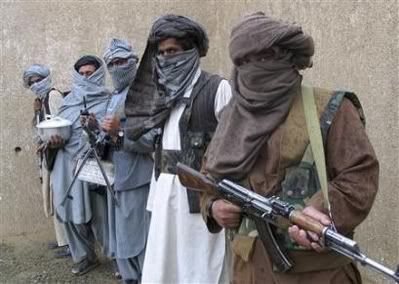
SAN FRANCISCO - The lawyer and parents of American-born Taliban soldier John Walker Lindh renewed their call to President Bush on Tuesday to commute his 20-year sentence and set him free.
Lindh, 27, was captured in Afghanistan in November 2001 by U.S. forces sent to topple the Taliban after the Sept. 11 terrorist attacks. He was charged with conspiring to kill Americans and supporting terrorists but pleaded guilty in 2002 to lesser offenses of supplying services to the now-defunct Taliban government.
Lindh had converted to Islam and went to Afghanistan to fight for the Taliban against the Northern Alliance in 2001.
"His only offense was serving in the army of Afghanistan," his mother Marilyn Walker said at a news conference Tuesday. "He's admitted this was a mistake on his part."
But the father of CIA officer Mike Spann, who was killed in an Afghanistan prison uprising where Lindh was captured, called for Lindh to serve his full sentence.
Johnny Spann of Wingfield, Ala., said Lindh had a duty as an American to come to the CIA officer's aid during the riot and didn't.
"He could have helped save Mike's life," Spann said. "He could have helped save the lives of some of his al-Qaida cohorts."
Lindh attorney James Brosnahan said he filed a formal commutation petition with President Bush and new Attorney General Michael Mukasey. It's the fourth such attempt by Brosnahan, who brokered the plea deal and 20-year sentence.
Neither the president nor the Department of Justice have acted on the previous commutation requests. A Justice Department spokesman didn't immediately return a call for comment.
This really pisses me off. I can't believe someone out there wants this guy freed. Shame.
other news:
Navy saves gravely ill girl on cruise
President & CEO of Forbes Magazine in support of Giuliani
By PAUL ELIAS, Associated Press Write
SAN FRANCISCO - The lawyer and parents of American-born Taliban soldier John Walker Lindh renewed their call to President Bush on Tuesday to commute his 20-year sentence and set him free.
Lindh, 27, was captured in Afghanistan in November 2001 by U.S. forces sent to topple the Taliban after the Sept. 11 terrorist attacks. He was charged with conspiring to kill Americans and supporting terrorists but pleaded guilty in 2002 to lesser offenses of supplying services to the now-defunct Taliban government.
Lindh had converted to Islam and went to Afghanistan to fight for the Taliban against the Northern Alliance in 2001.
"His only offense was serving in the army of Afghanistan," his mother Marilyn Walker said at a news conference Tuesday. "He's admitted this was a mistake on his part."
But the father of CIA officer Mike Spann, who was killed in an Afghanistan prison uprising where Lindh was captured, called for Lindh to serve his full sentence.
Johnny Spann of Wingfield, Ala., said Lindh had a duty as an American to come to the CIA officer's aid during the riot and didn't.
"He could have helped save Mike's life," Spann said. "He could have helped save the lives of some of his al-Qaida cohorts."
Lindh attorney James Brosnahan said he filed a formal commutation petition with President Bush and new Attorney General Michael Mukasey. It's the fourth such attempt by Brosnahan, who brokered the plea deal and 20-year sentence.
Neither the president nor the Department of Justice have acted on the previous commutation requests. A Justice Department spokesman didn't immediately return a call for comment.
This really pisses me off. I can't believe someone out there wants this guy freed. Shame.
other news:
Navy saves gravely ill girl on cruise
President & CEO of Forbes Magazine in support of Giuliani
It runs in the family.
Britney Spears' sixteen year old sis is pregnant
from TMZ.COM
Jamie Lynn Spears, 16, has confirmed to OK! Magazine that she is pregnant. Oh. My. God.
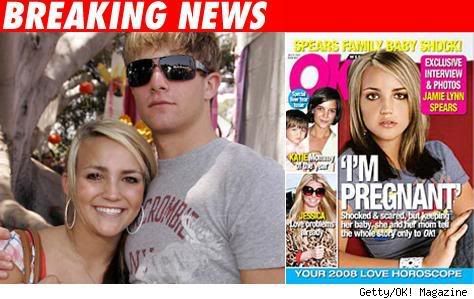
A source tells us the interview, which hits stands tomorrow, is six pages and is on the record with Jamie Lynn and her mother. She tells the mag that the father is Casey Aldridge, who she has been dating for some time and first met at church. Brit's younger sister, star of Nick's "Zoey 101," says she's keeping the baby.
Sources tell us that she has not yet told her older sister. Well, she knows now.
UPDATE: Nickelodeon issued the following statement this afternoon: "We respect Jamie Lynn's decision to take responsibility in this sensitive and personal situation. We know this is a very difficult time for her and her family, and our primary concern right now is for Jamie Lynn's well being."
QUE HORROR! I can't believe she got knocked-up at sixteen! That is just wrong on so many
levels! She met the guy at church too... Oh well, at least she's keeping the baby... much better than letting it go... hopefully she'll give her baby the love and care it deserves.
from TMZ.COM
Jamie Lynn Spears, 16, has confirmed to OK! Magazine that she is pregnant. Oh. My. God.
A source tells us the interview, which hits stands tomorrow, is six pages and is on the record with Jamie Lynn and her mother. She tells the mag that the father is Casey Aldridge, who she has been dating for some time and first met at church. Brit's younger sister, star of Nick's "Zoey 101," says she's keeping the baby.
Sources tell us that she has not yet told her older sister. Well, she knows now.
UPDATE: Nickelodeon issued the following statement this afternoon: "We respect Jamie Lynn's decision to take responsibility in this sensitive and personal situation. We know this is a very difficult time for her and her family, and our primary concern right now is for Jamie Lynn's well being."
QUE HORROR! I can't believe she got knocked-up at sixteen! That is just wrong on so many
levels! She met the guy at church too... Oh well, at least she's keeping the baby... much better than letting it go... hopefully she'll give her baby the love and care it deserves.
Grumpy Harry.

Harry Reid denies anyone is winning at anything
If this is what winning looks like, then Senate Majority Leader Harry Reid wants no part of it.
Tired of Republican crowing about winning on Iraq funding, the budget battle and the energy bill, Reid (D-Nev.) shot back on Tuesday afternoon.
"We hear a lot of Republicans boasting ... because of their unprecedented obstruction," Reid said.
Indeed, Republicans have gotten their way in the battle over spending, have forced Democrats to jettison rollbacks of tax breaks for oil companies, and have beaten back attempts to pay for expanded children's health care programs with a tobacco tax increase. Even though they're in the minority, the GOP, backed by President Bush, has used the filibuster to block Democratic priorities over and over this fall.
"Who's winning?" Reid asked a group of reporters. "Big Oil, Big Tobacco. ... Al Qaeda has regrouped and is able to fight a civil war in Iraq. ... The American people are losing."
Reid left the microphones to head to a signing ceremony for legislation which increases gas mileage rules for the first time in 30 years — something Democrats will indeed tout as a "W" in their won-loss column.
This comment says it all:
The President is the only one that understood the true message of the 2006 Election results. That was that the American people were tired of seeing money wasted on petty programs and programs that didn't work. The American people wanted fiscal responsibility to return to DC. The American people wanted a new direction in Iraq. Not to lose in Iraq or retreat from Iraq, but a new direction. The President is the only one in Washington that got that message. The President is winning and history will show that he understood the results better than anyone else.
Posted By: TCA | December 18, 2007 at 03:47 PM
Mike Huckabee is CLUELESS.
The Problem With Pastor Mike
Foreign-policy foolishness just won't suffice.
By Peter Wehner

Coolest president ever!
Former Arkansas governor and Republican presidential hopeful Mike Huckabee has written an article for Foreign Affairs magazine, the first two paragraphs of which are stunningly silly, misguided, and unfortunately for Huckabee, deeply revealing.
The two opening paragraphs read this way:
The United States, as the world's only superpower, is less vulnerable to military defeat. But it is more vulnerable to the animosity of other countries. Much like a top high school student, if it is modest about its abilities and achievements, if it is generous in helping others, it is loved. But if it attempts to dominate others, it is despised.
American foreign policy needs to change its tone and attitude, open up, and reach out. The Bush administration's arrogant bunker mentality has been counterproductive at home and abroad. My administration will recognize that the United States' main fight today does not pit us against the world but pits the world against the terrorists. At the same time, my administration will never surrender any of our sovereignty, which is why I was the first presidential candidate to oppose ratification of the Law of the Sea Treaty, which would endanger both our national security and our economic interests.
Where ought one to begin untangling this unholy mess?
Perhaps the place to begin is with his contention that America is ungenerous, which (according to Huckabee) explains the animus now directed at the United States. The fact is that the United States has sacrificed an enormous amount of blood and treasure to help other nations. Any suggestion otherwise is wrong and even offensive.
We have, for starters, liberated more than 50 million people from two of the most repressive regimes in modern history (the Taliban and the Baathist police state in Iraq). The global AIDS initiative qualifies as among the most humane and generous acts in the history of American foreign policy. We give billions in additional foreign aid, including the enormous generosity America displayed in helping Indonesia and other nations in the aftermath of the earthquake and tsunami that devastated Indonesia and other nations in December 2004.
The United States, while imperfect, ranks as perhaps the most benevolent superpower (to say nothing of its status as a benevolent nation) in human history. Unlike past empires, we are using American power and influence for great good instead of as a means of advancing oppression.
Beyond that, the belief that if we are modest and generous we will be “loved” by other nations, and that anger at America is based on our attempts to “dominate,” is both naive and foolish. Some nations (like Cuba, Syria, Iran, North Korea, and others) will oppose us because they are totalitarian states that hate our efforts to curb their ambitions and advance freedom and self-determination.
They are not the loving kind.
Other nations (like France under Jacques Chirac) will oppose us because they can’t stand the idea of a unipolar world and want to counterbalance it. And other nations (like China and Russia) will oppose our efforts to end genocide in Darfur and keep Iran from gaining nuclear weapons because of their economic interests.
Memo to Mike Huckabee: Sometimes we are despised for all the right reasons.
Ronald Reagan engendered anger from nations because he called the Soviet Union an “evil empire;” deployed Cruise and Pershing Missiles in Europe; moved ahead with the Strategic Defense Initiative; and supported the contras in Nicaragua. Millions took to the streets in Europe to oppose his defense build-up. Does Governor Huckabee believe Reagan’s actions were wrong simply because in many countries they were unpopular? Of course we would prefer to have universal support for our actions rather than encounter opposition. But does Huckabee understand that sometimes right and wise actions elicit opposition, and sometimes even intense and widespread opposition?
The popularity of the United States decreased in many Muslim nations in the aftermath of taking down the Taliban regime for its role in harboring and supporting al-Qaeda, which in turn was responsible for the worst attack on the American homeland in our history. Was that anger against America justified? Would Huckabee base his foreign-policy decisions on how our actions poll in Waziristan or Gaza under Hamas, or in madrasas throughout the Middle East? Based on his Foreign Affairs essay, it’s reasonable to believe he might.
As for his claim that the Bush administration’s “arrogant bunker mentality” has been counterproductive at home and abroad, the same point applies. Many Middle East dictatorships recoiled at the president’s decision in 2002 to sideline Yasser Arafat (who in many ways is the father of modern terrorism), and his insistence that Palestinian authorities renounce terrorism as an instrument of state policy if they ever hope to have a homeland. Was it “arrogant” to do so? Does Huckabee wish the president had done more to stand with dictators in the Middle East? Does he wish the president still abided by the ABM Treaty with Russia?
Governor Huckabee also seems ignorant about the extent of cooperation that, on a daily basis, is garnered for the war against militant Islam. Contrary to the portrait he paints, we are seeing unprecedented cooperation in tracking, arresting, and blocking funding for terrorist organizations. Is Governor Huckabee familiar with the Proliferation Security Initiative, which more than 70 nations have joined in an effort to deny terrorists, rogue states, and their supplier networks access to weapons-of-mass-destruction-related material? Is he aware that America and its allies shut down a sophisticated nuclear black market network headed by A. Q. Khan?
Does he know that NATO has taken over command of international forces in Afghanistan — the first mission in NATO’s history outside the Euro-Atlantic region? Does he know (or care) that the United States won the unanimous approval of the U.N. Security Council for Resolution 1441, which said Saddam Hussein had to comply with previous resolutions or face “serious consequences” (which all parties took to mean war)? And if the president’s policies have been so counterproductive abroad, how does he explain the rise to power of Sarkozy in France and Merkel in Germany — two nations where anti-American animus is said to run deepest?
In his Foreign Affairs essay, Huckabee writes, “After President Bush included Iran in the ‘axis of evil,’ everything went downhill fast.” Everything? Is the former governor of Arkansas at all familiar with the history of Iran since the 1979 revolution? Is he aware of Iran’s actions when it comes to its nuclear ambitions, support for terrorism, and the oppression of its own people — actions which earned it a place on the “axis of evil” list? Does Huckabee dispute that the Iranian regime is evil — or is he only upset that President Bush spoke truthful words about it? And what does he make of the fact that according to the latest National Intelligence Estimate Iran in 2003 ceased production of its nuclear weapons program — a year after the “axis of evil speech” and in the immediate aftermath of Operations Enduring Freedom and Iraqi Freedom?
Huckabee writes, “The Bush administration has properly said that it will not take the military option for dealing with Iran off the table. Neither will I. But if we do not put other options on the table, eventually a military strike will become the only viable one.”
Is Huckabee unaware of all the other options on the table, which Iran has so far rejected? And in arguing that we should re-establish diplomatic ties with Iran, Huckabee writes, “When one stops talking to a parent or a friend, differences cannot be resolved and relationships cannot move forward.” This echoes his opening reference to the United States being like a high-school student.
If Pastor Mike thinks that dealing with Mahmoud Ahmadinejad and Sayyid Ali Khamenei is akin to tension arising between high-school juniors Sally and Sue, he has a few things to learn — and the presidency is not the place for such basic on-the-job training.
The role of commander-in-chief is the most important one we look to in a president, particularly when America is at war. Governor Huckabee’s article in Foreign Affairs, while fine (if largely conventional) in some respects, is fundamentally unserious; on national security matters, he is likewise. And when the final votes are tallied in the GOP race, Mike Huckabee’s words, on these issues and others, will cost him.
Foreign-policy foolishness just won't suffice.
By Peter Wehner
Coolest president ever!
Former Arkansas governor and Republican presidential hopeful Mike Huckabee has written an article for Foreign Affairs magazine, the first two paragraphs of which are stunningly silly, misguided, and unfortunately for Huckabee, deeply revealing.
The two opening paragraphs read this way:
American foreign policy needs to change its tone and attitude, open up, and reach out. The Bush administration's arrogant bunker mentality has been counterproductive at home and abroad. My administration will recognize that the United States' main fight today does not pit us against the world but pits the world against the terrorists. At the same time, my administration will never surrender any of our sovereignty, which is why I was the first presidential candidate to oppose ratification of the Law of the Sea Treaty, which would endanger both our national security and our economic interests.
Where ought one to begin untangling this unholy mess?
Perhaps the place to begin is with his contention that America is ungenerous, which (according to Huckabee) explains the animus now directed at the United States. The fact is that the United States has sacrificed an enormous amount of blood and treasure to help other nations. Any suggestion otherwise is wrong and even offensive.
We have, for starters, liberated more than 50 million people from two of the most repressive regimes in modern history (the Taliban and the Baathist police state in Iraq). The global AIDS initiative qualifies as among the most humane and generous acts in the history of American foreign policy. We give billions in additional foreign aid, including the enormous generosity America displayed in helping Indonesia and other nations in the aftermath of the earthquake and tsunami that devastated Indonesia and other nations in December 2004.
The United States, while imperfect, ranks as perhaps the most benevolent superpower (to say nothing of its status as a benevolent nation) in human history. Unlike past empires, we are using American power and influence for great good instead of as a means of advancing oppression.
Beyond that, the belief that if we are modest and generous we will be “loved” by other nations, and that anger at America is based on our attempts to “dominate,” is both naive and foolish. Some nations (like Cuba, Syria, Iran, North Korea, and others) will oppose us because they are totalitarian states that hate our efforts to curb their ambitions and advance freedom and self-determination.
They are not the loving kind.
Other nations (like France under Jacques Chirac) will oppose us because they can’t stand the idea of a unipolar world and want to counterbalance it. And other nations (like China and Russia) will oppose our efforts to end genocide in Darfur and keep Iran from gaining nuclear weapons because of their economic interests.
Memo to Mike Huckabee: Sometimes we are despised for all the right reasons.
Ronald Reagan engendered anger from nations because he called the Soviet Union an “evil empire;” deployed Cruise and Pershing Missiles in Europe; moved ahead with the Strategic Defense Initiative; and supported the contras in Nicaragua. Millions took to the streets in Europe to oppose his defense build-up. Does Governor Huckabee believe Reagan’s actions were wrong simply because in many countries they were unpopular? Of course we would prefer to have universal support for our actions rather than encounter opposition. But does Huckabee understand that sometimes right and wise actions elicit opposition, and sometimes even intense and widespread opposition?
The popularity of the United States decreased in many Muslim nations in the aftermath of taking down the Taliban regime for its role in harboring and supporting al-Qaeda, which in turn was responsible for the worst attack on the American homeland in our history. Was that anger against America justified? Would Huckabee base his foreign-policy decisions on how our actions poll in Waziristan or Gaza under Hamas, or in madrasas throughout the Middle East? Based on his Foreign Affairs essay, it’s reasonable to believe he might.
As for his claim that the Bush administration’s “arrogant bunker mentality” has been counterproductive at home and abroad, the same point applies. Many Middle East dictatorships recoiled at the president’s decision in 2002 to sideline Yasser Arafat (who in many ways is the father of modern terrorism), and his insistence that Palestinian authorities renounce terrorism as an instrument of state policy if they ever hope to have a homeland. Was it “arrogant” to do so? Does Huckabee wish the president had done more to stand with dictators in the Middle East? Does he wish the president still abided by the ABM Treaty with Russia?
Governor Huckabee also seems ignorant about the extent of cooperation that, on a daily basis, is garnered for the war against militant Islam. Contrary to the portrait he paints, we are seeing unprecedented cooperation in tracking, arresting, and blocking funding for terrorist organizations. Is Governor Huckabee familiar with the Proliferation Security Initiative, which more than 70 nations have joined in an effort to deny terrorists, rogue states, and their supplier networks access to weapons-of-mass-destruction-related material? Is he aware that America and its allies shut down a sophisticated nuclear black market network headed by A. Q. Khan?
Does he know that NATO has taken over command of international forces in Afghanistan — the first mission in NATO’s history outside the Euro-Atlantic region? Does he know (or care) that the United States won the unanimous approval of the U.N. Security Council for Resolution 1441, which said Saddam Hussein had to comply with previous resolutions or face “serious consequences” (which all parties took to mean war)? And if the president’s policies have been so counterproductive abroad, how does he explain the rise to power of Sarkozy in France and Merkel in Germany — two nations where anti-American animus is said to run deepest?
In his Foreign Affairs essay, Huckabee writes, “After President Bush included Iran in the ‘axis of evil,’ everything went downhill fast.” Everything? Is the former governor of Arkansas at all familiar with the history of Iran since the 1979 revolution? Is he aware of Iran’s actions when it comes to its nuclear ambitions, support for terrorism, and the oppression of its own people — actions which earned it a place on the “axis of evil” list? Does Huckabee dispute that the Iranian regime is evil — or is he only upset that President Bush spoke truthful words about it? And what does he make of the fact that according to the latest National Intelligence Estimate Iran in 2003 ceased production of its nuclear weapons program — a year after the “axis of evil speech” and in the immediate aftermath of Operations Enduring Freedom and Iraqi Freedom?
Huckabee writes, “The Bush administration has properly said that it will not take the military option for dealing with Iran off the table. Neither will I. But if we do not put other options on the table, eventually a military strike will become the only viable one.”
Is Huckabee unaware of all the other options on the table, which Iran has so far rejected? And in arguing that we should re-establish diplomatic ties with Iran, Huckabee writes, “When one stops talking to a parent or a friend, differences cannot be resolved and relationships cannot move forward.” This echoes his opening reference to the United States being like a high-school student.
If Pastor Mike thinks that dealing with Mahmoud Ahmadinejad and Sayyid Ali Khamenei is akin to tension arising between high-school juniors Sally and Sue, he has a few things to learn — and the presidency is not the place for such basic on-the-job training.
The role of commander-in-chief is the most important one we look to in a president, particularly when America is at war. Governor Huckabee’s article in Foreign Affairs, while fine (if largely conventional) in some respects, is fundamentally unserious; on national security matters, he is likewise. And when the final votes are tallied in the GOP race, Mike Huckabee’s words, on these issues and others, will cost him.
Sunday, December 16, 2007








Huckabee and Babwa Walters are so UNCOOL.
The Real Mike Huckabee
Huck disses President Bush
While Huckabee accuses President Bush of being arrogant, he doesn't seem to have any problem playing teacher to ignorant Americans: The Bush administration has never adequately explained the theology and ideology behind Islamic terrorism or convinced us of its ruthless fanaticism. The first rule of war is "know your enemy," and most Americans do not know theirs. To grasp the magnitude of the threat, we first have to understand what makes Islamic terrorists tick.
And in case you're wondering, Huckabee understands the enemy, because he's heard of Sayyid Qutb. Then there's the recurring "if only I had been president I would have made all the right decisions" theme.
On Iraq: Unlike President George W. Bush, who marginalized General Eric Shinseki, the former army chief of staff, when he recommended sending several hundred thousand troops to Iraq, I would have met with Shinseki privately and carefully weighed his advice.
On Al Qaeda:
Despite the Bush administration's continued claims that the U.S. military will pursue "actionable targets," according to a July 2007 article in The New York Times based on interviews with a dozen current and former military and defense officials, a classified raid targeting bin Laden's top deputy, Ayman al-Zawahiri, in Pakistan was aborted in early 2005. Then Defense Secretary Donald Rumsfeld called off the attack at the very last minute, as Navy Seals in parachutes were preparing in C-130s in Afghanistan, because he felt he needed Musharraf's permission to proceed. Why did Rumsfeld, instead of President Bush, call off the attack? Did he ask for Musharraf's permission or assume he would not get it? When I am president, I will make the final call on such actions.
Huckabee concludes his article by saying:
Our history, from the snows of Valley Forge to the flames of 9/11, has been one of perseverance. I understand the threats we face today. When I am president, America will look this evil in the eye, confront it, defeat it, and emerge stronger than ever.
It is easy to be a peace lover; the challenging part is being a peacemaker.As I wrote earlier this week, can we really afford to trust somebody with zero foreign policy experience who has a record of helping to release the most violent of criminals back into society, to stare down our enemies? I totally understand that many social conservatives are rallying behind Huckabee, because they feel he is the only candidate who represents them. And I also understand that some Huckabee supporters feel as though us Northeastern conservatives are being condescending in our criticisms of Huckabee and his followers. But for those social conservatives who also view national security as important, I strongly advise taking a look at his Foreign Affairs article and examining his record as governor, and asking whether you seriously believe he is up to the task of being commander in chief during a time of war.
Germany Admits Expelling Iranian “Diplomat” For Attempted Nuke Theft
You won't hear this on the news!
Germany expelled an Iranian diplomat posted to Berlin in July whom it suspected of trying to get his hands on materiel used in uranium enrichment, the weekly Der Spiegel reports in its issue out Monday.
“The consular attache Mohraramalai D. made contact with a Bavarian firm of specialists, apparently trying to buy a piece of equipment which could also be used in uranium enrichment,” the magazine said.
The German foreign ministry contacted by AFP on Saturday refused to comment on the report.
Barbra Walters is an ungrateful hag
Walters disses Mr and Mrs Bush's Christmas Card for being too Christian. What an idiot!
Barbara Walters likes to receive Christmas greetings from high-profile celebrities and leaders, but apparently not if they refer to the Bible.
On Thursday's episode of ABC's The View, Walters expressed dismay that President and Mrs. Bush would send out greetings containing Scripture.
During the segment, Walters showed the other gals some of the "highfalutin Christmas cards," and explained the White House card:
"First of all, let me show you the cover of the White House, which is nice and bland…So that's pleasant enough. This is what interested me, that it is a religious Christmas card. Usually in the past when I have received a Christmas card, it's been 'happy holiday's' and so on- And this says:
"'You alone are the Lord. You made the heavens, even the highest heavens, and all their starry host, the earth and all that is on it, the seas and all that is in them. You gave life to everything, and the multitudes of heaven worship you.'
"That's from Nehemiah in the Old Testament. I don't remember- and I'm sure people will remind me-getting a religious card. Now does this also go to agnostics and atheists and Muslims and -"
Moderator Whoopie Goldberg and co-host Sherri Shepherd tried to steer clear of controversy by joking that the Scriptures were about Walters, but Walters persisted in her critique, asking, "Don't you think it's a little interesting that the president of all the people is sending out a religious Christmas card?"
Walters showed her co-hosts a Christmas card from Elton John and his partner David Furnish that had angels on the cover. She didn't have similar concerns over the religious imagery as she did about the Scripture printed in the White House card.
Co-host Joy Behar pointed out to Walters that Elton John's card was "religious," and Walters responded, "But it doesn't say anything religious. It says 'Season's Greetings.'"
Later in the show Walters did say, "By the way, I don't want to put down the President of the United States and his wife. I think it's very nice that they sent me a Christmas card."
Christmas greetings can be sent to Barbara Walters at the following address. CMI asks that Christmas greetings be worded in the spirit of the season.
Barbara Walters
c/o The View
320 West 66th Street
New York, NY 10023
Huck disses President Bush
While Huckabee accuses President Bush of being arrogant, he doesn't seem to have any problem playing teacher to ignorant Americans: The Bush administration has never adequately explained the theology and ideology behind Islamic terrorism or convinced us of its ruthless fanaticism. The first rule of war is "know your enemy," and most Americans do not know theirs. To grasp the magnitude of the threat, we first have to understand what makes Islamic terrorists tick.
And in case you're wondering, Huckabee understands the enemy, because he's heard of Sayyid Qutb. Then there's the recurring "if only I had been president I would have made all the right decisions" theme.
On Iraq: Unlike President George W. Bush, who marginalized General Eric Shinseki, the former army chief of staff, when he recommended sending several hundred thousand troops to Iraq, I would have met with Shinseki privately and carefully weighed his advice.
On Al Qaeda:
Despite the Bush administration's continued claims that the U.S. military will pursue "actionable targets," according to a July 2007 article in The New York Times based on interviews with a dozen current and former military and defense officials, a classified raid targeting bin Laden's top deputy, Ayman al-Zawahiri, in Pakistan was aborted in early 2005. Then Defense Secretary Donald Rumsfeld called off the attack at the very last minute, as Navy Seals in parachutes were preparing in C-130s in Afghanistan, because he felt he needed Musharraf's permission to proceed. Why did Rumsfeld, instead of President Bush, call off the attack? Did he ask for Musharraf's permission or assume he would not get it? When I am president, I will make the final call on such actions.
Huckabee concludes his article by saying:
Our history, from the snows of Valley Forge to the flames of 9/11, has been one of perseverance. I understand the threats we face today. When I am president, America will look this evil in the eye, confront it, defeat it, and emerge stronger than ever.
It is easy to be a peace lover; the challenging part is being a peacemaker.As I wrote earlier this week, can we really afford to trust somebody with zero foreign policy experience who has a record of helping to release the most violent of criminals back into society, to stare down our enemies? I totally understand that many social conservatives are rallying behind Huckabee, because they feel he is the only candidate who represents them. And I also understand that some Huckabee supporters feel as though us Northeastern conservatives are being condescending in our criticisms of Huckabee and his followers. But for those social conservatives who also view national security as important, I strongly advise taking a look at his Foreign Affairs article and examining his record as governor, and asking whether you seriously believe he is up to the task of being commander in chief during a time of war.
Germany Admits Expelling Iranian “Diplomat” For Attempted Nuke Theft
You won't hear this on the news!
Germany expelled an Iranian diplomat posted to Berlin in July whom it suspected of trying to get his hands on materiel used in uranium enrichment, the weekly Der Spiegel reports in its issue out Monday.
“The consular attache Mohraramalai D. made contact with a Bavarian firm of specialists, apparently trying to buy a piece of equipment which could also be used in uranium enrichment,” the magazine said.
The German foreign ministry contacted by AFP on Saturday refused to comment on the report.
Barbra Walters is an ungrateful hag
Walters disses Mr and Mrs Bush's Christmas Card for being too Christian. What an idiot!
Barbara Walters likes to receive Christmas greetings from high-profile celebrities and leaders, but apparently not if they refer to the Bible.
On Thursday's episode of ABC's The View, Walters expressed dismay that President and Mrs. Bush would send out greetings containing Scripture.
During the segment, Walters showed the other gals some of the "highfalutin Christmas cards," and explained the White House card:
"First of all, let me show you the cover of the White House, which is nice and bland…So that's pleasant enough. This is what interested me, that it is a religious Christmas card. Usually in the past when I have received a Christmas card, it's been 'happy holiday's' and so on- And this says:
"'You alone are the Lord. You made the heavens, even the highest heavens, and all their starry host, the earth and all that is on it, the seas and all that is in them. You gave life to everything, and the multitudes of heaven worship you.'
"That's from Nehemiah in the Old Testament. I don't remember- and I'm sure people will remind me-getting a religious card. Now does this also go to agnostics and atheists and Muslims and -"
Moderator Whoopie Goldberg and co-host Sherri Shepherd tried to steer clear of controversy by joking that the Scriptures were about Walters, but Walters persisted in her critique, asking, "Don't you think it's a little interesting that the president of all the people is sending out a religious Christmas card?"
Walters showed her co-hosts a Christmas card from Elton John and his partner David Furnish that had angels on the cover. She didn't have similar concerns over the religious imagery as she did about the Scripture printed in the White House card.
Co-host Joy Behar pointed out to Walters that Elton John's card was "religious," and Walters responded, "But it doesn't say anything religious. It says 'Season's Greetings.'"
Later in the show Walters did say, "By the way, I don't want to put down the President of the United States and his wife. I think it's very nice that they sent me a Christmas card."
Christmas greetings can be sent to Barbara Walters at the following address. CMI asks that Christmas greetings be worded in the spirit of the season.
Barbara Walters
c/o The View
320 West 66th Street
New York, NY 10023
Friday, December 14, 2007
All hail Bush! And here's why!
Democrats too busy fighting each other
So don't expect anything to get done for a while!
Once again the Dems caved in to President GWB's demands. Teehee! Now will someone please tell me why President Bush is not on Time's 100 Most Influential List? He was right on pretty much everything, from stem cell research to The Surge. Now the Dems are blaming each other for their own failures, which I guess is part of President Bush's divide and conquer strategy! Face it folks: Team Reid/Pelosi/Gore is no match for Team Bush/Cheney/Rove! Pwned, pwned and pwned again!
When Democrats took control of Congress in January, House Speaker Nancy Pelosi (D-Calif.) and Senate Majority Leader Harry M. Reid (D-Nev.) pledged to jointly push an ambitious agenda to counter 12 years of Republican control.
Now, as Congress struggles to adjourn for Christmas, relations between House Democrats and their colleagues in the Senate have devolved into finger-pointing.
House Ways and Means Committee Chairman Charles B. Rangel (D-N.Y.) accuses Senate Democratic leaders of developing "Stockholm syndrome," showing sympathy to their Republican captors by caving in on legislation to provide middle-class tax cuts paid for with tax increases on the super-rich, tying war funding to troop withdrawal timelines, and mandating renewable energy quotas. If Republicans want to filibuster a bill, Rangel said, Reid should keep the bill on the Senate floor and force the Republicans to talk it to death.
Reid, in turn, has taken to the Senate floor to criticize what he called the speaker's "iron hand" style of governance.
Democrats in each chamber are now blaming their colleagues in the other for the mess in which they find themselves. The predicament caused the majority party yesterday surrender to President Bush on domestic spending levels, drop a cherished renewable-energy mandate and move toward leaving a raft of high-profile legislation, from addressing the mortgage crisis to providing middle-class tax relief, undone or incomplete.
"If there's going to be a filibuster, let's hear the damn filibuster," Rangel fumed. "Let's fight this damned thing out."
In the past few weeks, the House has thrown wave after wave of legislation at the Senate -- on energy, Iraq war policy, the housing and mortgage crisis, and middle-income tax cuts offset largely by tax increases on the wealthy.
Most of it has died quietly, a predetermined fate that both sides could foresee before the first vote was cast. Yet they went ahead anyway. Just last night, the House, for a second time, passed legislation to stave off the growth of the alternative minimum tax, to be paid for by a measure to stop hedge fund managers from deferring compensation in offshore tax havens. Like the previous House version, it has virtually no chance of passing in the Senate.
Officially, House Democrats blame Senate Republicans, who have used parliamentary tactics to block even uncontroversial measures. But they are increasingly expressing public frustration with Reid and Senate Democrats for not putting up a better fight.
House Financial Services Committee Chairman Barney Frank (D-Mass.) called it a "hold and fold" strategy: Senate Republicans put a "hold" on Democratic bills, and Senate Democratic leaders promptly fold their tents.
Asked about his decision on government funding, House Appropriations Committee Chairman David R. Obey (D-Wis.) groused to the Capitol Hill newspaper Roll Call: "I'll tell you how soon I will make a decision when I know how soon the Senate sells us out." Senate Democrats have fired back, accusing Pelosi and her liberal allies of sending over legislation that they know cannot pass in the Senate, and of making demands that will not gain any GOP votes. Sen. Evan Bayh (D-Ind.) noted that, this summer, Reid employed just the kind of theatrics Rangel and other House Democrats are demanding, holding the Senate open all night, pulling out cots and forcing a dusk-till-dawn debate on an Iraq war withdrawal measure before a vote on war funding. Democrats gained not a single vote after the all-night antics.
"I understand the frustration; we're frustrated, too," Bayh said. "But holding a bunch of Kabuki theater doesn't get anything done."
As they wrap up their first year in control of the entire Capitol since 1994, Democrats are trying to prove that they can be an equal partner to Bush. But their first 11 months have been politically and legislatively brutal, with congressional approval ratings dropping this week to 32 percent, a notch below Bush's 33 percent, according to the latest Washington Post-ABC News poll. Their support plummeted as the liberal base grew outraged over the Democratic inability to counter the president on any war issue, while moderates and centrists looking for bipartisan kitchen-table accomplishments instead saw partisan gridlock. The disputes have at times taken on starkly personal tones. In closed-door bicameral leadership meetings, Pelosi has questioned Reid's intentions on issues such as war funding tied to troop withdrawal timelines and an alternative minimum tax fix that is fully funded by tax increase offsets, suggesting that his words have not always matched his actions.
Reid has let his own frustration show. After Republican senators accused Pelosi of lying about her intentions on a comprehensive energy bill, the majority leader offered a backhanded defense.
"I can't control Speaker Pelosi," he said on the chamber floor. "I hope everybody understands that. She is a strong, independent woman. She runs the House with an iron hand. I support what she does, but no one needs to come and tell me I didn't keep my word."
Reid, the son of a hard-rock miner from a tiny, rural Nevada town, and Pelosi, the daughter of a mayor of Baltimore who married a multimillionaire and moved to San Francisco, have little in common on a personal level. They have what several lawmakers and aides describe as a formal, all-business relationship, one that involves little personal chit-chat when they sit down for their weekly meetings on Tuesday evenings.
Some days Reid and Pelosi get down to business and quickly settle cross-chamber disputes, but other times it requires a different touch to deliver certain messages. After Tuesday's Senate Democratic leadership meeting, Reid dispatched deputies to inform Pelosi that the Senate would not stand for the latest offer to eliminate earmarks, as well as all war funds, from a year-end omnibus spending package.
One of those instructed to talk to Pelosi was Sen. Barbara Boxer (D-Calif.), a fellow Bay Area liberal who is a close friend of the speaker's and engages her in a personal way that Reid never does.
While many House Democrats see Reid's decision-making process as mercurial, one Senate Democrat suggested that some lawmakers might confuse Reid's tone and brevity with lack of respect.
"When Harry's done talking, the conversation's over. Boom," the Democratic senator said, mimicking someone hanging up the phone.
A top aide said that Reid and the speaker have a "natural frustration" because of the limitations they face within their chambers, but that both blame Senate Republicans, who have routinely forced Reid to round up 60 votes -- to prevent a filibuster -- on everything from a contentious immigration bill to popular ethics legislation. Even on the best of days, Democrats hold just a 51 to 49 majority in the Senate.
"We understand the speaker can pass bills only with Democratic votes. And we know she understands the Constitution and the closely divided Senate requires Senator Reid to pick up 20 percent of Senate Republicans just to get a vote on something, let alone pass it," said Jim Manley, Reid's spokesman.
The 60-vote threshold has become the flashpoint for the intramural Democratic dispute.
Senate Democrats contend that their House counterparts simply do not understand the modern Senate when they badger Reid about holding all-night filibusters. In a series of 20th-century changes, Senate filibusters became a thing of the past. Rules pushed by senators seeking to pass civil rights legislation allow filibusters to be thwarted if 60 or more members vote to cut off the debate. As long as the minority party has 41 votes, it no longer has to hold the floor and talk a bill to death.
Republicans, who spent 12 years in similar battles, are just enjoying the spectacle.
"Just let 'em stew for a while," said soon-to-retire Senate Minority Whip Trent Lott (R-Miss.), a veteran of the GOP's own squabbles.
So don't expect anything to get done for a while!
Once again the Dems caved in to President GWB's demands. Teehee! Now will someone please tell me why President Bush is not on Time's 100 Most Influential List? He was right on pretty much everything, from stem cell research to The Surge. Now the Dems are blaming each other for their own failures, which I guess is part of President Bush's divide and conquer strategy! Face it folks: Team Reid/Pelosi/Gore is no match for Team Bush/Cheney/Rove! Pwned, pwned and pwned again!
When Democrats took control of Congress in January, House Speaker Nancy Pelosi (D-Calif.) and Senate Majority Leader Harry M. Reid (D-Nev.) pledged to jointly push an ambitious agenda to counter 12 years of Republican control.
Now, as Congress struggles to adjourn for Christmas, relations between House Democrats and their colleagues in the Senate have devolved into finger-pointing.
House Ways and Means Committee Chairman Charles B. Rangel (D-N.Y.) accuses Senate Democratic leaders of developing "Stockholm syndrome," showing sympathy to their Republican captors by caving in on legislation to provide middle-class tax cuts paid for with tax increases on the super-rich, tying war funding to troop withdrawal timelines, and mandating renewable energy quotas. If Republicans want to filibuster a bill, Rangel said, Reid should keep the bill on the Senate floor and force the Republicans to talk it to death.
Reid, in turn, has taken to the Senate floor to criticize what he called the speaker's "iron hand" style of governance.
Democrats in each chamber are now blaming their colleagues in the other for the mess in which they find themselves. The predicament caused the majority party yesterday surrender to President Bush on domestic spending levels, drop a cherished renewable-energy mandate and move toward leaving a raft of high-profile legislation, from addressing the mortgage crisis to providing middle-class tax relief, undone or incomplete.
"If there's going to be a filibuster, let's hear the damn filibuster," Rangel fumed. "Let's fight this damned thing out."
In the past few weeks, the House has thrown wave after wave of legislation at the Senate -- on energy, Iraq war policy, the housing and mortgage crisis, and middle-income tax cuts offset largely by tax increases on the wealthy.
Most of it has died quietly, a predetermined fate that both sides could foresee before the first vote was cast. Yet they went ahead anyway. Just last night, the House, for a second time, passed legislation to stave off the growth of the alternative minimum tax, to be paid for by a measure to stop hedge fund managers from deferring compensation in offshore tax havens. Like the previous House version, it has virtually no chance of passing in the Senate.
Officially, House Democrats blame Senate Republicans, who have used parliamentary tactics to block even uncontroversial measures. But they are increasingly expressing public frustration with Reid and Senate Democrats for not putting up a better fight.
House Financial Services Committee Chairman Barney Frank (D-Mass.) called it a "hold and fold" strategy: Senate Republicans put a "hold" on Democratic bills, and Senate Democratic leaders promptly fold their tents.
Asked about his decision on government funding, House Appropriations Committee Chairman David R. Obey (D-Wis.) groused to the Capitol Hill newspaper Roll Call: "I'll tell you how soon I will make a decision when I know how soon the Senate sells us out." Senate Democrats have fired back, accusing Pelosi and her liberal allies of sending over legislation that they know cannot pass in the Senate, and of making demands that will not gain any GOP votes. Sen. Evan Bayh (D-Ind.) noted that, this summer, Reid employed just the kind of theatrics Rangel and other House Democrats are demanding, holding the Senate open all night, pulling out cots and forcing a dusk-till-dawn debate on an Iraq war withdrawal measure before a vote on war funding. Democrats gained not a single vote after the all-night antics.
"I understand the frustration; we're frustrated, too," Bayh said. "But holding a bunch of Kabuki theater doesn't get anything done."
As they wrap up their first year in control of the entire Capitol since 1994, Democrats are trying to prove that they can be an equal partner to Bush. But their first 11 months have been politically and legislatively brutal, with congressional approval ratings dropping this week to 32 percent, a notch below Bush's 33 percent, according to the latest Washington Post-ABC News poll. Their support plummeted as the liberal base grew outraged over the Democratic inability to counter the president on any war issue, while moderates and centrists looking for bipartisan kitchen-table accomplishments instead saw partisan gridlock. The disputes have at times taken on starkly personal tones. In closed-door bicameral leadership meetings, Pelosi has questioned Reid's intentions on issues such as war funding tied to troop withdrawal timelines and an alternative minimum tax fix that is fully funded by tax increase offsets, suggesting that his words have not always matched his actions.
Reid has let his own frustration show. After Republican senators accused Pelosi of lying about her intentions on a comprehensive energy bill, the majority leader offered a backhanded defense.
"I can't control Speaker Pelosi," he said on the chamber floor. "I hope everybody understands that. She is a strong, independent woman. She runs the House with an iron hand. I support what she does, but no one needs to come and tell me I didn't keep my word."
Reid, the son of a hard-rock miner from a tiny, rural Nevada town, and Pelosi, the daughter of a mayor of Baltimore who married a multimillionaire and moved to San Francisco, have little in common on a personal level. They have what several lawmakers and aides describe as a formal, all-business relationship, one that involves little personal chit-chat when they sit down for their weekly meetings on Tuesday evenings.
Some days Reid and Pelosi get down to business and quickly settle cross-chamber disputes, but other times it requires a different touch to deliver certain messages. After Tuesday's Senate Democratic leadership meeting, Reid dispatched deputies to inform Pelosi that the Senate would not stand for the latest offer to eliminate earmarks, as well as all war funds, from a year-end omnibus spending package.
One of those instructed to talk to Pelosi was Sen. Barbara Boxer (D-Calif.), a fellow Bay Area liberal who is a close friend of the speaker's and engages her in a personal way that Reid never does.
While many House Democrats see Reid's decision-making process as mercurial, one Senate Democrat suggested that some lawmakers might confuse Reid's tone and brevity with lack of respect.
"When Harry's done talking, the conversation's over. Boom," the Democratic senator said, mimicking someone hanging up the phone.
A top aide said that Reid and the speaker have a "natural frustration" because of the limitations they face within their chambers, but that both blame Senate Republicans, who have routinely forced Reid to round up 60 votes -- to prevent a filibuster -- on everything from a contentious immigration bill to popular ethics legislation. Even on the best of days, Democrats hold just a 51 to 49 majority in the Senate.
"We understand the speaker can pass bills only with Democratic votes. And we know she understands the Constitution and the closely divided Senate requires Senator Reid to pick up 20 percent of Senate Republicans just to get a vote on something, let alone pass it," said Jim Manley, Reid's spokesman.
The 60-vote threshold has become the flashpoint for the intramural Democratic dispute.
Senate Democrats contend that their House counterparts simply do not understand the modern Senate when they badger Reid about holding all-night filibusters. In a series of 20th-century changes, Senate filibusters became a thing of the past. Rules pushed by senators seeking to pass civil rights legislation allow filibusters to be thwarted if 60 or more members vote to cut off the debate. As long as the minority party has 41 votes, it no longer has to hold the floor and talk a bill to death.
Republicans, who spent 12 years in similar battles, are just enjoying the spectacle.
"Just let 'em stew for a while," said soon-to-retire Senate Minority Whip Trent Lott (R-Miss.), a veteran of the GOP's own squabbles.
Would Reagan survive in today's GOP?
Would Reagan survive in today's GOP? And is Mrs. Clinton in for a fall this winter?
Peggy Noonan
What is happening in Iowa is no longer boring but big, and may prove huge.
The Republican race looks--at the moment--to be determined primarily by one thing, the question of religious faith. In my lifetime faith has been a significant issue in presidential politics, but not the sole determinative one. Is that changing? If it is, it is not progress.
Mike Huckabee is in the lead due, it appears, to voter approval of the depth and sincerity of his religious beliefs as lived out in his ministry as an ordained Southern Baptist. He flashes "Christian leader" over his picture in commercials; he asserts his faith is "mainstream"; his surrogates speak of Mormonism as "strange" and "definitely a factor." Mr. Huckabee said this summer that a candidate's faith is "subject to question," "part of the game."
He tells the New York Times that he doesn't know a lot about Mitt Romney's faith, but isn't it the one in which Jesus and the devil are brothers? This made me miss the old days of Gore Vidal's "The Best Man," in which a candidate started a whispering campaign that his opponent's wife was a thespian.
Mr. Huckabee has of course announced that he apologizes to Mr. Romney, which allowed him to elaborate on his graciousness and keep the story alive. He should have looked abashed. Instead he betrayed the purring pleasure of "a Christian with four aces," in Mark Twain's words.
Christian conservatives have been rising, most recently, for 30 years in national politics, since they helped elect Jimmy Carter. They care about the religious faith of their leaders, and their interest is legitimate. Faith is a shaping force. Lincoln got grilled on it. But there is a sense in Iowa now that faith has been heightened as a determining factor in how to vote, that such things as executive ability, professional history, temperament, character, political philosophy and professed stands are secondary, tertiary.
But they are not, and cannot be. They are central. Things seem to be getting out of kilter, with the emphasis shifting too far.
The great question: Does it make Mr. Huckabee, does it seal his rise, that he has acted in such a manner? Or does it damage him? Republicans on the ground in Iowa and elsewhere will decide that. And in the deciding they may be deciding more than one man's future. They may be deciding if Republicans are becoming a different kind of party.
I wonder if our old friend Ronald Reagan could rise in this party, this environment. Not a regular churchgoer, said he experienced God riding his horse at the ranch, divorced, relaxed about the faiths of his friends and aides, or about its absence. He was a believing Christian, but he spent his adulthood in relativist Hollywood, and had a father who belonged to what some saw, and even see, as the Catholic cult. I'm just not sure he'd be pure enough to make it in this party. I'm not sure he'd be considered good enough.
***
This thought occurs that Hillary Clinton's entire campaign is, and always was, a Potemkin village, a giant head fake, a haughty facade hollow at the core. That she is disorganized on the ground in Iowa, taken aback by a challenge to her invincibility, that she doesn't actually have an A team, that her advisers have always been chosen more for proven loyalty than talent, that her supporters don't feel deep affection for her. That she's scrambling chaotically to catch up, with surrogates saying scuzzy things about Barack Obama and drug use, and her following up with apologies that will, as always, keep the story alive. That her guru-pollster, the almost universally disliked Mark Penn, has, according to Newsday, become the focus of charges that he has "mistakenly run Clinton as a de facto incumbent" and that the top officials on the campaign have never had a real understanding of Iowa.
This is true of Mrs. Clinton and her Iowa campaign: They thought it was a queenly procession, not a brawl. Now they're reduced to spinning the idea that expectations are on Mr. Obama, that he'd better win big or it's a loss. They've been reduced too to worrying about the weather. If there's a blizzard on caucus day, her supporters, who skew old, may not turn out. The defining picture of the caucuses may be a 78-year-old woman being dragged from her home by young volunteers in a tinted-window SUV.
This is, still, an amazing thing to see. It is a delight of democracy that now and then assumptions are confounded, that all the conventional wisdom of the past year is compressed and about to blow. It takes a Potemkin village.
A thought on the presence of Bill Clinton. He is showing up all over in Iowa and New Hampshire, speaking, shaking hands, drawing crowds. But when he speaks, he has a tendency to speak about himself. It's all, always, me-me-me in his gigantic bullying neediness. Still, he's there, and he's a draw, and the plan was that his presence would boost his wife's fortunes. The way it was supposed to work, the logic, was this: People miss Bill. They miss the '90s. They miss the pre-9/11 world. So they'll love seeing him back in the White House. So they'll vote for Hillary. Because she'll bring him. "Two for the price of one."
It appears not to be working. Might it be that they don't miss Bill as much as everyone thought? That they don't actually want Bill back in the White House?
Maybe. But maybe it's this. Maybe they'd love to have him back in the White House. Maybe they just don't want him to bring her. Maybe they miss the Cuckoo's Nest and they'd love having Jack Nicholson's McMurphy running through the halls. Maybe they just don't miss Nurse Ratched. Does she have to come?
***
It is clear in Iowa that immigration is the great issue that won't go away. Members of the American elite, including U.S. senators, continue to do damage to the public debate on immigration. They do not view it as a crucial question of America's continuance. They view it as an onerous issue that might upset their personal plans, an issue dominated by pro-immigration groups and power centers on the one hand, and the pesky American people, with their limited and quasi-racist concerns, on the other.
Because politicians see immigration as just another issue in "the game," they feel compelled to speak of it not with honest indifference but with hot words and images. With a lack of sympathy. This is in contrast to normal Americans, who do not use hot words, and just want the problem handled and the rule of law returned to the borders.
Politicians, that is, distort the debate, not because they care so much but because they care so little.
Hillary Clinton is not up at night worrying about the national-security implications of open borders in the age of terror. She's up at night worrying about whether to use Mr. Obama's position on driver's licenses for illegals against him in ads or push polls.
A real and felt concern among the candidates about immigration is a rare thing. And people can tell. They can tell with both parties. This is the real source of bitterness in this debate. It's not regnant racism. It's knowing the political class is incapable of caring, and so repairing.
Peggy Noonan
What is happening in Iowa is no longer boring but big, and may prove huge.
The Republican race looks--at the moment--to be determined primarily by one thing, the question of religious faith. In my lifetime faith has been a significant issue in presidential politics, but not the sole determinative one. Is that changing? If it is, it is not progress.
Mike Huckabee is in the lead due, it appears, to voter approval of the depth and sincerity of his religious beliefs as lived out in his ministry as an ordained Southern Baptist. He flashes "Christian leader" over his picture in commercials; he asserts his faith is "mainstream"; his surrogates speak of Mormonism as "strange" and "definitely a factor." Mr. Huckabee said this summer that a candidate's faith is "subject to question," "part of the game."
He tells the New York Times that he doesn't know a lot about Mitt Romney's faith, but isn't it the one in which Jesus and the devil are brothers? This made me miss the old days of Gore Vidal's "The Best Man," in which a candidate started a whispering campaign that his opponent's wife was a thespian.
Mr. Huckabee has of course announced that he apologizes to Mr. Romney, which allowed him to elaborate on his graciousness and keep the story alive. He should have looked abashed. Instead he betrayed the purring pleasure of "a Christian with four aces," in Mark Twain's words.
Christian conservatives have been rising, most recently, for 30 years in national politics, since they helped elect Jimmy Carter. They care about the religious faith of their leaders, and their interest is legitimate. Faith is a shaping force. Lincoln got grilled on it. But there is a sense in Iowa now that faith has been heightened as a determining factor in how to vote, that such things as executive ability, professional history, temperament, character, political philosophy and professed stands are secondary, tertiary.
But they are not, and cannot be. They are central. Things seem to be getting out of kilter, with the emphasis shifting too far.
The great question: Does it make Mr. Huckabee, does it seal his rise, that he has acted in such a manner? Or does it damage him? Republicans on the ground in Iowa and elsewhere will decide that. And in the deciding they may be deciding more than one man's future. They may be deciding if Republicans are becoming a different kind of party.
I wonder if our old friend Ronald Reagan could rise in this party, this environment. Not a regular churchgoer, said he experienced God riding his horse at the ranch, divorced, relaxed about the faiths of his friends and aides, or about its absence. He was a believing Christian, but he spent his adulthood in relativist Hollywood, and had a father who belonged to what some saw, and even see, as the Catholic cult. I'm just not sure he'd be pure enough to make it in this party. I'm not sure he'd be considered good enough.
This thought occurs that Hillary Clinton's entire campaign is, and always was, a Potemkin village, a giant head fake, a haughty facade hollow at the core. That she is disorganized on the ground in Iowa, taken aback by a challenge to her invincibility, that she doesn't actually have an A team, that her advisers have always been chosen more for proven loyalty than talent, that her supporters don't feel deep affection for her. That she's scrambling chaotically to catch up, with surrogates saying scuzzy things about Barack Obama and drug use, and her following up with apologies that will, as always, keep the story alive. That her guru-pollster, the almost universally disliked Mark Penn, has, according to Newsday, become the focus of charges that he has "mistakenly run Clinton as a de facto incumbent" and that the top officials on the campaign have never had a real understanding of Iowa.
This is true of Mrs. Clinton and her Iowa campaign: They thought it was a queenly procession, not a brawl. Now they're reduced to spinning the idea that expectations are on Mr. Obama, that he'd better win big or it's a loss. They've been reduced too to worrying about the weather. If there's a blizzard on caucus day, her supporters, who skew old, may not turn out. The defining picture of the caucuses may be a 78-year-old woman being dragged from her home by young volunteers in a tinted-window SUV.
This is, still, an amazing thing to see. It is a delight of democracy that now and then assumptions are confounded, that all the conventional wisdom of the past year is compressed and about to blow. It takes a Potemkin village.
A thought on the presence of Bill Clinton. He is showing up all over in Iowa and New Hampshire, speaking, shaking hands, drawing crowds. But when he speaks, he has a tendency to speak about himself. It's all, always, me-me-me in his gigantic bullying neediness. Still, he's there, and he's a draw, and the plan was that his presence would boost his wife's fortunes. The way it was supposed to work, the logic, was this: People miss Bill. They miss the '90s. They miss the pre-9/11 world. So they'll love seeing him back in the White House. So they'll vote for Hillary. Because she'll bring him. "Two for the price of one."
It appears not to be working. Might it be that they don't miss Bill as much as everyone thought? That they don't actually want Bill back in the White House?
Maybe. But maybe it's this. Maybe they'd love to have him back in the White House. Maybe they just don't want him to bring her. Maybe they miss the Cuckoo's Nest and they'd love having Jack Nicholson's McMurphy running through the halls. Maybe they just don't miss Nurse Ratched. Does she have to come?
It is clear in Iowa that immigration is the great issue that won't go away. Members of the American elite, including U.S. senators, continue to do damage to the public debate on immigration. They do not view it as a crucial question of America's continuance. They view it as an onerous issue that might upset their personal plans, an issue dominated by pro-immigration groups and power centers on the one hand, and the pesky American people, with their limited and quasi-racist concerns, on the other.
Because politicians see immigration as just another issue in "the game," they feel compelled to speak of it not with honest indifference but with hot words and images. With a lack of sympathy. This is in contrast to normal Americans, who do not use hot words, and just want the problem handled and the rule of law returned to the borders.
Politicians, that is, distort the debate, not because they care so much but because they care so little.
Hillary Clinton is not up at night worrying about the national-security implications of open borders in the age of terror. She's up at night worrying about whether to use Mr. Obama's position on driver's licenses for illegals against him in ads or push polls.
A real and felt concern among the candidates about immigration is a rare thing. And people can tell. They can tell with both parties. This is the real source of bitterness in this debate. It's not regnant racism. It's knowing the political class is incapable of caring, and so repairing.
Gratitude.
From the website:
The sign we are using is intended to communicate
"thank you from the bottom of my heart. "
To make the sign simply place your hand on your heart
as though you're saying the Pledge of Allegiance. Then
pull your hand down and out, bending at the elbow
(not the wrist), stopping for a moment at about the belly button with your hand flat, palm up, angled toward the person you're thanking.
Muslim-American rushes to help Jews being attacked.

A Muslim man jumped to the aid of three Jewish subway riders after they were attacked by a group of young people who objected to one of the Jews saying "Happy Hanukkah," a spokeswoman for the three said Wednesday.
The New York Police Department's Hate Crimes Task Force is investigating Friday's incident on the Q train.
Friday's altercation on the Q train began when somebody yelled out "Merry Christmas," to which rider Walter Adler responded, "Happy Hanukkah," said Toba Hellerstein.
"Almost immediately, you see the look in this guy's face like I've called his mother something," Adler told CNN affiliate WABC.
Two women who were with a group of 10 rowdy people then began to verbally assault Adler's companions with anti-Semitic language, Hellerstein said.
One member of the group allegedly yelled, "Oh, Hanukkah. That's the day that the Jews killed Jesus," she said.
When Adler tried to intercede, a male member of the group punched him, she said.
Another passenger, Hassan Askari -- a Muslim student from Bangladesh -- came to Adler's aid, and the group began physically and verbally assaulting him, Hellerstein said.
"A Muslim-American saved us when our own people were on the train and didn't do anything," Adler said. Video Watch Adler describe the altercation.
Adler pulled the emergency brake and the train stopped at DeKalb Avenue station, where police came on board.
The 10 suspects, ages 19 to 20, were taken into custody, said Brooklyn district attorney spokesman Sandy Silverstein.
Askari was first handcuffed alongside them, but he was released when Adler told police he was not an attacker, Hellerstein said.
Alder was treated at Long Island College Hospital for injuries that included a fractured nose and a cut lip that required several stitches, while Askari suffered a black eye, Hellerstein said.
advertisement
The suspects are to appear in Brooklyn District Court on February 7 on charges that include assault, attempted assault, menacing, harassment, unlawful assembly, riot and disorderly conduct, Silverstein said.
The New York Police Department's Hate Crimes Task Force is investigating the incident, and will determine whether the suspects will be charged with hate crimes, Officer Philip Hauser told CNN.
CNN.COM
other news:
US troops may replace British army in Basra
Injured Marines fighting on!
Londonistan:Mohammed To Beat Jack As Top UK Boys’ Name
Tuesday, December 11, 2007
w00t!

The Spice Girls are back and they're making tons of money in L.A.! Here they are at the Victoria's Secret Pink Carpet, looking all over-the-top and washed-up. I'm sure they're all awesome but I love Posh Spice the most! Yes, even if she's a level 8 Thetan she's still the prettiest Spice Girl! If you check out her '97 photos, you'll hardly see any difference between then and now. She looks exactly the same except this time she's got bigger boobs!
Hawkish team that belies liberal image
An interesting article about Giuliani's team!
Rudy Giuliani was having breakfast at the Peninsula Hotel in Manhattan when he heard an aircraft had hit the World Trade Center on September 11 2001.
His breakfast companion was Bill Simon, the well-connected son of a Nixon-era Treasury Secretary, who was running for governor of California and wanted advice from his longtime friend.
“I’ve got to go,” said Mr Giuliani, leaving Mr Simon to finish breakfast alone as the mayor raced towards the burning Twin Towers.
Mr Simon’s minor role in the drama of 9/11 deepened a bond with Mr Giuliani that dated back to the 1980s, when they worked together as Mafia-busting federal prosecutors in New York.
Six years after that ill-fated breakfast, the duo are working together again but this time it is Mr Giuliani seeking advice from Mr Simon on how to get elected.
As policy director of the Giuliani presidential campaign, Mr Simon was given the job of building intellectual firepower behind his friend’s bid for the Republican nomination.
He has responded by assembling a stellar line-up of advisers whose identities provide important clues about what kind of president Mr Giuliani would be.
If Mr Simon’s aim was to assemble a team that would debunk the caricature of Mr Giuliani as a New York liberal, he has succeeded in spectacular fashion.
While the former mayor is known for his moderate views on social issues such as abortion and gay marriage, his policy gurus are drawn mostly from the right.
On foreign policy, Mr Giuliani has a more hawkish group of advisers than any other Republican candidate.
The most prominent is Norman Podhoretz, a leading neoconservative who recently wrote an essay titled “The Case for Bombing Iran” and subtitled “I hope and pray that President Bush will do it”.
The chief foreign policy adviser is Charles Hill, a Yale scholar and former diplomat, who signed an open letter to Mr Bush days after 9/11 calling for Saddam Hussein to be ousted.
Mr Giuliani has promised to strike a balance between “realism and idealism” in foreign policy and distances himself from the neoconservative tag. But his choice of advisers signals that he would bring the same rugged uncompromising approach to international affairs that inspired his clampdown on crime in New York.
The Giuliani team has drawn parallels with the coterie of foreign policy hawks – nicknamed The Vulcans – that gathered around George W. Bush when he ran for president in 2000. As with The Vulcans, several Giuliani aides have ties to the Hoover Institution in California – a breeding ground for Republican officials in recent decades.
On economic policy, Mr Simon has recruited a heavy-hitting group of Reaganite conservatives who favour low taxes, small government and open markets. The most high profile is Steve Forbes, the media tycoon, who ran for president in 1996 and 2000 promising to replace income tax with a flat federal sales tax. Another is Michael Boskin, an economist at the Hoover Institution and advocate of using private accounts to reform the social security system.
While Mr Giuliani’s foreign policy and economic gurus have grabbed most attention, arguably the most politically symbolic members of Team Rudy are his legal advisers.
Chief among them is Theodore Olson, a former solicitor-general whose wife was killed in one of the hijacked planes on 9/11. Mr Olson is a leading light within the Federalist Society, a powerful network of conservative lawyers, whose membership includes at least three right-leaning Supreme Court judges. By surrounding himself with the great and good of the judicial conservative movement, Mr Giuliani hopes to convince Republicans that his moderate views on social issues would not influence his choice of nominees for judicial vacancies. ‘I’ve known Rudy Giuliani for over 25 years,” says Mr Olson. “And I trust his principles and his judgment.”
If Team Rudy succeeds in helping Mr Giuliani become president, many of them can expect prominent positions in his administration, with Mr Simon high on the list.
Word of '07: w00t!
This word is so stupid, but I use it anyway!
"W00t," a hybrid of letters and numbers used by gamers as an exclamation of happiness or triumph, topped all other terms in the Springfield-based dictionary publisher's online poll for the word that best sums up 2007.
Merriam-Webster's president, John Morse, said "w00t" was an ideal choice because it blends whimsy and new technology.

Monday, December 10, 2007
George W. Bush: Diplomat
GWB is the coolest guy, ever!
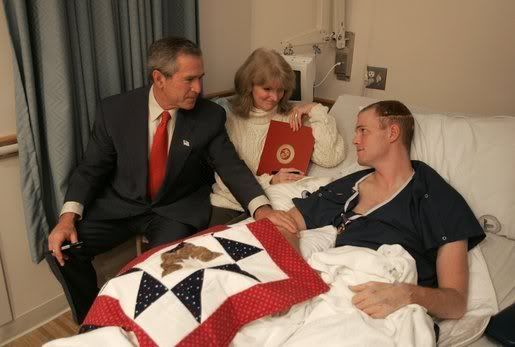
He's much better at this "diplomacy thing" than most folks!
Time magazine writer recognizes his excellent foreign record.
“George W. Bush: Diplomat” read the headline over the commentary by Massimo Calabresi in Time magazine. It was a recognition that far from being a madman who pissed off the world, President Bush has diplomatic accomplishments that go well beyond the Annapolis summit.
Let’s see, he got Libya to give up its WMD program, got North Korea to give up its nuke program, got NATO’s help in Afghanistan, and kept Pakistan and India on the same page in the war on terrorism.
The Iraq war has gone so well that two of the Axis of Weasels has elected two very pro-American leaders. The third member has split politically.
While is not diplomacy, it does show that far from turning the world against us — squandering the goodwill from 9/11 as Democrats spin it (wasting the pity is what they mean) — Bush has built relations with allies.
Overlooked by critics of Bush’s diplomatic record is that there is a fellow on the other side who also “failed” diplomatically. I remember that Reagan was blamed for the “failure” at Iceland while Gorbachev was praised for trying.
But what the press touts as success can be the opposite. Neville Chamberlain received grand reviews upon his return from Munich.
And Reagan’s “failure” was the correct course of action. Gorbachev wanted us to give up our technological edge in military weaponry.
Had we done that, the initials USSR would have contemporary meaning in this century.
Bush observed that and learned from it. His aggressiveness on the war on terrorism paid off for the next president, just as Reagan’s “failed diplomacy” with the Soviets allowed President Bush 41 to preside over the dissolution of that Evil Empire.
Of course there are world leaders who hate us: Hugo Chavez, Mahmoud Ahmadinjad, Kim Jong-Il and Fidel Castro (is he still around?) all hate us.
Good.
It is good to be the enemy of tyrants. That is what this nation is all about.
Unfortunately Calabresi of Time does not delve into these successes. His purpose is to show some split between the vice president and president.
This just in: An employee and his boss don’t agree on everything all the time. Film at 11.
Wrote Calabresi: “Cheney’s office denies any division between Bush and the Vice President over the new diplomacy. A senior Administration official acknowledges, however, that the President has increasingly overridden Cheney and offers a nuanced view of the relationship.”
The quibble is a reminder that you do not judge a presidency by the day-to-day news coverage. Contemporary news reports seldom provide more than a brief sketch. Far from being a bungling old fool who would accidentally trigger World War III, Ronald Reagan was the man who got to give the Soviet Union a final shove into the dustbin of history.
So it goes with Bush.
other news:
Will Smith: GWB has an "unevolved" perspective
Once again, President Bush proved himself right; Dems wrong
First Lady Laura Bush calls on Myanmar's regime to 'move aside'
White House celebrates Hanukkah; Remembers Daniel Pearl
check this out:
33% of us got it right
This article was written last month, but I love it so I'm gonna link it here! Here's an excerpt:
Gabor Steingart writing for Der Speigel captured what is happening in Washington — what the American press is not admitting. Bush was right. His critics were wrong.
The 33.6% who approve of his job performance (current RCP averages) got it right. The 60.6% opposed got it wrong.
Wrote Steingart: “He may be America’s most unpopular politician, but George W. Bush is no lame duck. As a wartime president, Bush dominates the political agenda. He is discreetly influencing his party’s choice of presidential candidate while committing his country to an aggressive foreign policy, the effects of which are likely to continue well beyond his term in office.”
It is called perseverance. It used to be considered an American virtue.
Steingart captured the American spirit at the end of this paragraph: “First, there has been noticeable improvement on the Iraqi war front. Unless the Pentagon statistics Bush recited on Friday in a speech to soldiers at Fort Jackson, South Carolina, are made up, the new Iraq strategy appears to be working. The number of weekly bombing attacks on US troops has dropped by half, and the number of US military deaths is the lowest in a year and a half. At the same time, US forces are arresting or killing more than 1,500 terrorist “thugs,” as Bush called them, each month. If the military successes continue, public opinion toward Bush and his Republicans could soon improve. Americans are not against war itself, they just don’t like losing.”
Exactly. Steingart gets it. Reid, Pelosi and Obama do not. They are guided by political expediency. History guides Bush.
In my column this week, I concluded, “As they shop for a presidential candidate, Republicans are looking for the next Reagan, a fellow who suffered a great dip in popularity early in his first term. I suggest they may be better off looking for the next George Walker Bush.”
The Iraq war is far from over. But if the next 12 months see a reduction in deaths the way the last 2 months have, then Americans will accept Iraq as a victory.
A college Republican shows some class!
"A lone College Republican stood in silent protest of Sean Penn's anti-americanism. There was no shouting, no rushing the stage, just one man and his sign. The people of the Dennis Kucinich campaign showed the world how tolerant they really are! The CR was pushed, shoved and shouted down. A police report has been filed and charges will be considered by the DA."
Gordon Brown is clueless.
Gordon Brown: War is Over
GORDON Brown yesterday delivered a stirring festive message to Our Boys in Iraq: “Happy Christmas – war is over.”
Is Gordon Brown clueless or what? Last I checked the war in Iraq ain't over yet and the road to victory remains dangerous and uncertain. In the article linked above, Gordon Brown claims that the situation in Basra City has greatly improved since the British pull-out... I seriously doubt that, but if that's the case, and if the war is truly over, then where is the declaration of victory? Or will there be none since Iranian-backed Shiite militias are now running the place?
Father Enlists to Honor Fallen Son
This is such a sweet story!
When First Lt. Nathan Krissoff of Reno, Nev., was killed in Iraq a year ago, his father, Bill, an orthopedic surgeon, searched for a way to honor his son's sacrifice. The 61-year-old decided to enlist in the Navy Medical Corps in the hope of being assigned to Iraq.
Krissoff is a taut, fit man who swims a mile every day. But a Navy medical recruiter told him that he was well past the enlistment age limit, and that getting an age waiver could take a year.
In August, the surgeon seized an opportunity when he and his wife, Christine, were invited to meet President Bush in Reno along with the families of other fallen soldiers from the area.
"He asked if there was anything he could do," Krissoff said. "I said, 'Well, there is one thing. I'd like to join the Navy Medical Corps. Is there any way you could help me with this process?' And Karl Rove was in the room and he asked me to fax my papers to him in the White House."
Within days, Krissoff received a call from Navy Medical recruiter Lt. Cmdr. Ken Hopkins, who said Krissoff had been granted an age waiver and had a stack of papers to sign to become a military doctor.
British, Israeli Intel are Skeptical of NIE Report
The CIA sucks, seriously. They just want to make my favoriteeee president look bad!! Pfft!
British spy chiefs have grave doubts that Iran has mothballed its nuclear weapons programme, as a US intelligence report claimed last week, and believe the CIA has been hoodwinked by Teheran…
British intelligence is concerned that US spy chiefs were so determined to avoid giving President Bush a reason to go to war - as their reports on Saddam Hussein’s weapons programmes did in Iraq - that they got it wrong this time.
A senior British official delivered a withering assessment of US intelligence-gathering abilities in the Middle East and revealed that British spies shared the concerns of Israeli defence chiefs that Iran was still pursuing nuclear weapons.
The source said British analysts believed that Iranian nuclear staff, knowing their phones were tapped, deliberately gave misinformation. “We are sceptical. We want to know what the basis of it is, where did it come from? Was it on the basis of the defector? Was it on the basis of the intercept material? They say things on the phone because they know we are up on the phones. They say black is white. They will say anything to throw us off.
Nancy Pelosi Approved of Waterboarding
Democrats are the worst flip-floppers in history. First the WMDs, now this.
In September 2002, four members of Congress met in secret for a first look at a unique CIA program designed to wring vital information from reticent terrorism suspects in U.S. custody. For more than an hour, the bipartisan group, which included current House Speaker Nancy Pelosi (D-Calif.), was given a virtual tour of the CIA's overseas detention sites and the harsh techniques interrogators had devised to try to make their prisoners talk.
Among the techniques described, said two officials present, was waterboarding, a practice that years later would be condemned as torture by Democrats and some Republicans on Capitol Hill. But on that day, no objections were raised. Instead, at least two lawmakers in the room asked the CIA to push harder, two U.S. officials said.
"The briefer was specifically asked if the methods were tough enough," said a U.S. official who witnessed the exchange.
Congressional leaders from both parties would later seize on waterboarding as a symbol of the worst excesses of the Bush administration's counterterrorism effort. The CIA last week admitted that videotape of an interrogation of one of the waterboarded detainees was destroyed in 2005 against the advice of Justice Department and White House officials, provoking allegations that its actions were illegal and the destruction was a coverup.
Yet long before "waterboarding" entered the public discourse, the CIA gave key legislative overseers about 30 private briefings, some of which included descriptions of that technique and other harsh interrogation methods, according to interviews with multiple U.S. officials with firsthand knowledge.
Am I the only one who thinks the CIA did the right thing by destroying those tapes? The CIA is whacky and they've been whacky for decades!! Besides, they were interrogating al-Qaeda terrorists- not cute fluffy bunnies or Disney princesses! And if thats the only way to keep ugly terrorists locked-up behind bars, then so be it. Gosh, am I being too b*tchy today??
GORDON Brown yesterday delivered a stirring festive message to Our Boys in Iraq: “Happy Christmas – war is over.”
Is Gordon Brown clueless or what? Last I checked the war in Iraq ain't over yet and the road to victory remains dangerous and uncertain. In the article linked above, Gordon Brown claims that the situation in Basra City has greatly improved since the British pull-out... I seriously doubt that, but if that's the case, and if the war is truly over, then where is the declaration of victory? Or will there be none since Iranian-backed Shiite militias are now running the place?
Father Enlists to Honor Fallen Son
This is such a sweet story!
When First Lt. Nathan Krissoff of Reno, Nev., was killed in Iraq a year ago, his father, Bill, an orthopedic surgeon, searched for a way to honor his son's sacrifice. The 61-year-old decided to enlist in the Navy Medical Corps in the hope of being assigned to Iraq.
Krissoff is a taut, fit man who swims a mile every day. But a Navy medical recruiter told him that he was well past the enlistment age limit, and that getting an age waiver could take a year.
In August, the surgeon seized an opportunity when he and his wife, Christine, were invited to meet President Bush in Reno along with the families of other fallen soldiers from the area.
"He asked if there was anything he could do," Krissoff said. "I said, 'Well, there is one thing. I'd like to join the Navy Medical Corps. Is there any way you could help me with this process?' And Karl Rove was in the room and he asked me to fax my papers to him in the White House."
Within days, Krissoff received a call from Navy Medical recruiter Lt. Cmdr. Ken Hopkins, who said Krissoff had been granted an age waiver and had a stack of papers to sign to become a military doctor.
British, Israeli Intel are Skeptical of NIE Report
The CIA sucks, seriously. They just want to make my favoriteeee president look bad!! Pfft!
British spy chiefs have grave doubts that Iran has mothballed its nuclear weapons programme, as a US intelligence report claimed last week, and believe the CIA has been hoodwinked by Teheran…
British intelligence is concerned that US spy chiefs were so determined to avoid giving President Bush a reason to go to war - as their reports on Saddam Hussein’s weapons programmes did in Iraq - that they got it wrong this time.
A senior British official delivered a withering assessment of US intelligence-gathering abilities in the Middle East and revealed that British spies shared the concerns of Israeli defence chiefs that Iran was still pursuing nuclear weapons.
The source said British analysts believed that Iranian nuclear staff, knowing their phones were tapped, deliberately gave misinformation. “We are sceptical. We want to know what the basis of it is, where did it come from? Was it on the basis of the defector? Was it on the basis of the intercept material? They say things on the phone because they know we are up on the phones. They say black is white. They will say anything to throw us off.
Nancy Pelosi Approved of Waterboarding
Democrats are the worst flip-floppers in history. First the WMDs, now this.
In September 2002, four members of Congress met in secret for a first look at a unique CIA program designed to wring vital information from reticent terrorism suspects in U.S. custody. For more than an hour, the bipartisan group, which included current House Speaker Nancy Pelosi (D-Calif.), was given a virtual tour of the CIA's overseas detention sites and the harsh techniques interrogators had devised to try to make their prisoners talk.
Among the techniques described, said two officials present, was waterboarding, a practice that years later would be condemned as torture by Democrats and some Republicans on Capitol Hill. But on that day, no objections were raised. Instead, at least two lawmakers in the room asked the CIA to push harder, two U.S. officials said.
"The briefer was specifically asked if the methods were tough enough," said a U.S. official who witnessed the exchange.
Congressional leaders from both parties would later seize on waterboarding as a symbol of the worst excesses of the Bush administration's counterterrorism effort. The CIA last week admitted that videotape of an interrogation of one of the waterboarded detainees was destroyed in 2005 against the advice of Justice Department and White House officials, provoking allegations that its actions were illegal and the destruction was a coverup.
Yet long before "waterboarding" entered the public discourse, the CIA gave key legislative overseers about 30 private briefings, some of which included descriptions of that technique and other harsh interrogation methods, according to interviews with multiple U.S. officials with firsthand knowledge.
Am I the only one who thinks the CIA did the right thing by destroying those tapes? The CIA is whacky and they've been whacky for decades!! Besides, they were interrogating al-Qaeda terrorists- not cute fluffy bunnies or Disney princesses! And if thats the only way to keep ugly terrorists locked-up behind bars, then so be it. Gosh, am I being too b*tchy today??
Thursday, December 6, 2007
Mass demonstrations and Katie Holmes.
Iraqis stage mass demonstrations against al-Qaeda
BAGHDAD (AP) - Villagers paraded empty coffins at mock funerals near Baghdad on Thursday, in protest of al-Qaida in Iraq attacks that killed as many as 45 people in a single village in recent months. Hundreds of residents and Muslim sheiks from Dwelah, a Shiite enclave about 45 miles north of Baghdad, held a huge procession in the Bawya area south of the capital because they feared reprisals if they did so in their hometown. Dust blew through crowded streets as men hoisted flag-draped coffins over their heads, chanting, “We remember the victims!” Another rally snaked through thoroughfares in Baghdad’s mixed Karradah neighborhood, where Dwelah residents and their Shiite brethren from the capital demanded more protection from the Iraqi government.
Katie Holmes is no longer human!
Everyone's favorite female Thetan has a new cut! She'd make a great addition to the Spice Girls if only she were a couple of decades older. After all, she and Vicky Beckham have a lot of things in common:
They married rich men
They indulge in high-fashion
They have near-identical bob cuts
They worship Xenu
They insist they have talent
God love 'em!
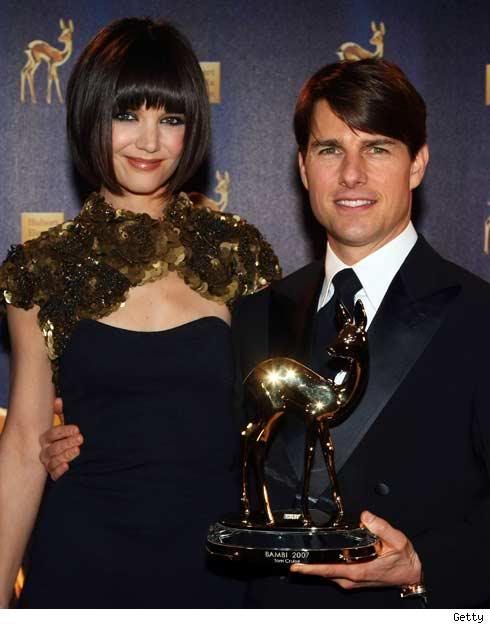
Poor girl. There is no life left in her eyes. She sold her soul to Tom Cruise!
BAGHDAD (AP) - Villagers paraded empty coffins at mock funerals near Baghdad on Thursday, in protest of al-Qaida in Iraq attacks that killed as many as 45 people in a single village in recent months. Hundreds of residents and Muslim sheiks from Dwelah, a Shiite enclave about 45 miles north of Baghdad, held a huge procession in the Bawya area south of the capital because they feared reprisals if they did so in their hometown. Dust blew through crowded streets as men hoisted flag-draped coffins over their heads, chanting, “We remember the victims!” Another rally snaked through thoroughfares in Baghdad’s mixed Karradah neighborhood, where Dwelah residents and their Shiite brethren from the capital demanded more protection from the Iraqi government.
Katie Holmes is no longer human!
Everyone's favorite female Thetan has a new cut! She'd make a great addition to the Spice Girls if only she were a couple of decades older. After all, she and Vicky Beckham have a lot of things in common:
They married rich men
They indulge in high-fashion
They have near-identical bob cuts
They worship Xenu
They insist they have talent
God love 'em!
Poor girl. There is no life left in her eyes. She sold her soul to Tom Cruise!
Tuesday, December 4, 2007
Still standing!
President Bush, down and all but counted out by friend and foe alike just three months ago, is rising like a bloodied but unbowed prizefighter, and Karl Rove predicts peril for Republicans and their presidential nominee if they shun the lame-duck president on the campaign trail.
The president had been pummeled ever since Democrats retook control of Congress in January, but he has pushed ahead with his second-term agenda on issues ranging from opposing federal funding of embryonic stem-cell research, pushing for peace in the Middle East and establishing security in Iraq. Some in his own party broke with him on the war, but as the "surge" takes hold and the president regains his footing — and with rising poll numbers, to boot — Mr. Bush looms large for Republican contenders next November.
"Nobody can risk looking disrespectful to the president without paying a price, and they need to understand that," said Mr. Rove, Mr. Bush's former top political adviser.
Source: Washington Times
The president had been pummeled ever since Democrats retook control of Congress in January, but he has pushed ahead with his second-term agenda on issues ranging from opposing federal funding of embryonic stem-cell research, pushing for peace in the Middle East and establishing security in Iraq. Some in his own party broke with him on the war, but as the "surge" takes hold and the president regains his footing — and with rising poll numbers, to boot — Mr. Bush looms large for Republican contenders next November.
"Nobody can risk looking disrespectful to the president without paying a price, and they need to understand that," said Mr. Rove, Mr. Bush's former top political adviser.
Source: Washington Times
Subscribe to:
Posts (Atom)
