

Top al-Qaida figure killed in Pakistan
By ROBERT H. REID and PAMELA HESS, Associated Press Writers
SLAMABAD, Pakistan - A missile from a U.S. Predator drone struck a suspected terrorist safehouse in Pakistan and killed a top al-Qaida commander believed responsible for a brazen bomb attack during a visit last year by Vice President Dick Cheney to Afghanistan, a U.S. official said Thursday.
The strike that killed Abu Laith al-Libi was conducted Monday night or early Tuesday against a facility in Pakistan's north Waziristan region, the lawless tribal area bordering Afghanistan, the official said on condition of anonymity because he is not authorized to discuss the strike publicly.
The killing of such a major al-Qaida figure is likely to embarrass Pakistan President Pervez Musharraf, who has repeatedly said he would not sanction U.S. military action against al-Qaida members believed to be regrouping in the wild borderlands near Afghanistan.
An estimated 12 people were killed in the strike, including Arabs, Turkmen from central Asia and local Taliban members, according to an intelligence official in the area who spoke on condition of anonymity. He said the bodies of those killed were badly mangled by the force of the explosion and it was difficult to identify them.
The Predator is an unmanned reconnaissance aircraft that has been armed by both Air Force and CIA with Hellfire anti-tank missiles. Even though all signs point to the CIA, agency officials would not confirm their aircraft were involved in the strike.
U.S.-led coalition and NATO-led force in Afghanistan could not confirm al-Libi's death.
The U.S. military is currently now allowed to carry out attacks in Pakistan. A senior U.S. official said last week that the top two U.S. intelligence officials made a secret visit to Pakistan in early January to seek permission from Musharraf for greater involvement of American forces in trying to ferret out al-Qaida and other militant groups active in the tribal regions along the Afghanistan border, a senior U.S. official said.
That official, speaking on condition of anonymity given the secret nature of the talks, declined to disclose what was said, but Musharraf was quoted two days after the Jan. 9 meeting with CIA Director Michael Hayden and Mike McConnell, director of national intelligence, as saying U.S. troops would be regarded as invaders if they crossed into Pakistan to hunt al-Qaida militants.
The CIA first used the remotely piloted craft as a strike plane in November 2002 against six alleged al-Qaida members traveling in a vehicle in Yemen.
In January 2006, Ayman Al-Zawahri, al-Qaida's second-in-command, was the target of a missiles allegedly fired from a CIA Predator drone near Pakistan's border with Afghanistan. The terror leader was not at the site, but officials said four key al-Qaida operatives were killed.
The U.S. says al-Libi — whose name means "the Libyan" in Arabic — was likely behind the February 2007 bombing at the U.S. base at Bagram in Afghanistan during a visit by Cheney. The attack killed 23 people but Cheney was deep inside the sprawling base and was not hurt.
The bombing added to the impression that Western forces and the shaky government of Afghan President Hamid Karzai are vulnerable to assault by Taliban and al-Qaida militants.
Terrorism experts said al-Libi's death was a significant setback for al-Qaida because of his extensive ties to the Taliban, but they said the terror network would likely regroup and replace him.
"Al-Libi has been waging jihad for more than 10 years and it will be a blow to both al-Qaida and the Taliban, but not in a way that will lead to the downfall of those organizations," said Eric Rosenbach, terror expert and executive director of the Center for International Affairs at Harvard's Kennedy School.
Pakistani officials denied any knowledge of al-Libi's death. A Web site that frequently carries announcements from militant groups said al-Libi had been "martyred with a group of his brothers in the land of Muslim Pakistan" but gave no further details.
Residents near the Pakistani town of Mir Ali in North Waziristan said they could hear U.S. Predator drones flying in the area shortly before the explosion, which destroyed the compound.
The Pakistani newspaper Dawn said the victims were buried in a local cemetery.
Rumors spread Thursday in the border area that al-Libi or his deputy died in the missile strike. But Pakistan's Interior Ministry spokesman, Javed Iqbal Cheema, insisted authorities had "no information" indicating al-Libi was dead.
Defense Secretary Robert Gates said he did not "have anything definitive" to say on reports of al-Libi's death.
The Libyan-born al-Libi was among the most high-profile figures in al-Qaida after its leader Osama bin Laden and his deputy al-Zawahri.
Al-Libi also led an al-Qaida training camp and appeared in a number of al-Qaida Internet videos.
In spring 2007, al-Qaida's media wing, Al-Sahab, released a video interview with a bearded man identified as al-Libi. In it, he accuses Shiite Muslims of fighting alongside American forces in Iraq, and claimed that mujahedeen would crush foreign troops in Afghanistan.
Al-Libi also led an al-Qaida training camp and appeared in a number of al-Qaida Internet videos.
He was known to maintain close ties with tribes living on the Pakistani side of the mountainous border, where U.S. officials believe al-Qaida has been regrouping.
"Al-Libi's death is a significant blow to al-Qaida the organization because he is one of the few people left in the organization who has a historical track record," said Farhana Ali, terror expert at the RAND corporation.
But, she added, "al-Qaida's strength is that it knows how to secure membership and recruitment, and because the movement will continue, al-Libi will be replaced."
A Pakistani intelligence official said that al-Libi was based near Mir Ali until late 2003 when he moved back into Afghanistan to take charge of al-Qaida operations on both sides of the border area. But he retained links with North Waziristan, the official said on condition of anonymity because of the sensitivity of the information.
Mir Ali is the second-biggest town in North Waziristan and has a strong presence of foreign militants, mostly Uzbeks with links to al-Qaida who fled to Pakistan's tribal regions after the fall of the Taliban regime in Afghanistan in 2001.
The 2006 Predator attack that failed to hit al-Zawahri drew criticism from Pakistan which said that the 17 killed were people from in the village of Damadola in the Bajur tribal area, about four miles inside Pakistan.
Pakistani security officials said the four top operatives were believed killed in the strike. They included Midhat Mursi al-Sayid Umar, who the U.S. Justice Department called an explosives and poisons expert; Abu Obaidah al-Masri, the al-Qaida chief responsible for attacks on U.S. forces in eastern Afghanistan; and Abdul Rehman al-Maghribi, a Moroccan and relative of al-Zawahri, possibly his son-in-law. Some of the officials also said a fourth man, Khalid Habib, the al-Qaida operations chief along the Afghan-Pakistan border, was believed to be dead.
Rosenbach said militants who rise to No. 3 al-Qaida positions, like al-Libi, are often in charge of planning operations, exposing them to capture or death. Others he named included Mohammed Atef, who was killed, and Abu Faraj al-Libbi, who was captured.
"It has to be one of the most dangerous jobs on earth. They generally don't last longer than a year — mostly because the al-Qaida chief of operations has a large 'signature' resulting from planning operations," he said. "Our intelligence has done an excellent job in tracking them down."
Thursday, January 31, 2008

Wednesday, January 30, 2008
Anti-Bush jerks are feelin' the heat!
BRATTLEBORO, Vt. - A town petition making President Bush and Vice President Dick Cheney subject to arrest for crimes against the Constitution has triggered a barrage of criticism from people who say residents are "wackjobs" and "nuts."
In e-mail messages, voicemail messages and telephone calls, outraged people are calling the measure the equivalent of treason and vowing never to visit Vermont.
"Has everyone up there been out in the cold too long?" said one.
"I would like to know how I could get some water from your town," said another. "It's obvious that there is something special in it."
The petition — with more than 436 signatures, or at least the 5 percent of voters necessary to be considered — was submitted Thursday and the town Select Board voted 3-2 Friday to put it on the ballot. It goes to a town-wide vote March 4.
It reads: "Shall the Selectboard instruct the Town Attorney to draft indictments against President Bush and Vice President Cheney for crimes against our Constitution, and publish said indictments for consideration by other authorities and shall it be the law of the Town of Brattleboro that the Brattleboro Police, pursuant to the above-mentioned indictments, arrest and detain George Bush and Richard Cheney in Brattleboro if they are not duly impeached, and prosecute or extradite them to other authorities that may reasonably contend to prosecute them?"
News of the measure made the rounds on the Internet, and soon people started calling and writing. The Brattleboro Area Chamber of Commerce got about 60 e-mails Monday, all of them negative, said Executive Director Jerry Goldberg.
A day later, he said, "we had three or four calls in a row that were very positive. One even volunteered to help."
The petition has no legal standing, since the town attorney has no authority to write an indictment and the police have no authority to arrest Bush or Cheney if either visits Brattleboro.
Anger at the Bush administration is hardly new in Vermont. The state Senate voted last year to support impeaching the president. Anti-war rallies are regular occurrences, and "Impeach Bush" bumper stickers are common.
The petition prompted Brent Caflisch to go to his computer in Rosemount, Minn. "Maybe the terrorists will do us all a favor and attack your town next, our country would be much safer with several thousand dead wackjobs in Vermont," he wrote.
It went on to say terrorists could kidnap the three Select Board members who voted in favor, "cut their heads off, video tape it and put it on the internet."
Caflisch, who confirmed sending the e-mail, said Tuesday he did it out of disgust after reading about the measure on The Drudge Report.
A few messages were positive ("Arrest Bush and Cheney? You go, Brattleboro!" wrote one man) but most were critical.
"Be American, not a sniffeling liberal town that sleeps under the shield of safety provided to you by your President," said another e-mail. "Vacation to VT CANCELLED!"
The reaction caught town officials off guard, and left some workers on edge.
"We have some concerns about safety," said Town Clerk Annette Cappy. "After reading some of these e-mails, you can't help it."
Acting Police Chief Eugene Wrinn said any threats would be taken seriously and possibly prosecuted. So far, no threats have been made, he said.
"If someone is concerned for their safety, if there's a threat of harm, we will look at that seriously," he said.
Resident Kurt Daims, who submitted the petition, said late Tuesday he was chagrined that the town and its employees were subject to ridicule.
"I feel bad for people who are loyal to Bush who have lost a son or had one in the service and it's hard for them to admit the utter waste of it, and that it was caused by this man in the White House," he said.
F*ck 'em!
In e-mail messages, voicemail messages and telephone calls, outraged people are calling the measure the equivalent of treason and vowing never to visit Vermont.
"Has everyone up there been out in the cold too long?" said one.
"I would like to know how I could get some water from your town," said another. "It's obvious that there is something special in it."
The petition — with more than 436 signatures, or at least the 5 percent of voters necessary to be considered — was submitted Thursday and the town Select Board voted 3-2 Friday to put it on the ballot. It goes to a town-wide vote March 4.
It reads: "Shall the Selectboard instruct the Town Attorney to draft indictments against President Bush and Vice President Cheney for crimes against our Constitution, and publish said indictments for consideration by other authorities and shall it be the law of the Town of Brattleboro that the Brattleboro Police, pursuant to the above-mentioned indictments, arrest and detain George Bush and Richard Cheney in Brattleboro if they are not duly impeached, and prosecute or extradite them to other authorities that may reasonably contend to prosecute them?"
News of the measure made the rounds on the Internet, and soon people started calling and writing. The Brattleboro Area Chamber of Commerce got about 60 e-mails Monday, all of them negative, said Executive Director Jerry Goldberg.
A day later, he said, "we had three or four calls in a row that were very positive. One even volunteered to help."
The petition has no legal standing, since the town attorney has no authority to write an indictment and the police have no authority to arrest Bush or Cheney if either visits Brattleboro.
Anger at the Bush administration is hardly new in Vermont. The state Senate voted last year to support impeaching the president. Anti-war rallies are regular occurrences, and "Impeach Bush" bumper stickers are common.
The petition prompted Brent Caflisch to go to his computer in Rosemount, Minn. "Maybe the terrorists will do us all a favor and attack your town next, our country would be much safer with several thousand dead wackjobs in Vermont," he wrote.
It went on to say terrorists could kidnap the three Select Board members who voted in favor, "cut their heads off, video tape it and put it on the internet."
Caflisch, who confirmed sending the e-mail, said Tuesday he did it out of disgust after reading about the measure on The Drudge Report.
A few messages were positive ("Arrest Bush and Cheney? You go, Brattleboro!" wrote one man) but most were critical.
"Be American, not a sniffeling liberal town that sleeps under the shield of safety provided to you by your President," said another e-mail. "Vacation to VT CANCELLED!"
The reaction caught town officials off guard, and left some workers on edge.
"We have some concerns about safety," said Town Clerk Annette Cappy. "After reading some of these e-mails, you can't help it."
Acting Police Chief Eugene Wrinn said any threats would be taken seriously and possibly prosecuted. So far, no threats have been made, he said.
"If someone is concerned for their safety, if there's a threat of harm, we will look at that seriously," he said.
Resident Kurt Daims, who submitted the petition, said late Tuesday he was chagrined that the town and its employees were subject to ridicule.
"I feel bad for people who are loyal to Bush who have lost a son or had one in the service and it's hard for them to admit the utter waste of it, and that it was caused by this man in the White House," he said.
F*ck 'em!
Sunday, January 27, 2008
Hero.
Wounded Marine Invited To State Of The Union
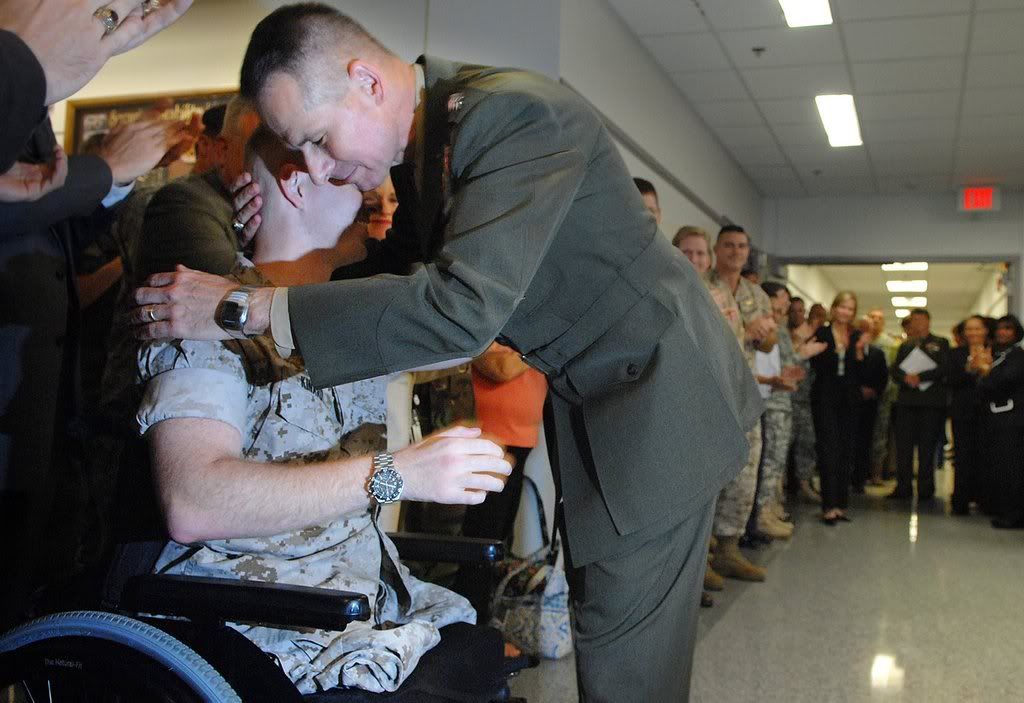
SPARTANBURG, S.C. — A year ago, Andrew Kinard was just getting back to speaking and eating solid foods. On Monday, the Marine first lieutenant will be in the Capitol listening to President Bush give his last State of the Union in a seat of honor.
Upstate prosecutor Trey Gowdy says he is trying to talk Kinard into going to law school and becoming a federal prosecutor or maybe a politician down the road. “Andrew is, frankly, limitless politically,” Gowdy said. “He could serve in the highest offices of this country.”
Gowdy said Kinard’s injury has not damaged his character.
“The first time I met him, I knew there was something different about him,” Gowdy said. “He’s compassionate. He’s kindhearted. He’s mature. All of that existed before his injury. And now, he’s all those things with a story that’s as compelling as any you will ever hear.”
Kinard says law school is just one option for his life after the Marines, but for now, he is focused on his new knee and “what’s after Walter Reed and the hospital experience.”
“I’m very excited about exploring new opportunities,” he said.
As for his invitation to the State of the Union speech, Kinard won’t say where he will be sitting. His parents will attend a reception in Washington before the speech.
“It’s a once-in-a-lifetime opportunity,” father, Harry Kinard, said. “ ‘Don’t expect to get another invitation,’ I told Andrew. Not unless he becomes president someday.”
“What a difference a year makes,” said his father, Dr. Harry Kinard, a Spartanburg urologist. “A year ago, Andrew was having a tough time. It’s amazing how far he’s come.”
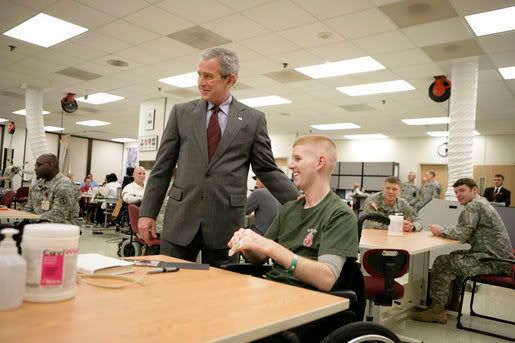
The 25-year-old Marine was injured in a bomb blast in October 2006. Today, he is continuing his occupational and physical therapy at Walter Reed Army Medical Center.
He can walk short distances with the assistance of canes and has a new state-of-the-art knee joint. He can drive and works part time at the Pentagon.
His father describes the job as a “nonpaying internship” at the Office of the General Counsel, but for Andrew Kinard, who is still on active duty, it’s everything.
“Doing any sort of work sort of restores my sense of purpose,” he said in a recent telephone interview with the (Spartanburg) Herald-Journal. “Being at the hospital for a very long period of time, you can sort of lose traction.
“Having a job again, having something where I’m on a schedule and being held accountable for my performance, that’s great because it allows me to get back into the mode of having a job.”
(From PatDollard.Com)
SPARTANBURG, S.C. — A year ago, Andrew Kinard was just getting back to speaking and eating solid foods. On Monday, the Marine first lieutenant will be in the Capitol listening to President Bush give his last State of the Union in a seat of honor.
Upstate prosecutor Trey Gowdy says he is trying to talk Kinard into going to law school and becoming a federal prosecutor or maybe a politician down the road. “Andrew is, frankly, limitless politically,” Gowdy said. “He could serve in the highest offices of this country.”
Gowdy said Kinard’s injury has not damaged his character.
“The first time I met him, I knew there was something different about him,” Gowdy said. “He’s compassionate. He’s kindhearted. He’s mature. All of that existed before his injury. And now, he’s all those things with a story that’s as compelling as any you will ever hear.”
Kinard says law school is just one option for his life after the Marines, but for now, he is focused on his new knee and “what’s after Walter Reed and the hospital experience.”
“I’m very excited about exploring new opportunities,” he said.
As for his invitation to the State of the Union speech, Kinard won’t say where he will be sitting. His parents will attend a reception in Washington before the speech.
“It’s a once-in-a-lifetime opportunity,” father, Harry Kinard, said. “ ‘Don’t expect to get another invitation,’ I told Andrew. Not unless he becomes president someday.”
“What a difference a year makes,” said his father, Dr. Harry Kinard, a Spartanburg urologist. “A year ago, Andrew was having a tough time. It’s amazing how far he’s come.”
The 25-year-old Marine was injured in a bomb blast in October 2006. Today, he is continuing his occupational and physical therapy at Walter Reed Army Medical Center.
He can walk short distances with the assistance of canes and has a new state-of-the-art knee joint. He can drive and works part time at the Pentagon.
His father describes the job as a “nonpaying internship” at the Office of the General Counsel, but for Andrew Kinard, who is still on active duty, it’s everything.
“Doing any sort of work sort of restores my sense of purpose,” he said in a recent telephone interview with the (Spartanburg) Herald-Journal. “Being at the hospital for a very long period of time, you can sort of lose traction.
“Having a job again, having something where I’m on a schedule and being held accountable for my performance, that’s great because it allows me to get back into the mode of having a job.”
(From PatDollard.Com)


Thursday, January 24, 2008
Blackwater to the rescueee!
Blackwater credited with saving 180 American lives
Blackwaterfacts.com
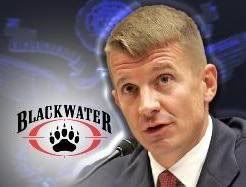
Erik Prince, CEO of Blackwater Worldwide
Readers of this blog know about how Blackwater Worldwide recently rescued three young American women from deadly mob violence in Kenya. The three are only a fraction of Americans whose lives Blackwater is credited with saving.
Over the past six years, Blackwater personnel have saved the lives of more than 180 Americans around the world.
In Iraq from 2004-2007, Blackwater rescued or medically treated and evacuated more than 40 U.S. soldiers, Marines and U.S. Government officials. Virtually all instances were humanitarian responses to calls for volunteers. The incidents involved fires, post-missile and mortar attack response, suicide bombing involving mass casualties, and day and night rescues of stranded or trapped Americans.
On the U.S. Gulf Coast in the immediate aftermath of hurricane Katrina, Blackwater volunteers rescued over 50 Americans trapped on rooftops. Blackwater also conducted emergency medical evacuations for 175 Americans in the first week of the 2005 disaster.
In Africa in 2006, Blackwater medical personnel saved an American in Chad by administering emergency life saving surgery and medical evacuation Burkina Faso. They also conducted a rescue of three American missionaries and seven aid workers in Kenya in January 2008.
In Afghanistan 2007 Blackwater personnel rescued three Americans from a bombed and burning hotel. In January 2008 Blackwater again rescued one American from a hotel bombed by the Taliban.
In over 90 percent of these cases, Blackwater was not paid a dime to act. The company and its people did so out of a professional drive to help Americans in danger whenever possible.
Blackwaterfacts.com
Erik Prince, CEO of Blackwater Worldwide
Readers of this blog know about how Blackwater Worldwide recently rescued three young American women from deadly mob violence in Kenya. The three are only a fraction of Americans whose lives Blackwater is credited with saving.
Over the past six years, Blackwater personnel have saved the lives of more than 180 Americans around the world.
In Iraq from 2004-2007, Blackwater rescued or medically treated and evacuated more than 40 U.S. soldiers, Marines and U.S. Government officials. Virtually all instances were humanitarian responses to calls for volunteers. The incidents involved fires, post-missile and mortar attack response, suicide bombing involving mass casualties, and day and night rescues of stranded or trapped Americans.
On the U.S. Gulf Coast in the immediate aftermath of hurricane Katrina, Blackwater volunteers rescued over 50 Americans trapped on rooftops. Blackwater also conducted emergency medical evacuations for 175 Americans in the first week of the 2005 disaster.
In Africa in 2006, Blackwater medical personnel saved an American in Chad by administering emergency life saving surgery and medical evacuation Burkina Faso. They also conducted a rescue of three American missionaries and seven aid workers in Kenya in January 2008.
In Afghanistan 2007 Blackwater personnel rescued three Americans from a bombed and burning hotel. In January 2008 Blackwater again rescued one American from a hotel bombed by the Taliban.
In over 90 percent of these cases, Blackwater was not paid a dime to act. The company and its people did so out of a professional drive to help Americans in danger whenever possible.
"The best of spiritual America, the spirit of America is in Iraq..."
Obsession with reality makes film different
Result is 'a pulsating pictorial of the effects of terror'
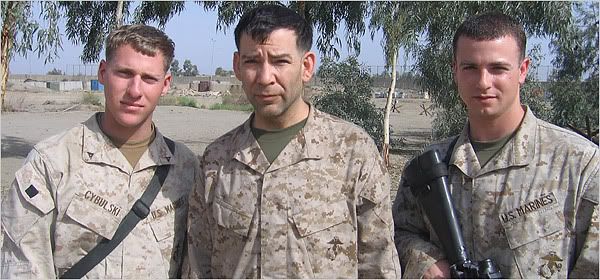
This spring, Pat Dollard's Young Americans will air on cable television, the result of years of work. But there's a good reason for the time it has taken: Pat Dollard is a man obsessed with reality, his reality of the war he experienced while embedded with the 3rd battalion 7th Marines in Ramadi.
Mixing that desire with Hollywood never is simple, either. Getting attention for movie projects often is a large part of the goal, with much of a project's budget going to advertising. Just that attention can make a film a blockbuster or package it for the discounted DVDs. Publicity is everything in Hollywood, and that's what makes the films about the war in Iraq so different.
Despite a lot of attention, films like Redacted have been shunned by mass audiences and panned by critics who actually wanted to like the film or agree with the message.
"I am glad the movie was made, and I wish it were better," said a New York Times film critic in an attempt to be as flattering as possible to much celebrated director Brian De Palma.
his spring, Pat Dollard's Young Americans will air on cable television, the result of years of work. But there's a good reason for the time it has taken: Pat Dollard is a man obsessed with reality, his reality of the war he experienced while embedded with the 3rd battalion 7th Marines in Ramadi.
Mixing that desire with Hollywood never is simple, either. Getting attention for movie projects often is a large part of the goal, with much of a project's budget going to advertising. Just that attention can make a film a blockbuster or package it for the discounted DVDs. Publicity is everything in Hollywood, and that's what makes the films about the war in Iraq so different.
Despite a lot of attention, films like Redacted have been shunned by mass audiences and panned by critics who actually wanted to like the film or agree with the message.
"I am glad the movie was made, and I wish it were better," said a New York Times film critic in an attempt to be as flattering as possible to much celebrated director Brian De Palma.
The first five minutes were exhilarating and frightening. I found myself nodding my head and anticipating what was going to happen, because I had been there before.
Dollard himself makes no pretense of objectivity, his website sells "Jihad Killer" shirts and during Young Americans the audience will hear Dollard's voice give on-the-spot editorials.
"You see, you liberals, this is what you're supporting!"
...
Over half a year and 600 hours of footage in the formerly most dangerous place on earth has had a spill-over effect into how Dollard perceives the world today.
"The best of spiritual America, the spirit of America is in Iraq," is how he describes it. Being spared when so many around him died has had a profound effect on this documentarian. "I'm a God man myself."
A part of this literal cultural warrior still is in Ramadi. "I feel contempt for the average civilian," Dollard says. "I can't stand that I live in a culture, especially in Hollywood, where measure of man is self-indulgence."
Young Americans debuts this spring on Showtime. You have been warned.
Result is 'a pulsating pictorial of the effects of terror'
This spring, Pat Dollard's Young Americans will air on cable television, the result of years of work. But there's a good reason for the time it has taken: Pat Dollard is a man obsessed with reality, his reality of the war he experienced while embedded with the 3rd battalion 7th Marines in Ramadi.
Mixing that desire with Hollywood never is simple, either. Getting attention for movie projects often is a large part of the goal, with much of a project's budget going to advertising. Just that attention can make a film a blockbuster or package it for the discounted DVDs. Publicity is everything in Hollywood, and that's what makes the films about the war in Iraq so different.
Despite a lot of attention, films like Redacted have been shunned by mass audiences and panned by critics who actually wanted to like the film or agree with the message.
"I am glad the movie was made, and I wish it were better," said a New York Times film critic in an attempt to be as flattering as possible to much celebrated director Brian De Palma.
his spring, Pat Dollard's Young Americans will air on cable television, the result of years of work. But there's a good reason for the time it has taken: Pat Dollard is a man obsessed with reality, his reality of the war he experienced while embedded with the 3rd battalion 7th Marines in Ramadi.
Mixing that desire with Hollywood never is simple, either. Getting attention for movie projects often is a large part of the goal, with much of a project's budget going to advertising. Just that attention can make a film a blockbuster or package it for the discounted DVDs. Publicity is everything in Hollywood, and that's what makes the films about the war in Iraq so different.
Despite a lot of attention, films like Redacted have been shunned by mass audiences and panned by critics who actually wanted to like the film or agree with the message.
"I am glad the movie was made, and I wish it were better," said a New York Times film critic in an attempt to be as flattering as possible to much celebrated director Brian De Palma.
The first five minutes were exhilarating and frightening. I found myself nodding my head and anticipating what was going to happen, because I had been there before.
Dollard himself makes no pretense of objectivity, his website sells "Jihad Killer" shirts and during Young Americans the audience will hear Dollard's voice give on-the-spot editorials.
"You see, you liberals, this is what you're supporting!"
...
Over half a year and 600 hours of footage in the formerly most dangerous place on earth has had a spill-over effect into how Dollard perceives the world today.
"The best of spiritual America, the spirit of America is in Iraq," is how he describes it. Being spared when so many around him died has had a profound effect on this documentarian. "I'm a God man myself."
A part of this literal cultural warrior still is in Ramadi. "I feel contempt for the average civilian," Dollard says. "I can't stand that I live in a culture, especially in Hollywood, where measure of man is self-indulgence."
Young Americans debuts this spring on Showtime. You have been warned.
Wednesday, January 23, 2008
Tuesday, January 22, 2008
Bomb bomb bomb Iran!
Stopping Iran: Why the Case for Military Action Still Stands
Norman Podhoretz
Up until a fairly short time ago, scarcely anyone dissented from the assessment offered with “high confidence” by the National Intelligence Estimate [NIE] of 2005 that Iran was “determined to develop nuclear weapons.” Correlatively, no one believed the protestations of the mullahs ruling Iran that their nuclear program was designed strictly for peaceful uses.
The reason for this near-universal consensus was that Iran, with its vast reserves of oil and natural gas, had no need for nuclear energy, and that in any case, the very nature of its program contradicted the protestations.
Here is how Time magazine put it as early as March 2003—long before, be it noted, the radical Mahmoud Ahmadinejad had replaced the putatively moderate Mohamed Khatami as president:
On a visit last month to Tehran, International Atomic Energy Agency [IAEA] director Mohamed ElBaradei announced he had discovered that Iran was constructing a facility to enrich uranium—a key component of advanced nuclear weapons—near Natanz. But diplomatic sources tell Time the plant is much further along than previously revealed. The sources say work on the plant is “extremely advanced” and involves “hundreds” of gas centrifuges ready to produce enriched uranium and “the parts for a thousand others ready to be assembled.”
So, too, the Federation of American Scientists about a year later:
It is generally believed that Iran’s efforts are focused on uranium enrichment, though there are some indications of work on a parallel plutonium effort. Iran claims it is trying to establish a complete nuclear-fuel cycle to support a civilian energy program, but this same fuel cycle would be applicable to a nuclear-weapons development program. Iran appears to have spread their nuclear activities around a number of sites to reduce the risk of detection or attack.
And just as everyone agreed with the American intelligence community that Iran was “determined to develop nuclear weapons,” everyone also agreed with President George W. Bush that it must not be permitted to succeed. Here, the reasons were many and various...
[More?]
Footnotes:
1 Among the principal authors of the new NIE, an editorial in the Wall Street Journal reported, were “three former State Department officials with previous reputations as ‘hyper-partisan anti-Bush officials,’ according to an intelligence source.” Even without knowing this, a careful reader of the new NIE summary could easily tell that it had been written by opponents of the military option who, moreover, were not so sure that Iran was all that dangerous.
2 It is worth noting that a number of Israeli experts—including Ephraim Halevy, the former (and very dovish) director of the Mossad—were convinced that the halt had lasted only about two years, that the program had been resumed, probably in 2005, and that it was still up and running.
3 That negotiation was merely a tactic used by Iran to buy time was not idle speculation. As we learn from Richelson: “Iranian nuclear negotiator Hassan Rouhani told his nation’s Supreme Cultural Revolution Council in September 2005 that Iran, in dealing with the IAEA, had agreed to suspend activities only in areas where it was not experiencing technical problems, and that the Isfahan uranium-conversion facility was completed while negotiating with the [European Union]. Rouhan informed the council that ‘while we were talking with the Europeans in Tehran, we were installing equipment in parts of the facility. . . . [B]y creating a calm environment, we were able to complete the work.’”
4 A typically conspiratorial version of this view, circulating through the Middle East, holds that Bush actually arranged for the new NIE, as a cover for capitulating to Iran. Evidently acting on this interpretation, the Sunni regimes (including Saudi Arabia and Egypt) that were expected by Condoleezza Rice to form a coalition against Shiite Iran once the U.S. got the “peace process” going between Israel and the Palestinians (hence the meeting she arranged at Annapolis) have instead been scrambling in various ways to come to terms with Tehran. As Gerald Steinberg of the Jerusalem Center for Public Affairs pointed out: “Within two weeks following publication of the NIE report, . . . Egypt moved to improve relations with Iran.” What was even more extraordinary, “Saudi Arabia welcomed Iranian President Ahmadinejad to Mecca.” The effects of the NIE were also manifest in China, which “signed a major contract on energy development and supply with Iran,” as well as in Russia, which, after stalling on a long-promised delivery, “quickly dispatched two shipments of nuclear fuel for the Bushehr nuclear reactor.”
Norman Podhoretz
Up until a fairly short time ago, scarcely anyone dissented from the assessment offered with “high confidence” by the National Intelligence Estimate [NIE] of 2005 that Iran was “determined to develop nuclear weapons.” Correlatively, no one believed the protestations of the mullahs ruling Iran that their nuclear program was designed strictly for peaceful uses.
The reason for this near-universal consensus was that Iran, with its vast reserves of oil and natural gas, had no need for nuclear energy, and that in any case, the very nature of its program contradicted the protestations.
Here is how Time magazine put it as early as March 2003—long before, be it noted, the radical Mahmoud Ahmadinejad had replaced the putatively moderate Mohamed Khatami as president:
So, too, the Federation of American Scientists about a year later:
And just as everyone agreed with the American intelligence community that Iran was “determined to develop nuclear weapons,” everyone also agreed with President George W. Bush that it must not be permitted to succeed. Here, the reasons were many and various...
[More?]
Footnotes:
1 Among the principal authors of the new NIE, an editorial in the Wall Street Journal reported, were “three former State Department officials with previous reputations as ‘hyper-partisan anti-Bush officials,’ according to an intelligence source.” Even without knowing this, a careful reader of the new NIE summary could easily tell that it had been written by opponents of the military option who, moreover, were not so sure that Iran was all that dangerous.
2 It is worth noting that a number of Israeli experts—including Ephraim Halevy, the former (and very dovish) director of the Mossad—were convinced that the halt had lasted only about two years, that the program had been resumed, probably in 2005, and that it was still up and running.
3 That negotiation was merely a tactic used by Iran to buy time was not idle speculation. As we learn from Richelson: “Iranian nuclear negotiator Hassan Rouhani told his nation’s Supreme Cultural Revolution Council in September 2005 that Iran, in dealing with the IAEA, had agreed to suspend activities only in areas where it was not experiencing technical problems, and that the Isfahan uranium-conversion facility was completed while negotiating with the [European Union]. Rouhan informed the council that ‘while we were talking with the Europeans in Tehran, we were installing equipment in parts of the facility. . . . [B]y creating a calm environment, we were able to complete the work.’”
4 A typically conspiratorial version of this view, circulating through the Middle East, holds that Bush actually arranged for the new NIE, as a cover for capitulating to Iran. Evidently acting on this interpretation, the Sunni regimes (including Saudi Arabia and Egypt) that were expected by Condoleezza Rice to form a coalition against Shiite Iran once the U.S. got the “peace process” going between Israel and the Palestinians (hence the meeting she arranged at Annapolis) have instead been scrambling in various ways to come to terms with Tehran. As Gerald Steinberg of the Jerusalem Center for Public Affairs pointed out: “Within two weeks following publication of the NIE report, . . . Egypt moved to improve relations with Iran.” What was even more extraordinary, “Saudi Arabia welcomed Iranian President Ahmadinejad to Mecca.” The effects of the NIE were also manifest in China, which “signed a major contract on energy development and supply with Iran,” as well as in Russia, which, after stalling on a long-promised delivery, “quickly dispatched two shipments of nuclear fuel for the Bushehr nuclear reactor.”
Bomb factory at Columbia professor's home.
From MichelleMalkin.Com:
Mystery in Brooklyn: Bomb factory at Columbia University professor’s home
Police stumbled upon a bomb-making factory Sunday in the home of a Columbia professor who specializes in the spread of infectious disease - and are investigating whether he and his roommate have terror ties.
Cops evacuated the Brooklyn Heights neighborhood around the Remsen St. home of Michael Clatts, a medical anthropologist, after finding seven pipe bombs fitted with fuses in his flat, police sources said.
The frightening cache was discovered almost by accident - Ivaylo Ivanov, the man living with Clatts, accidentally shot off the tip of his left index finger and sought police help in the street about 1:15 a.m.
When investigators went to the 37-year-old Ivanov’s apartment, they found the bombs, already capped on both ends and filled with powder. One of the pipe bombs was inserted into a Nerf football, cops said.
A 9-mm. handgun, two ammunition magazines, a 12-gauge shotgun, silencers, a bulletproof vest, a crossbow and bomb-making equipment, including a drill and threading machine that could be used to make pipe bombs, were also recovered, cops said.
Clatts cannot be located. Who is he?
Clatts is a medical anthropologist with a specialty in epidemiol.ogy - the spread of disease among large populations.
He is an associate professor in Columbia University’s Mailman School of Public Health and holds a Ph.D. from the Ivy League school.
The senior director of communication for the school, Randee Levine, said she cannot comment on a police investigation.
Clatts’ exact relationship with Ivanov is unknown. Building residents said Clatts once described himself and Ivanov as roommates, nothing more.
Cops became suspicious of Ivanov because he first claimed he had been shot by a stranger but then admitted shooting himself. Fearing another person had been injured at the address, police went to the apartment and opened the door to the bomb factory. They immediately sealed the apartment while they got a search warrant, cops said.
Cops called the bomb squad, which evacuated the building and three others nearby and removed the materials. Residents were not allowed back inside for nearly 12 hours.
Police said last night they were uncertain whether all of the bombs were operative.
Ivanov has prior arrests for possession of drug paraphernalia, including hypodermic needles, a police source said. A man with the same name was deported from the U.S. a couple of years ago for drug dealing, but cops are unsure whether this is the same person, a police source said.
Mystery in Brooklyn: Bomb factory at Columbia University professor’s home
Police stumbled upon a bomb-making factory Sunday in the home of a Columbia professor who specializes in the spread of infectious disease - and are investigating whether he and his roommate have terror ties.
Cops evacuated the Brooklyn Heights neighborhood around the Remsen St. home of Michael Clatts, a medical anthropologist, after finding seven pipe bombs fitted with fuses in his flat, police sources said.
The frightening cache was discovered almost by accident - Ivaylo Ivanov, the man living with Clatts, accidentally shot off the tip of his left index finger and sought police help in the street about 1:15 a.m.
When investigators went to the 37-year-old Ivanov’s apartment, they found the bombs, already capped on both ends and filled with powder. One of the pipe bombs was inserted into a Nerf football, cops said.
A 9-mm. handgun, two ammunition magazines, a 12-gauge shotgun, silencers, a bulletproof vest, a crossbow and bomb-making equipment, including a drill and threading machine that could be used to make pipe bombs, were also recovered, cops said.
Clatts cannot be located. Who is he?
Clatts is a medical anthropologist with a specialty in epidemiol.ogy - the spread of disease among large populations.
He is an associate professor in Columbia University’s Mailman School of Public Health and holds a Ph.D. from the Ivy League school.
The senior director of communication for the school, Randee Levine, said she cannot comment on a police investigation.
Clatts’ exact relationship with Ivanov is unknown. Building residents said Clatts once described himself and Ivanov as roommates, nothing more.
Cops became suspicious of Ivanov because he first claimed he had been shot by a stranger but then admitted shooting himself. Fearing another person had been injured at the address, police went to the apartment and opened the door to the bomb factory. They immediately sealed the apartment while they got a search warrant, cops said.
Cops called the bomb squad, which evacuated the building and three others nearby and removed the materials. Residents were not allowed back inside for nearly 12 hours.
Police said last night they were uncertain whether all of the bombs were operative.
Ivanov has prior arrests for possession of drug paraphernalia, including hypodermic needles, a police source said. A man with the same name was deported from the U.S. a couple of years ago for drug dealing, but cops are unsure whether this is the same person, a police source said.
Heath Ledger!!!! :(
Heath Ledger dead at 28
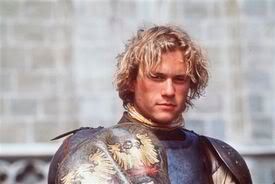
NEW YORK - Heath Ledger, the talented 28-year-old actor who gravitated toward dark, brooding roles that defied his leading-man looks, was found dead Tuesday in a Manhattan apartment, facedown at the foot of his bed with prescription sleeping pills nearby, police said.
There was no obvious indication that the Australian-born Ledger had committed suicide, NYPD spokesman Paul Browne said.
Ledger had an appointment for a massage at the SoHo apartment that is believed to be the home of the "Brokeback Mountain" actor, Browne said. The massage therapist and a housekeeper found his naked body at about 3:30 p.m. They tried to revive him, but he was already dead.
"I had such great hope for him," said Mel Gibson, who played Ledger's vengeful father in "The Patriot," in a statement. "He was just taking off and to lose his life at such a young age is a tragic loss."
Outside the Manhattan building on an upscale street, paparazzi and gawkers gathered, and several police officers put up barricades to control the crowd of about 300. Onlookers craned their necks as officers brought out a black bodybag on a gurney, took it across the sidewalk and put it into a medical examiner's office van.
As the door opened, bystanders snapped pictures with camera phones, rolled video and said, "He's coming out!"
An autopsy was planned for Wednesday, medical examiner's office spokeswoman Ellen Borakove said.
While not a marquee movie star, Ledger was an award-winning actor who chose his roles carefully rather than cashing in on big-money parts. He was nominated for an Oscar for his performance as a gay cowboy in "Brokeback Mountain." During filming, he met Michelle Williams, who played his wife in the film. The two had a daughter, now 2-year-old Matilda, and lived together in Brooklyn until they split up last year.
It was a shocking and unforeseen conclusion for one of Hollywood's bright young stars. Though his leading man looks propelled him to early stardom in films like "10 Things I Hate About You" and "A Knight's Tale," his career took a notable turn toward dramatic and brooding roles with 2001's "Monster's Ball."
Ledger's publicist, Mara Buxbaum, said in a statement: "We are all deeply saddened and shocked by this accident. This is an extremely difficult time for his loved ones and we are asking the media to please respect the family's privacy and avoid speculation until the facts are known."
In the Australian city of Perth, where Ledger was born and raised, his father called the actor's death "tragic, untimely and accidental."
"He was (a) down-to-earth, generous, kind-hearted, life-loving, unselfish individual, extremely inspirational to many," Kim Ledger said, reading from a prepared statement. "Heath has touched so many people on so many different levels during his short life."
Ledger eschewed Hollywood glitz in favor of a bohemian life in Brooklyn, where he became one of the borough's most famous residents. "Brokeback" would be his breakthrough role, establishing him as one of his generation's finest talents and an actor willing to take risks.
Ledger began to gravitate more toward independent fare, including Lasse Hallstrom's "Casanova" and Terry Gilliam's "The Brothers Grimm," both released in 2005. His 2006 film "Candy" now seems destined to have an especially haunting quality: In a particularly realistic performance, Ledger played a poet wrestling with a heroin addiction along with his girlfriend, played by Abbie Cornish.
But Ledger's most recent choices were arguably the boldest yet: He costarred in "I'm Not There," in which he played one of the many incarnations of Bob Dylan ƒƒ‚‚ as did Cate Blanchett, whose performance in that film earned an Oscar nomination Tuesday for best supporting actress.
And in what may be his final finished performance, Ledger proved that he wouldn't be intimidated by taking on a character as iconic as Jack Nicholson's Joker. Ledger's version of the "Batman" villain, glimpsed in early teaser trailers, made it clear that his Joker would be more depraved and dark.
Curiosity about Ledger's final performance will likely stoke further interest in the summer blockbuster. "Dark Knight" director Christopher Nolan said this month that Ledger's Joker would be wildly different from Nicholson's.
"It was a very great challenge for Heath," Nolan said. "He's extremely original, extremely frightening, tremendously edgy. A very young character, a very anarchic presence that taps into a lot of our basic fears and panic."
Ledger told The New York Times in a November interview that he "stressed out a little too much" during the Dylan film and had trouble sleeping while portraying the Joker, whom he called a "psychopathic, mass-murdering, schizophrenic clown with zero empathy."
"Last week I probably slept an average of two hours a night," Ledger told the newspaper. "I couldn't stop thinking. My body was exhausted, and my mind was still going." He said he took two Ambien pills, which worked for only an hour, the paper said.
Ledger was a widely recognized figure in his Manhattan neighborhood, where he used to shop at a home and children's store. Michelle Vella, an employee there, said she had frequently seen Ledger with his daughter ƒƒ‚‚ carrying the toddler on his shoulders, or having ice cream with her.
"It's so sad. They were really close," Vella said. "He's a very down-to-earth guy and an amazing father."
Before settling down with Williams, Ledger had relationships with actresses Heather Graham and Naomi Watts. He met Watts while working on "The Lords of Dogtown," a fictionalized version of a cult classic skateboarding documentary, in 2004.
Ledger was born in 1979 to a mining engineer and a French teacher and got his first acting role playing Peter Pan at age 10 in a local theater company. He began acting in independent films as a 16-year-old in Sydney and played a cyclist hoping to land a spot on an Olympic team in a 1996 television show, "Seat."
After several independent films, Ledger moved to Los Angeles at age 19 and starred opposite Julia Stiles in "10 Things I Hate About You." Offers for other teen flicks soon came his way, but Ledger turned them down, preferring to remain idle than sign on for projects he didn't like.
"It wasn't a hard decision for me," Ledger told the Associated Press in 2001. "It was hard for everyone else around me to understand. Agents were like, 'You're crazy,' my parents were like, 'Come on, you have to eat.'"
NEW YORK - Heath Ledger, the talented 28-year-old actor who gravitated toward dark, brooding roles that defied his leading-man looks, was found dead Tuesday in a Manhattan apartment, facedown at the foot of his bed with prescription sleeping pills nearby, police said.
There was no obvious indication that the Australian-born Ledger had committed suicide, NYPD spokesman Paul Browne said.
Ledger had an appointment for a massage at the SoHo apartment that is believed to be the home of the "Brokeback Mountain" actor, Browne said. The massage therapist and a housekeeper found his naked body at about 3:30 p.m. They tried to revive him, but he was already dead.
"I had such great hope for him," said Mel Gibson, who played Ledger's vengeful father in "The Patriot," in a statement. "He was just taking off and to lose his life at such a young age is a tragic loss."
Outside the Manhattan building on an upscale street, paparazzi and gawkers gathered, and several police officers put up barricades to control the crowd of about 300. Onlookers craned their necks as officers brought out a black bodybag on a gurney, took it across the sidewalk and put it into a medical examiner's office van.
As the door opened, bystanders snapped pictures with camera phones, rolled video and said, "He's coming out!"
An autopsy was planned for Wednesday, medical examiner's office spokeswoman Ellen Borakove said.
While not a marquee movie star, Ledger was an award-winning actor who chose his roles carefully rather than cashing in on big-money parts. He was nominated for an Oscar for his performance as a gay cowboy in "Brokeback Mountain." During filming, he met Michelle Williams, who played his wife in the film. The two had a daughter, now 2-year-old Matilda, and lived together in Brooklyn until they split up last year.
It was a shocking and unforeseen conclusion for one of Hollywood's bright young stars. Though his leading man looks propelled him to early stardom in films like "10 Things I Hate About You" and "A Knight's Tale," his career took a notable turn toward dramatic and brooding roles with 2001's "Monster's Ball."
Ledger's publicist, Mara Buxbaum, said in a statement: "We are all deeply saddened and shocked by this accident. This is an extremely difficult time for his loved ones and we are asking the media to please respect the family's privacy and avoid speculation until the facts are known."
In the Australian city of Perth, where Ledger was born and raised, his father called the actor's death "tragic, untimely and accidental."
"He was (a) down-to-earth, generous, kind-hearted, life-loving, unselfish individual, extremely inspirational to many," Kim Ledger said, reading from a prepared statement. "Heath has touched so many people on so many different levels during his short life."
Ledger eschewed Hollywood glitz in favor of a bohemian life in Brooklyn, where he became one of the borough's most famous residents. "Brokeback" would be his breakthrough role, establishing him as one of his generation's finest talents and an actor willing to take risks.
Ledger began to gravitate more toward independent fare, including Lasse Hallstrom's "Casanova" and Terry Gilliam's "The Brothers Grimm," both released in 2005. His 2006 film "Candy" now seems destined to have an especially haunting quality: In a particularly realistic performance, Ledger played a poet wrestling with a heroin addiction along with his girlfriend, played by Abbie Cornish.
But Ledger's most recent choices were arguably the boldest yet: He costarred in "I'm Not There," in which he played one of the many incarnations of Bob Dylan ƒƒ‚‚ as did Cate Blanchett, whose performance in that film earned an Oscar nomination Tuesday for best supporting actress.
And in what may be his final finished performance, Ledger proved that he wouldn't be intimidated by taking on a character as iconic as Jack Nicholson's Joker. Ledger's version of the "Batman" villain, glimpsed in early teaser trailers, made it clear that his Joker would be more depraved and dark.
Curiosity about Ledger's final performance will likely stoke further interest in the summer blockbuster. "Dark Knight" director Christopher Nolan said this month that Ledger's Joker would be wildly different from Nicholson's.
"It was a very great challenge for Heath," Nolan said. "He's extremely original, extremely frightening, tremendously edgy. A very young character, a very anarchic presence that taps into a lot of our basic fears and panic."
Ledger told The New York Times in a November interview that he "stressed out a little too much" during the Dylan film and had trouble sleeping while portraying the Joker, whom he called a "psychopathic, mass-murdering, schizophrenic clown with zero empathy."
"Last week I probably slept an average of two hours a night," Ledger told the newspaper. "I couldn't stop thinking. My body was exhausted, and my mind was still going." He said he took two Ambien pills, which worked for only an hour, the paper said.
Ledger was a widely recognized figure in his Manhattan neighborhood, where he used to shop at a home and children's store. Michelle Vella, an employee there, said she had frequently seen Ledger with his daughter ƒƒ‚‚ carrying the toddler on his shoulders, or having ice cream with her.
"It's so sad. They were really close," Vella said. "He's a very down-to-earth guy and an amazing father."
Before settling down with Williams, Ledger had relationships with actresses Heather Graham and Naomi Watts. He met Watts while working on "The Lords of Dogtown," a fictionalized version of a cult classic skateboarding documentary, in 2004.
Ledger was born in 1979 to a mining engineer and a French teacher and got his first acting role playing Peter Pan at age 10 in a local theater company. He began acting in independent films as a 16-year-old in Sydney and played a cyclist hoping to land a spot on an Olympic team in a 1996 television show, "Seat."
After several independent films, Ledger moved to Los Angeles at age 19 and starred opposite Julia Stiles in "10 Things I Hate About You." Offers for other teen flicks soon came his way, but Ledger turned them down, preferring to remain idle than sign on for projects he didn't like.
"It wasn't a hard decision for me," Ledger told the Associated Press in 2001. "It was hard for everyone else around me to understand. Agents were like, 'You're crazy,' my parents were like, 'Come on, you have to eat.'"
Friday, January 18, 2008


WTF is wrong with Canada?
Canada manual: US prisoners face torture
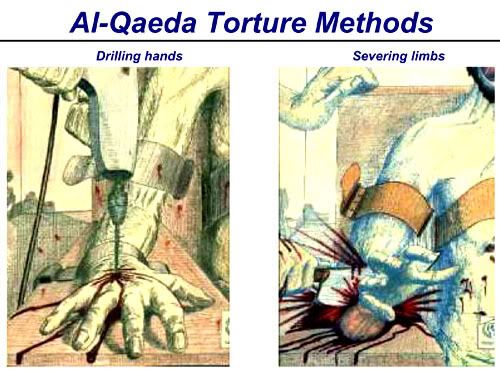
Check out Pat Dollard's site for a little preview of how al-Qaeda tortures people. Compare that to sleep deprivation. I mean, for f*ck's sake! Canada sucks!
TORONTO - A training manual for Canadian diplomats lists the United States as a country where prisoners risk torture and abuse, citing interrogation techniques such as stripping prisoners, blindfolding and sleep deprivation.
The Foreign Affairs Department document, released Friday, singled out the U.S. detention center at Guantanamo Bay. It also names Israel, Afghanistan, China, Egypt, Iran, Saudi Arabia, Mexico and Syria as places where inmates could face torture.
The listing drew a sharp response from the U.S., a key NATO ally and trading partner, which asked to removed from the manual.
"We find it to be offensive for us to be on the same list with countries like Iran and China. Quite frankly it's absurd," U.S. Ambassador David Wilkins told The Associated Press. "For us to be on a list like that is just ridiculous."
He said the U.S. does not authorize or condone torture. "We think it should be removed and we've made that request. We have voiced our opinion very forcefully," Wilkins said.
Michael Mendel, the Israeli Embassy spokesman, said Israel's Supreme Court "is on record as expressly prohibiting any type of torture. If Israel is included in the list in question, the ambassador of Israel would expect its removal," he said.
A Canadian citizen, Omar Khadr, is in custody at Guantanamo, but Canada has long publicly said it accepts U.S. assurances that Khadr is being treated humanely.
The government inadvertently released the manual to lawyers for Amnesty International who are working on a lawsuit involving alleged abuse of Afghan detainees by local Afghan authorities, after the detainees were handed over by Canadian troops.
Canada said the manual is for training, and does not amount to official government policy.
"It is not a policy document or any kind of a statement of policy. As such it does not convey the government's views or positions," said Neil Hrab, a spokesman for Canada's Foreign Affairs Department.
"The training manual purposely raised public issues to stimulate discussion and debate in the classroom."
Human rights groups have long called on Canada to pressure the United States to return Khadr from Guantanamo. They say Canada has not done enough for Khadr, who has been in custody since he was 15. Khadr is accused of tossing a grenade that killed one U.S. soldier and wounded another in Afghanistan in 2002.
He is the son of an alleged al-Qaida financier, and his family has received little sympathy in Canada, where they've been called the "First Family of Terrorism."
Dennis Edney, one of Khadr's lawyers, said the foreign affairs document shows that Canada says one thing publicly but believes something else privately.
"Canada was well aware that Omar Khadr's allegations of being tortured had a ring of truth to it. Canada has not once raised the protection of Omar Khadr when there are such serious allegations," Edney said. "What does that say to you about Canada's commitment to the rule of law and human rights? It talks on both sides of its face."
Wow. This really pissed me off.
Check out Pat Dollard's site for a little preview of how al-Qaeda tortures people. Compare that to sleep deprivation. I mean, for f*ck's sake! Canada sucks!
TORONTO - A training manual for Canadian diplomats lists the United States as a country where prisoners risk torture and abuse, citing interrogation techniques such as stripping prisoners, blindfolding and sleep deprivation.
The Foreign Affairs Department document, released Friday, singled out the U.S. detention center at Guantanamo Bay. It also names Israel, Afghanistan, China, Egypt, Iran, Saudi Arabia, Mexico and Syria as places where inmates could face torture.
The listing drew a sharp response from the U.S., a key NATO ally and trading partner, which asked to removed from the manual.
"We find it to be offensive for us to be on the same list with countries like Iran and China. Quite frankly it's absurd," U.S. Ambassador David Wilkins told The Associated Press. "For us to be on a list like that is just ridiculous."
He said the U.S. does not authorize or condone torture. "We think it should be removed and we've made that request. We have voiced our opinion very forcefully," Wilkins said.
Michael Mendel, the Israeli Embassy spokesman, said Israel's Supreme Court "is on record as expressly prohibiting any type of torture. If Israel is included in the list in question, the ambassador of Israel would expect its removal," he said.
A Canadian citizen, Omar Khadr, is in custody at Guantanamo, but Canada has long publicly said it accepts U.S. assurances that Khadr is being treated humanely.
The government inadvertently released the manual to lawyers for Amnesty International who are working on a lawsuit involving alleged abuse of Afghan detainees by local Afghan authorities, after the detainees were handed over by Canadian troops.
Canada said the manual is for training, and does not amount to official government policy.
"It is not a policy document or any kind of a statement of policy. As such it does not convey the government's views or positions," said Neil Hrab, a spokesman for Canada's Foreign Affairs Department.
"The training manual purposely raised public issues to stimulate discussion and debate in the classroom."
Human rights groups have long called on Canada to pressure the United States to return Khadr from Guantanamo. They say Canada has not done enough for Khadr, who has been in custody since he was 15. Khadr is accused of tossing a grenade that killed one U.S. soldier and wounded another in Afghanistan in 2002.
He is the son of an alleged al-Qaida financier, and his family has received little sympathy in Canada, where they've been called the "First Family of Terrorism."
Dennis Edney, one of Khadr's lawyers, said the foreign affairs document shows that Canada says one thing publicly but believes something else privately.
"Canada was well aware that Omar Khadr's allegations of being tortured had a ring of truth to it. Canada has not once raised the protection of Omar Khadr when there are such serious allegations," Edney said. "What does that say to you about Canada's commitment to the rule of law and human rights? It talks on both sides of its face."
Wow. This really pissed me off.
Iranians are at it again!
US: number of Iran bombs in Iraq already equals December
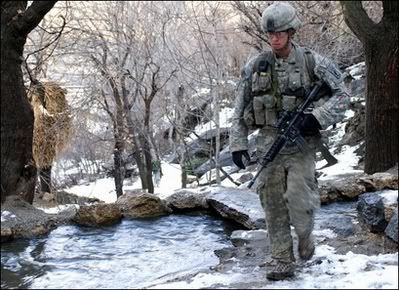
A US paratrooper on patrol in Kunar Province, Afghanistan, January 11. US Defense Secretary Robert Gates tried to mend fences Thursday with NATO allies in Afghanistan, but did not change his view that the alliance overall remains under-trained to fight.
US soldiers have already been targeted in the first two weeks of January by as many suspected Iranian explosives as in all of December, the US defense chief said Friday.
"During the first half of January there were as many IEDs (improvised explosive devices) as there were in all of December," Defense Secretary Robert Gates told reporters aboard a plane after a visit in Charleston, South Carolina.
Gates' military adviser, Peter Chiarelli, said later the secretary was actually referring to explosively formed penetrators (EFPs), which US officials say Iran has been supplying to insurgents in Iraq.
General David Petraeus, the commander of US forces in Iraq, said Wednesday that EFP attacks had dropped in recent months but increased at the start of January.
"The signature attacks that employ Iranian-provided weapons have decreased substantially," he told a small group of reporters accompanying him on his visit to the Iraq-Iran border post at Zurbitiyah.
"The EFPs (explosively formed penetrators) had been running at a low level until about the first 10 to 12 days of this month, when we saw a noticeable increase but, in the last several days they have gone down again," he said.
US officials observed a steady reduction in the use of Iranian explosives between October and November, which they believed showed a possible reduction of weapons being sent from Iraq's neighbor.
A US paratrooper on patrol in Kunar Province, Afghanistan, January 11. US Defense Secretary Robert Gates tried to mend fences Thursday with NATO allies in Afghanistan, but did not change his view that the alliance overall remains under-trained to fight.
US soldiers have already been targeted in the first two weeks of January by as many suspected Iranian explosives as in all of December, the US defense chief said Friday.
"During the first half of January there were as many IEDs (improvised explosive devices) as there were in all of December," Defense Secretary Robert Gates told reporters aboard a plane after a visit in Charleston, South Carolina.
Gates' military adviser, Peter Chiarelli, said later the secretary was actually referring to explosively formed penetrators (EFPs), which US officials say Iran has been supplying to insurgents in Iraq.
General David Petraeus, the commander of US forces in Iraq, said Wednesday that EFP attacks had dropped in recent months but increased at the start of January.
"The signature attacks that employ Iranian-provided weapons have decreased substantially," he told a small group of reporters accompanying him on his visit to the Iraq-Iran border post at Zurbitiyah.
"The EFPs (explosively formed penetrators) had been running at a low level until about the first 10 to 12 days of this month, when we saw a noticeable increase but, in the last several days they have gone down again," he said.
US officials observed a steady reduction in the use of Iranian explosives between October and November, which they believed showed a possible reduction of weapons being sent from Iraq's neighbor.
Boostin' the economy!
Bush wants fast tax aid to boost economy
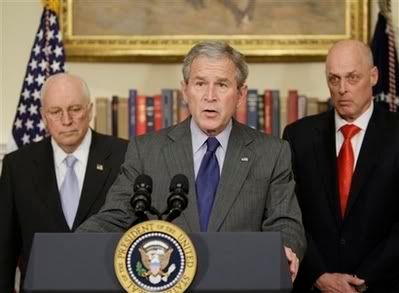
With recession fears rising and the stock market tumbling, President Bush on Friday called for up to $150 billion in tax relief for consumers and business — and said there was no time to waste.
Bush's urgent remarks gave fresh impetus to congressional leaders already hard at work on an economic rescue package that would include extra money for food stamps and jobless benefits in addition to tax rebates of hundreds of dollars each for millions of Americans. The hope is that people would immediately spend those rebates and give the economy a badly needed boost.
"I believe we can come together on a growth package very quickly, and we're going to need to," Bush said.
Bush said the rescue effort should be both quick and temporary, a one-time boost for a national economy that is in danger of sliding into the first recession since 2001 if it hasn't already edged across that line. The president's tone was somber in his remarks at the White House, but his mood was upbeat later in the day when he visited a factory to underscore his focus on the economy.
"Crank this sucker up," he exclaimed, an exhortation that could fit his hopes for economic revival, though he was referring specifically to a huge riding mower at Wright Manufacturing. Once the engine was roaring, Bush jumped on and steered the mower playfully.
Despite darkening economic reports, he said that if Congress passes a quick federal relief package, "We're gonna be just fine."
For a stimulus package to have much impact, he said it would need to represent roughly 1 percent of the gross domestic product, or about $140 billion to $150 billion.
On Capitol Hill, Democratic leaders pledged to cooperate with Bush and congressional Republicans. Senate Majority Leader Harry Reid, D-Nev., had criticized Bush on Thursday for deciding to speak publicly on the package before a deal had been struck, but Reid said Friday he was encouraged by the president's remarks.
With recession fears rising and the stock market tumbling, President Bush on Friday called for up to $150 billion in tax relief for consumers and business — and said there was no time to waste.
Bush's urgent remarks gave fresh impetus to congressional leaders already hard at work on an economic rescue package that would include extra money for food stamps and jobless benefits in addition to tax rebates of hundreds of dollars each for millions of Americans. The hope is that people would immediately spend those rebates and give the economy a badly needed boost.
"I believe we can come together on a growth package very quickly, and we're going to need to," Bush said.
Bush said the rescue effort should be both quick and temporary, a one-time boost for a national economy that is in danger of sliding into the first recession since 2001 if it hasn't already edged across that line. The president's tone was somber in his remarks at the White House, but his mood was upbeat later in the day when he visited a factory to underscore his focus on the economy.
"Crank this sucker up," he exclaimed, an exhortation that could fit his hopes for economic revival, though he was referring specifically to a huge riding mower at Wright Manufacturing. Once the engine was roaring, Bush jumped on and steered the mower playfully.
Despite darkening economic reports, he said that if Congress passes a quick federal relief package, "We're gonna be just fine."
For a stimulus package to have much impact, he said it would need to represent roughly 1 percent of the gross domestic product, or about $140 billion to $150 billion.
On Capitol Hill, Democratic leaders pledged to cooperate with Bush and congressional Republicans. Senate Majority Leader Harry Reid, D-Nev., had criticized Bush on Thursday for deciding to speak publicly on the package before a deal had been struck, but Reid said Friday he was encouraged by the president's remarks.
Thursday, January 17, 2008
FASHION: Dresses!
I'm totally into skirts and dresses! And I don't care for plain cuts or simple prints: The more glamorous/outrageous they look, the better! I mean c'mon, there's a good reason why Betsey Johnson is rich and famous.
B*tch is crazy. And her style reflects that.
From Net-A-Porter
Michael Kors and T-Bags




B*tch is crazy. And her style reflects that.
Michael Kors and T-Bags
Wednesday, January 16, 2008
FASHION: Maison Martin Margiela
Pure genius! is what I would say about Maison Martin Margiela's jaw-dropping new product, the Shredded High Boot! Show off your bold and edgy style by pulling on a pair of skillfully shredded leather boots and matching it with clean white pants and a suit jacket. If you think you look fat in white, then try on a pair of dark-washed skinny jeans in denim and forget about the damn suit jacket.


Libs still hunting for prey.
U.S. interrogations successful, lawful: spy chief
ST. MARY'S CITY, Maryland (Reuters) - The CIA's harsh questioning of terrorism suspects was legal and saved lives, the U.S. national intelligence director said on Wednesday, as Congress questioned a CIA lawyer about the agency's destruction of interrogation videotapes.
"It has saved lives. And so from my point of view, we've accomplished the mission within the bounds of U.S. law," the director, Michael McConnell, told students at St. Mary's College in Maryland.
The CIA's disclosure last month it destroyed hundreds of hours of videotapes depicting harsh interrogations, believed to have included a simulated form of drowning called waterboarding, cast U.S. treatment of terrorism suspects under the spotlight and drew criticism from human rights groups.
Waterboarding has been condemned internationally as a form of illegal torture, and McConnell was quoted in the current issue of The New Yorker magazine as saying he would consider the practice torture if it were applied to him.
"The United States does not engage in torture. We do use enhanced interrogation techniques," McConnell said. "There are Americans today that are alive, that are living and breathing because of those interrogation techniques."
While McConnell spoke, the House of Representatives Intelligence Committee met behind closed doors to question CIA attorney John Rizzo, who is reported to have been involved in the decision to destroy the tapes. The recordings depicted the interrogations of two suspected al Qaeda members in 2002, and the tapes were destroyed in 2005.
The committee had also subpoenaed Jose Rodriguez, the former head of the CIA's clandestine branch who is believed to have made the decision to destroy the tapes.
But the panel decided against calling him to testify after his attorney indicated Rodriguez would not answer questions, a House aide said. He remains under subpoena and may be called in the future to testify.
Rep. Peter Hoekstra of Michigan, the committee's ranking Republican, told reporters after the hearing with Rizzo, "We need to get Jose Rodriguez in here to testify."
"Jose was responsible for this -- or it appears that most press reports and other reports indicate that Jose was responsible for this decision to destroy the tapes," Hoekstra said.
The Washington Post reported that CIA lawyers and officials told Rodriguez he had the legal right to order the destruction.
Hoekstra and Intelligence Committee Chairman Silvestre Reyes, a Texas Democrat, said Rizzo was a cooperative witness. They did not disclose specifics.
Reyes said in a statement: "We will be identifying additional officials to talk to in the coming days and weeks. I urge members of the executive branch to cooperate with this investigation and let the truth be told."
The Justice Department has launched a criminal investigation, and sought to discourage congressional probes, fearing they could undermine its efforts.
Human rights activists and some intelligence analysts and congressional critics have questioned the validity of information gained under harsh interrogations and called for a ban on waterboarding. McConnell said it was important to keep suspects guessing about the techniques they would face.
ST. MARY'S CITY, Maryland (Reuters) - The CIA's harsh questioning of terrorism suspects was legal and saved lives, the U.S. national intelligence director said on Wednesday, as Congress questioned a CIA lawyer about the agency's destruction of interrogation videotapes.
"It has saved lives. And so from my point of view, we've accomplished the mission within the bounds of U.S. law," the director, Michael McConnell, told students at St. Mary's College in Maryland.
The CIA's disclosure last month it destroyed hundreds of hours of videotapes depicting harsh interrogations, believed to have included a simulated form of drowning called waterboarding, cast U.S. treatment of terrorism suspects under the spotlight and drew criticism from human rights groups.
Waterboarding has been condemned internationally as a form of illegal torture, and McConnell was quoted in the current issue of The New Yorker magazine as saying he would consider the practice torture if it were applied to him.
"The United States does not engage in torture. We do use enhanced interrogation techniques," McConnell said. "There are Americans today that are alive, that are living and breathing because of those interrogation techniques."
While McConnell spoke, the House of Representatives Intelligence Committee met behind closed doors to question CIA attorney John Rizzo, who is reported to have been involved in the decision to destroy the tapes. The recordings depicted the interrogations of two suspected al Qaeda members in 2002, and the tapes were destroyed in 2005.
The committee had also subpoenaed Jose Rodriguez, the former head of the CIA's clandestine branch who is believed to have made the decision to destroy the tapes.
But the panel decided against calling him to testify after his attorney indicated Rodriguez would not answer questions, a House aide said. He remains under subpoena and may be called in the future to testify.
Rep. Peter Hoekstra of Michigan, the committee's ranking Republican, told reporters after the hearing with Rizzo, "We need to get Jose Rodriguez in here to testify."
"Jose was responsible for this -- or it appears that most press reports and other reports indicate that Jose was responsible for this decision to destroy the tapes," Hoekstra said.
The Washington Post reported that CIA lawyers and officials told Rodriguez he had the legal right to order the destruction.
Hoekstra and Intelligence Committee Chairman Silvestre Reyes, a Texas Democrat, said Rizzo was a cooperative witness. They did not disclose specifics.
Reyes said in a statement: "We will be identifying additional officials to talk to in the coming days and weeks. I urge members of the executive branch to cooperate with this investigation and let the truth be told."
The Justice Department has launched a criminal investigation, and sought to discourage congressional probes, fearing they could undermine its efforts.
Human rights activists and some intelligence analysts and congressional critics have questioned the validity of information gained under harsh interrogations and called for a ban on waterboarding. McConnell said it was important to keep suspects guessing about the techniques they would face.
Bigger US role in Pakistan?
About time.
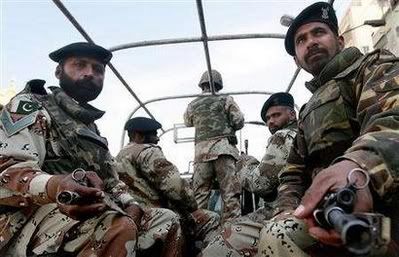
Pakistani Rangers patrolling the streets of Karachi
ST. PETERSBURG, Fla. - Pakistan is taking a more welcoming view of U.S. suggestions for using American troops to train and advise its own forces in the fight against anti-government extremists, the commander of U.S. forces in that region said Wednesday.
Navy Adm. William J. Fallon, commander of U.S. Central Command, said he believes increased violence inside Pakistan in recent months has led Pakistani leaders to conclude that they must focus more intensively on extremist al-Qaida hideouts near the border with Afghanistan.
He called this an important change from Pakistan's traditional focus on India as the main threat to its security, and it meshes with Defense Secretary Robert Gates' recent comment that al-Qaida terrorists hiding in the border area are increasingly aiming their campaign of violence at targets inside Pakistan.
"They see they've got real problems internally," Fallon said in a 20-minute interview with three reporters accompanying Adm. Mike Mullen, chairman of the Joint Chiefs of Staff, at a private conference here of military chiefs from Middle Eastern countries, hosted by Fallon. Pakistan was not attending.
In the latest sign of trouble, the Pakistani military said Wednesday that Islamic militants overran a military outpost close to the Afghan border in a battle that killed seven Pakistani soldiers and left 20 missing.
Although Pakistan has been a close U.S. ally in the war against terrorism since Sept. 11, 2001, the extent of U.S. military involvement inside Pakistan is a highly sensitive subject among Pakistanis.
"My sense is there is an increased willingness to address these problems, and we're going to try to help them," Fallon said. He said U.S. assistance would be "more robust," but he offered few details. "There is more willingness to do that now" on Pakistan's part, he said.
The Bush administration's anxiety about Pakistan's stability has grown in recent months, not only because of its potential implications for U.S. stability efforts in neighboring Afghanistan but also because of worry about the security of Pakistan's nuclear arsenal.
Senior U.S. military officials have visited there recently, including Navy Adm. Eric Olsen, commander of U.S. Special Operations Command.
In the interview in the seaside hotel where he and Mullen were meeting with Middle Eastern military chiefs, Fallon said he is concerned about weak coordination of U.S. and NATO efforts to stabilize Afghanistan. But he stressed that the security situation in Afghanistan is better than many realize.
"Our guys really get it," he said, referring to the 27,000 U.S. troops in Afghanistan. He said they are making inroads against the Taliban insurgency and he sees prospects for more gains this year.
Asked to assess the performance of NATO troops, who are in charge of the overall security mission, Fallon demurred.
"I will not pass judgment" on NATO's efforts, he said, noting that he was aware of a Los Angeles Times story published Wednesday that quoted Gates as questioning the competence of NATO forces operating in southern Afghanistan, heartland of the Pashtun tribal area that gave rise to the Taliban movement.
"I'm worried we're deploying (military advisors) that are not properly trained and I'm worried we have some military forces that don't know how to do counterinsurgency operations," Gates was quoted as saying in a Times interview.
In Washington, Gates' spokesman Geoff Morrell said the secretary had "read the article and is disturbed by what he read."
Morrell did not challenge the accuracy of the quotes in the story, but said he thought it left the wrong impression — that Gates had singled out a particular country.
"For the record he did not — to the L.A. Times or at any time otherwise — ever criticize publicly any single country for their performance in or commitment to the mission in Afghanistan," Morrell told Pentagon reporters in Washington.
Instead, Morrell said Gates had pointed out that "NATO as an alliance, does not train for counterinsurgency. The alliance has never had to do it before."
Fallon said he is overseeing a review of the Afghanistan mission, including not only the security effort but also the work in the political and economic realms.
"A lot of this is less coordinated than it might be, and if we could figure out how to get it harnessed together we might be able to leverage all the (contributions) ... to better effect," Fallon said.
Fallon said expanded U.S. military assistance to Pakistan would include, but is not limited to, a U.S. training program for tribal groups in the federally administered tribal areas bordering Afghanistan.
The admiral is to visit Pakistan and Afghanistan next week.
He said he has been impressed with Pakistan's new military chief, Gen. Ashfaq Kayani, who took over in December from President Pervez Musharraf.
"I was very heartened by his understanding of what the problems are and what he's going to need to do to meet them," Fallon said.
Pakistani Rangers patrolling the streets of Karachi
ST. PETERSBURG, Fla. - Pakistan is taking a more welcoming view of U.S. suggestions for using American troops to train and advise its own forces in the fight against anti-government extremists, the commander of U.S. forces in that region said Wednesday.
Navy Adm. William J. Fallon, commander of U.S. Central Command, said he believes increased violence inside Pakistan in recent months has led Pakistani leaders to conclude that they must focus more intensively on extremist al-Qaida hideouts near the border with Afghanistan.
He called this an important change from Pakistan's traditional focus on India as the main threat to its security, and it meshes with Defense Secretary Robert Gates' recent comment that al-Qaida terrorists hiding in the border area are increasingly aiming their campaign of violence at targets inside Pakistan.
"They see they've got real problems internally," Fallon said in a 20-minute interview with three reporters accompanying Adm. Mike Mullen, chairman of the Joint Chiefs of Staff, at a private conference here of military chiefs from Middle Eastern countries, hosted by Fallon. Pakistan was not attending.
In the latest sign of trouble, the Pakistani military said Wednesday that Islamic militants overran a military outpost close to the Afghan border in a battle that killed seven Pakistani soldiers and left 20 missing.
Although Pakistan has been a close U.S. ally in the war against terrorism since Sept. 11, 2001, the extent of U.S. military involvement inside Pakistan is a highly sensitive subject among Pakistanis.
"My sense is there is an increased willingness to address these problems, and we're going to try to help them," Fallon said. He said U.S. assistance would be "more robust," but he offered few details. "There is more willingness to do that now" on Pakistan's part, he said.
The Bush administration's anxiety about Pakistan's stability has grown in recent months, not only because of its potential implications for U.S. stability efforts in neighboring Afghanistan but also because of worry about the security of Pakistan's nuclear arsenal.
Senior U.S. military officials have visited there recently, including Navy Adm. Eric Olsen, commander of U.S. Special Operations Command.
In the interview in the seaside hotel where he and Mullen were meeting with Middle Eastern military chiefs, Fallon said he is concerned about weak coordination of U.S. and NATO efforts to stabilize Afghanistan. But he stressed that the security situation in Afghanistan is better than many realize.
"Our guys really get it," he said, referring to the 27,000 U.S. troops in Afghanistan. He said they are making inroads against the Taliban insurgency and he sees prospects for more gains this year.
Asked to assess the performance of NATO troops, who are in charge of the overall security mission, Fallon demurred.
"I will not pass judgment" on NATO's efforts, he said, noting that he was aware of a Los Angeles Times story published Wednesday that quoted Gates as questioning the competence of NATO forces operating in southern Afghanistan, heartland of the Pashtun tribal area that gave rise to the Taliban movement.
"I'm worried we're deploying (military advisors) that are not properly trained and I'm worried we have some military forces that don't know how to do counterinsurgency operations," Gates was quoted as saying in a Times interview.
In Washington, Gates' spokesman Geoff Morrell said the secretary had "read the article and is disturbed by what he read."
Morrell did not challenge the accuracy of the quotes in the story, but said he thought it left the wrong impression — that Gates had singled out a particular country.
"For the record he did not — to the L.A. Times or at any time otherwise — ever criticize publicly any single country for their performance in or commitment to the mission in Afghanistan," Morrell told Pentagon reporters in Washington.
Instead, Morrell said Gates had pointed out that "NATO as an alliance, does not train for counterinsurgency. The alliance has never had to do it before."
Fallon said he is overseeing a review of the Afghanistan mission, including not only the security effort but also the work in the political and economic realms.
"A lot of this is less coordinated than it might be, and if we could figure out how to get it harnessed together we might be able to leverage all the (contributions) ... to better effect," Fallon said.
Fallon said expanded U.S. military assistance to Pakistan would include, but is not limited to, a U.S. training program for tribal groups in the federally administered tribal areas bordering Afghanistan.
The admiral is to visit Pakistan and Afghanistan next week.
He said he has been impressed with Pakistan's new military chief, Gen. Ashfaq Kayani, who took over in December from President Pervez Musharraf.
"I was very heartened by his understanding of what the problems are and what he's going to need to do to meet them," Fallon said.
Europe: The New Base of Terrorists?
From PatDollard.Com:
Chertoff Says Islamicized Europe Now Greatest Terror Threat To U.S.

LONDON - Homeland Security Secretary Michael Chertoff said on Wednesday that one of the biggest threats to U.S. security may now come from within Europe.
In an interview with BBC radio, Chertoff said that American authorities were becoming increasingly aware of a real risk of Europe becoming a “platform for terrorists”.
He said it was important to step up security checks on passengers coming from Europe to the United States.
“One of the things we have become concerned about lately is the possibility of Europe becoming a platform for a threat against the United States,” Chertoff said.
“We have watched the rise of home-grown terrorism,” he added, citing the Madrid train bombing in March 2004 and recent foiled plots in Britain and Germany.
“That suggests to us that the terrorists are increasingly looking to Europe both as a target and as a platform for terrorist attacks.”
Chertoff’s comments came after reports that British intelligence services are investigating an Islamist Web site which said that a branch of al Qaeda had been established in Britain. (I'm not frickin' surprised about this! Britain is being invaded by Islamist dudes!)
Security experts fear a posting on the site, urging young Muslim men to rise up against what it called infidels such as Prime Minister Gordon Brown and former Prime Minister Tony Blair, may be genuine.
Chertoff said that while Washington had no plans to suspend a visa waiver program that allows most Europeans who travel to the United States as tourists to do so without a visa, authorities would like to step up advance checks on travelers.
“We do want to elevate some of the security measures in the program,” he said, proposing an advance travel authorization system which would require potential visitors to register online their intention to travel to America to allow authorities to clear them in advance.
Chertoff also said that the absence of any attacks in the United States since September 11, 2001 had created “a certain sense of complacency” which needed to be dispelled.
“When I lift my eyes and look around the world and I look at what happens in Britain and Germany and Spain and Bali and Pakistan, I don’t see terrorism going away, I see an al Qaeda that’s emboldened, he said.
“I don’t see any diminishment of the threat and my concern is that we not relax and let the enemy get ahead of us.”
Chertoff Says Islamicized Europe Now Greatest Terror Threat To U.S.
LONDON - Homeland Security Secretary Michael Chertoff said on Wednesday that one of the biggest threats to U.S. security may now come from within Europe.
In an interview with BBC radio, Chertoff said that American authorities were becoming increasingly aware of a real risk of Europe becoming a “platform for terrorists”.
He said it was important to step up security checks on passengers coming from Europe to the United States.
“One of the things we have become concerned about lately is the possibility of Europe becoming a platform for a threat against the United States,” Chertoff said.
“We have watched the rise of home-grown terrorism,” he added, citing the Madrid train bombing in March 2004 and recent foiled plots in Britain and Germany.
“That suggests to us that the terrorists are increasingly looking to Europe both as a target and as a platform for terrorist attacks.”
Chertoff’s comments came after reports that British intelligence services are investigating an Islamist Web site which said that a branch of al Qaeda had been established in Britain. (I'm not frickin' surprised about this! Britain is being invaded by Islamist dudes!)
Security experts fear a posting on the site, urging young Muslim men to rise up against what it called infidels such as Prime Minister Gordon Brown and former Prime Minister Tony Blair, may be genuine.
Chertoff said that while Washington had no plans to suspend a visa waiver program that allows most Europeans who travel to the United States as tourists to do so without a visa, authorities would like to step up advance checks on travelers.
“We do want to elevate some of the security measures in the program,” he said, proposing an advance travel authorization system which would require potential visitors to register online their intention to travel to America to allow authorities to clear them in advance.
Chertoff also said that the absence of any attacks in the United States since September 11, 2001 had created “a certain sense of complacency” which needed to be dispelled.
“When I lift my eyes and look around the world and I look at what happens in Britain and Germany and Spain and Bali and Pakistan, I don’t see terrorism going away, I see an al Qaeda that’s emboldened, he said.
“I don’t see any diminishment of the threat and my concern is that we not relax and let the enemy get ahead of us.”
NY POST: The Times is 'Murder' on our GIs
This is why I hate The New York Times.
January 16, 2008 -- Conservative columnists and bloggers are blasting The New York Times for what they call fuzzy math and shoddy research designation to trash the reputation of GIs by saying Iraq and Afghanistan war veterans are returning home as murderers.
The Times said in a front-page story on Sunday that it had found 121 cases of Iraq and Afghan war vets committing a homicide in the United States.
But veterans and right-wing critics crunched the numbers and discovered that the murder rate for returning vets is only one-fifth of that of young Americans who did not serve in the war zones.
Post columnist Ralph Peters called the lengthy Times article "part of the disgraceful left-wing campaign" to portray "our troops as clichéd maniacs."
Several hundred blogs have appeared since Sunday that are critical of the article. "I'm a veteran and I haven't killed anybody in years," wrote William Briggs. "But if you read The New York Times, you'd be right to worry that I might."
Efforts to obtain a response from the Times yesterday were unsuccessful.
The pro-troop group Move America Forward called the article "slander."
"It's obvious that The New York Times has an agenda of undermining the missions of our troops in the war on terror, so much so that they are willing to resort to demonstrably false statistics to support their anti-troop bias," said the group's chairman, Melanie Morgan.
The critics said the 121 killings have to be judged in context, by comparing the vets with those Americans who didn't serve in the war zones.
Justice Department statistics show that Americans in the veterans' age group, 18 to 34 years old, commit about 150 murders a year - an identical number of their civilian peers would've committed 700 to 750 murders in the same time-frame.
"In other words, the Times unwittingly makes the case that military service reduces the likelihood of a young man or woman committing a murder by 80 percent," Peters wrote.
January 16, 2008 -- Conservative columnists and bloggers are blasting The New York Times for what they call fuzzy math and shoddy research designation to trash the reputation of GIs by saying Iraq and Afghanistan war veterans are returning home as murderers.
The Times said in a front-page story on Sunday that it had found 121 cases of Iraq and Afghan war vets committing a homicide in the United States.
But veterans and right-wing critics crunched the numbers and discovered that the murder rate for returning vets is only one-fifth of that of young Americans who did not serve in the war zones.
Post columnist Ralph Peters called the lengthy Times article "part of the disgraceful left-wing campaign" to portray "our troops as clichéd maniacs."
Several hundred blogs have appeared since Sunday that are critical of the article. "I'm a veteran and I haven't killed anybody in years," wrote William Briggs. "But if you read The New York Times, you'd be right to worry that I might."
Efforts to obtain a response from the Times yesterday were unsuccessful.
The pro-troop group Move America Forward called the article "slander."
"It's obvious that The New York Times has an agenda of undermining the missions of our troops in the war on terror, so much so that they are willing to resort to demonstrably false statistics to support their anti-troop bias," said the group's chairman, Melanie Morgan.
The critics said the 121 killings have to be judged in context, by comparing the vets with those Americans who didn't serve in the war zones.
Justice Department statistics show that Americans in the veterans' age group, 18 to 34 years old, commit about 150 murders a year - an identical number of their civilian peers would've committed 700 to 750 murders in the same time-frame.
"In other words, the Times unwittingly makes the case that military service reduces the likelihood of a young man or woman committing a murder by 80 percent," Peters wrote.
Tuesday, January 15, 2008
RIP Brad Renfro
Aww I can't believe he's dead! I used to have an enormous crush on Brad Renfro when I was a kid, but I haven't thought about him since and I had no idea he was addicted to drugs and alcohol. Last year some other former child star died, but I can't remember his name. James Something?
So sad.


Renfro dies at 25
LOS ANGELES - Actor Brad Renfro, whose career began promisingly with a childhood role in "The Client" but rapidly faded as he struggled with drugs and alcohol, was found dead Tuesday in his home. He was 25.
Paramedics pronounced him dead at 9 a.m., said Craig Harvey, chief investigator for the Los Angeles County coroner's office. The cause of death was not immediately determined, Harvey said, but an autopsy could be conducted as early as Wednesday.
Renfro had reportedly been drinking with friends the evening before his death, Harvey said.
Renfro's lawyer, Richard Kaplan, said he did not know whether the death was connected to any problems with addiction.
"He was working hard on his sobriety," Kaplan said. "He was doing well. He was a nice person."
Renfro recently completed a role in "The Informers," a film adaptation of a Bret Easton Ellis novel that stars Winona Ryder, Brandon Routh and Billy Bob Thornton.
"Brad was an exceptionally talented young actor and our time spent with him was thoroughly enjoyable," Marco Weber, president of the film's production house, Senator Entertainment, said in a statement.
The actor served 10 days in jail in May 2006 after pleading no contest to driving while intoxicated and guilty to attempted possession of heroin.
The latter charge stemmed from his arrest in Los Angeles' Skid Row area, when he attempted to buy heroin from an undercover officer in 2005.
For several years he was better known for that drug bust and the resulting criminal case than for acting.
After one court appearance, he talked to reporters about drug rehabilitation, saying he was "tired of paying the consequences" for drinking and drug use and eager to get clean.
"It's definitely been an eye-opener," he said of his rehabilitation program.
Other run-ins with the law included a 1998 charge of cocaine and marijuana possession, for which he avoided jail time in a plea deal. He was also placed on probation in January 2001 and ordered to pay $4,000 for repairs to a 45-foot yacht he and a friend tried to steal in Florida in August 2000.
He was arrested again in May 2001 and charged with underage drinking, violating the terms of his probation, and was ordered into alcohol rehabilitation the following March.
A native of Knoxville, Tenn., Renfro's film career began when he was 12, acting opposite Susan Sarandon and Tommy Lee Jones in "The Client." His other credits included "Sleepers," "Deuces Wild," "Apt Pupil" and "The Jacket."
So sad.
Renfro dies at 25
LOS ANGELES - Actor Brad Renfro, whose career began promisingly with a childhood role in "The Client" but rapidly faded as he struggled with drugs and alcohol, was found dead Tuesday in his home. He was 25.
Paramedics pronounced him dead at 9 a.m., said Craig Harvey, chief investigator for the Los Angeles County coroner's office. The cause of death was not immediately determined, Harvey said, but an autopsy could be conducted as early as Wednesday.
Renfro had reportedly been drinking with friends the evening before his death, Harvey said.
Renfro's lawyer, Richard Kaplan, said he did not know whether the death was connected to any problems with addiction.
"He was working hard on his sobriety," Kaplan said. "He was doing well. He was a nice person."
Renfro recently completed a role in "The Informers," a film adaptation of a Bret Easton Ellis novel that stars Winona Ryder, Brandon Routh and Billy Bob Thornton.
"Brad was an exceptionally talented young actor and our time spent with him was thoroughly enjoyable," Marco Weber, president of the film's production house, Senator Entertainment, said in a statement.
The actor served 10 days in jail in May 2006 after pleading no contest to driving while intoxicated and guilty to attempted possession of heroin.
The latter charge stemmed from his arrest in Los Angeles' Skid Row area, when he attempted to buy heroin from an undercover officer in 2005.
For several years he was better known for that drug bust and the resulting criminal case than for acting.
After one court appearance, he talked to reporters about drug rehabilitation, saying he was "tired of paying the consequences" for drinking and drug use and eager to get clean.
"It's definitely been an eye-opener," he said of his rehabilitation program.
Other run-ins with the law included a 1998 charge of cocaine and marijuana possession, for which he avoided jail time in a plea deal. He was also placed on probation in January 2001 and ordered to pay $4,000 for repairs to a 45-foot yacht he and a friend tried to steal in Florida in August 2000.
He was arrested again in May 2001 and charged with underage drinking, violating the terms of his probation, and was ordered into alcohol rehabilitation the following March.
A native of Knoxville, Tenn., Renfro's film career began when he was 12, acting opposite Susan Sarandon and Tommy Lee Jones in "The Client." His other credits included "Sleepers," "Deuces Wild," "Apt Pupil" and "The Jacket."
Monday, January 14, 2008
Because NATO is fucking worthless...
3200 Marines Prepare To Kick Taliban Ass In Afghanstan
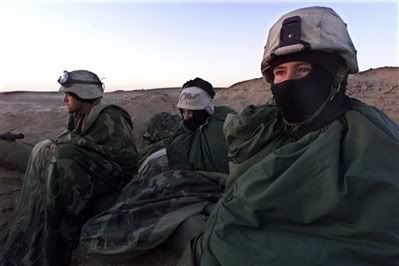
Unidentified U.S. Marines are shown in this 2001 file photo in Afghanistan.
WASHINGTON - About 3,200 Marines are being told to prepare to go to Afghanistan, military officials said Monday, in an effort to boost combat troop levels and get ready for an expected Taliban offensive this spring.
Once complete, the deployment would increase U.S. forces in Afghanistan to as much as 30,000, the highest level since the 2001 invasion after the terrorist attacks on the World Trade Center and the Pentagon.
The military began notifying the Marines and their families over the weekend, as Defense Secretary Robert Gates was expected to sign the formal deployment orders. It was not clear Monday whether the orders had been signed yet.
The proposal went to Gates on Friday, and while he told reporters that afternoon that he had some questions about the move, there has been every indication he was poised to approve it.
According to officials, 2,200 members of the 24th Marine Expeditionary Unit, based at Camp Lejeune, N.C., will go to Afghanistan, as well as about 1,000 members of the 2nd Battalion, 7th Marine Regiment, which is based at Twentynine Palms, Calif.
The officials spoke on condition of anonymity because the deployment announcement has not yet been made. If approved, the deployment to southern Afghanistan would be a "one-time, seven-month" assignment, Pentagon Press Secretary Geoff Morrell said Friday.
The 2nd Battalion, which is from the Marine Corps Air Ground Combat Center, is an infantry unit, and it will be used largely for training Afghan forces.
The decision to increase U.S. troop levels in Afghanistan represents a shift in Pentagon thinking that has been slowly developing in recent months. Commanders faced with increasing violence have said they need as many as 7,500 more troops, but Gates initially pressed for other NATO nations to fill the void.
NATO countries, however, faced public opposition to deeper involvement there and were slow to respond, leaving Gates to acknowledge recently that the U.S. may have to consider providing the extra combat troops.
Currently, there are about 27,000 U.S. troops in Afghanistan, including 14,000 with the NATO-led coalition. The other 13,000 U.S. troops are training Afghan forces and hunting al-Qaida terrorists.
Afghanistan Defense Ministry spokesman Gen. Mohammed Zahir Azimi said last week that the deployment would help combat Taliban insurgents. But Azimi added the long-term solution was to boost the fighting strength of Afghanistan's own army.
Unidentified U.S. Marines are shown in this 2001 file photo in Afghanistan.
WASHINGTON - About 3,200 Marines are being told to prepare to go to Afghanistan, military officials said Monday, in an effort to boost combat troop levels and get ready for an expected Taliban offensive this spring.
Once complete, the deployment would increase U.S. forces in Afghanistan to as much as 30,000, the highest level since the 2001 invasion after the terrorist attacks on the World Trade Center and the Pentagon.
The military began notifying the Marines and their families over the weekend, as Defense Secretary Robert Gates was expected to sign the formal deployment orders. It was not clear Monday whether the orders had been signed yet.
The proposal went to Gates on Friday, and while he told reporters that afternoon that he had some questions about the move, there has been every indication he was poised to approve it.
According to officials, 2,200 members of the 24th Marine Expeditionary Unit, based at Camp Lejeune, N.C., will go to Afghanistan, as well as about 1,000 members of the 2nd Battalion, 7th Marine Regiment, which is based at Twentynine Palms, Calif.
The officials spoke on condition of anonymity because the deployment announcement has not yet been made. If approved, the deployment to southern Afghanistan would be a "one-time, seven-month" assignment, Pentagon Press Secretary Geoff Morrell said Friday.
The 2nd Battalion, which is from the Marine Corps Air Ground Combat Center, is an infantry unit, and it will be used largely for training Afghan forces.
The decision to increase U.S. troop levels in Afghanistan represents a shift in Pentagon thinking that has been slowly developing in recent months. Commanders faced with increasing violence have said they need as many as 7,500 more troops, but Gates initially pressed for other NATO nations to fill the void.
NATO countries, however, faced public opposition to deeper involvement there and were slow to respond, leaving Gates to acknowledge recently that the U.S. may have to consider providing the extra combat troops.
Currently, there are about 27,000 U.S. troops in Afghanistan, including 14,000 with the NATO-led coalition. The other 13,000 U.S. troops are training Afghan forces and hunting al-Qaida terrorists.
Afghanistan Defense Ministry spokesman Gen. Mohammed Zahir Azimi said last week that the deployment would help combat Taliban insurgents. But Azimi added the long-term solution was to boost the fighting strength of Afghanistan's own army.
Saturday, January 12, 2008
Lose weight with lip gloss?
FUZE Slenderize Guilt Free Lip Gloss

This lip gloss is suppose to curb your hunger and boost your metabolism and all that glorious stuff, but I'm not sure if I should believe it. I remember when my aunt sent me this "slenderizing" toothpaste from Australia and it didn't work at all! I think the best way to lose weight is by hiring a trainer, a nutritionist and a dietitian. Is that how you spell dietitian? Gosh... which reminds me......... I have to follow an after-Christmas diet plan. lol
This lip gloss is suppose to curb your hunger and boost your metabolism and all that glorious stuff, but I'm not sure if I should believe it. I remember when my aunt sent me this "slenderizing" toothpaste from Australia and it didn't work at all! I think the best way to lose weight is by hiring a trainer, a nutritionist and a dietitian. Is that how you spell dietitian? Gosh... which reminds me......... I have to follow an after-Christmas diet plan. lol
National Reconciliation begins!
From PatDollard.Com:
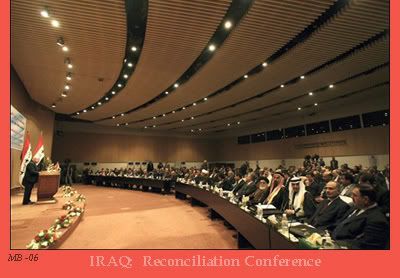
Iraq’s Parliament Adopts Law to Reinstate Former Baath Party Supporters to Government Jobs
Iraq’s parliament adopted legislation Saturday on the reinstatement of former Baath party supporters to government jobs, a benchmark sought by the United States as a key step toward national reconciliation.
The voting was carried out by a show of hands on each of the law’s 30 clauses. The bill, officially called the “Accountability and Justice” law, seeks to relax restrictions on the right of members of Saddam Hussein’s now-dissolved Baath party to fill government posts. It is also designed to reinstate thousands of Baathists in government jobs from which they had been dismissed because of their ties to the party.
The dismissal of thousands of Baath Party supporters from these jobs had deepened sectarian tensions between Iraq’s majority Shiites and the once-dominant Sunni Arabs.
other news:
Saddam’s Scrawl To Be Removed From Iraqi Flag
Iraq’s Parliament Adopts Law to Reinstate Former Baath Party Supporters to Government Jobs
Iraq’s parliament adopted legislation Saturday on the reinstatement of former Baath party supporters to government jobs, a benchmark sought by the United States as a key step toward national reconciliation.
The voting was carried out by a show of hands on each of the law’s 30 clauses. The bill, officially called the “Accountability and Justice” law, seeks to relax restrictions on the right of members of Saddam Hussein’s now-dissolved Baath party to fill government posts. It is also designed to reinstate thousands of Baathists in government jobs from which they had been dismissed because of their ties to the party.
The dismissal of thousands of Baath Party supporters from these jobs had deepened sectarian tensions between Iraq’s majority Shiites and the once-dominant Sunni Arabs.
other news:
Saddam’s Scrawl To Be Removed From Iraqi Flag
If Bush were president in the 1940s...
Bush: US should have acted on Auschwitz
GWB is tellin' it like it is.

A teary-eyed President Bush stopped in front of an aerial photo of Auschwitz on Friday at Israel's Holocaust memorial and said the U.S. should have sent bombers to prevent the extermination of Jews there.
Yad Vashem's chairman, Avner Shalev, quoted Bush as saying the U.S. should have "bombed it." Secretary of State Condoleezza Rice said Bush referred to the train tracks leading to Auschwitz, not the camp itself, where between 1.1 million and 1.5 million people were killed by Nazi Germany.
The issue of bombing the Nazi death camps or the rail lines leading to them has been debated for years — and the lack of action was interpreted by some as a sign of Allied indifference.
The Allies had detailed reports about Auschwitz toward the end of World War II from escaped prisoners. But they chose not to bomb the camp, the rail lines, or any of the other Nazi death camps, preferring instead to focus all resources on the broader military effort.
Some experts note only late in the war did the United States have the capability to bomb the infamous camp in occupied Poland, and also faced a moral dilemma since such an operation could kill thousands of prisoners. Even Jewish leaders at the time struggled with the issue and many concluded that loss of innocent lives under such circumstances was justifiable.
Bush twice had tears in his eyes during an hour-long tour of the museum, said Shalev, who guided Bush through the exhibits.
Upon viewing an aerial shot of Auschwitz, taken during the war by U.S. forces, he said Bush called the decision not to bomb it "complex." He then called over Rice to discuss President Franklin D. Roosevelt's decision, clearly pondering the options before rendering an opinion of his own, Shalev told The Associated Press.
Shalev quoted Bush as asking Rice, "Why didn't Roosevelt bomb it?" He said Rice and Bush discussed the matter further and then the president delivered his verdict.
"We should have bombed it," Shalev, speaking in Hebrew, quoted Bush as saying.
Briefing reporters later on Air Force One, Rice said Bush was talking about the rail lines to the camp.
"We were talking about the often-discussed 'Could the United States have done more by bombing the train tracks?'" Rice said. "And so we were just talking about the various explanations that had been given about why that might not have been done.
"It was an exhibit about the train tracks. And so we were just talking about the various explanations because, you know, there are three or four different explanations about why the United States chose not to try to bomb the train tracks," she said.
Rice did not detail those reasons.
Later Friday night, asked about Rice's remarks to reporters, Shalev told the AP the president was not specific about what the Allies should have bombed.
Tom Segev, a leading Israeli scholar of the Holocaust, said Bush's reported comment, which appeared spontaneous, marked the first time a U.S. president had made this acknowledgment.
"It is clear now that the U.S. knew a lot about it," Segev said. "It's possible that bombing at least the railway to the camps may have saved the lives of the Jews of Hungary. They were the very last ones who were sent to Auschwitz at a time when everybody knew what was going on."
At the dedication of the U.S. Holocaust Memorial Museum in Washington in 1993, Nobel Peace Prize laureate Elie Wiesel famously asked, "Why weren't the railways leading to Birkenau bombed by allied bombers? As long as I live I will not understand that." Birkenau was the site of the main gas chambers and crematoriums at Auschwitz. UNESCO last year approved a name change from Auschwitz concentration camp to Auschwitz-Birkenau.
At that same dedication, former President Bill Clinton said that the West has to "live forever with this knowledge ... (that) far too little was done," and that "rail lines to the camps within miles of militarily significant targets were left undisturbed."
Segev said the question of a bombing was not so clear cut, noting that it wasn't certain the United States had the ability to carry out such an operation.
In a response to a request that U.S. forces bomb Auschwitz and the rail lines, John J. McCloy, Roosevelt's assistant secretary of war, laid out the U.S. rationale for inaction.
"Such an operation could be executed only by the diversion of considerable air support essential to the success of our forces now engaged in decisive operations elsewhere and would in any case be of such doubtful efficacy that it would not be warrant use of our resources," he wrote in an Aug. 14, 1944, letter.
Holocaust scholar Michael Berenbaum said the photo presentation at the museum, and Bush's reported comments there, do not reflect the difficulties in bombing Auschwitz.
"It would have been a much more complex decision than what is presumed here," said Berenbaum, who teaches at the American Jewish University in Los Angeles.
Berenbaum said the aerial photos that Bush saw at the museum were not developed from the negatives until 1977, nor were they taken purposely to depict Auschwitz. U.S. intelligence forces took them during a bombing campaign on a German chemical plant nearby, which they carried out in August 1944.
But he also said there is no question that had the Allies been interested, they could have bombed Auschwitz and saved lives. By the time the idea was raised in summer 1944, they could have bombed the camp and the railway tracks leading to it using air bases in Italy or, if they had wanted to earlier, from Soviet territory.
"The Americans flubbed it," Berenbaum said. "The bombing could have weakened the infrastructure and made it more difficult to kill with the efficacy with which they killed."
In an article Berenbaum wrote for Encyclopaedia Britannica, he quoted Wiesel, who was a prisoner at Buna-Monowitz, the slave-labor camp of Auschwitz, as saying that inmates were "filled with joy" over the August 1944 Allied bombing of an adjacent plant. "We were no longer afraid of death; at any rate, not of that death," he quoted Wiesel as saying.
The David S. Wyman Institute for Holocaust Studies in Washington issued a statement praising Bush's reported remark.
"The refusal to bomb Auschwitz was part of a broader policy by the Roosevelt administration to refrain from taking action to rescue or shelter Jewish refugees during the Holocaust. Tragically, the United States turned away from one of history's most compelling moral challenges," said Rafael Medoff, the institute's director.
Eliezer Schweid, a professor of Jewish Thought at Israel's Hebrew University, said the question of a bombing is irrelevant in retrospect.
World Jewish leadership "was afraid to ask publicly" for the Allies to bomb the death camps, believing that would turn the conflict into a war for the Jews, Schweid said.
Bush was accompanied on his tour by a small party that included Rice, Israeli Prime Minister Ehud Olmert and Israeli President Shimon Peres.
At the compound, overlooking a forest on Jerusalem's outskirts, Bush visited a memorial to the 1.5 million Jewish children killed in the Holocaust, featuring six candles reflected 1.5 million times in a hall of mirrors.
At the site's Hall of Remembrance, he heard a cantor chant a Jewish prayer for the dead. There, Bush, wearing a yarmulke, placed a red, white and blue wreath on a stone slab that covers ashes of Holocaust victims taken from six extermination camps. He also lit a torch memorializing the victims.
"I was most impressed that people in the face of horror and evil would not forsake their God. In the face of unspeakable crimes against humanity, brave souls — young and old — stood strong for what they believe," Bush said.
"I wish as many people as possible would come to this place. It is a sobering reminder that evil exists, and a call that when evil exists we must resist it," he said.
The memorial was closed to the public and under heavy guard Friday, with armed soldiers standing atop some of the site's monuments and a police helicopter and surveillance blimp overhead.
It was Bush's second visit to the memorial. His first was in 1998, as governor of Texas. The last sitting U.S. president to visit was Clinton in 1994.
In the visitors' book, the president wrote simply, "God bless Israel, George Bush."
GWB is tellin' it like it is.
A teary-eyed President Bush stopped in front of an aerial photo of Auschwitz on Friday at Israel's Holocaust memorial and said the U.S. should have sent bombers to prevent the extermination of Jews there.
Yad Vashem's chairman, Avner Shalev, quoted Bush as saying the U.S. should have "bombed it." Secretary of State Condoleezza Rice said Bush referred to the train tracks leading to Auschwitz, not the camp itself, where between 1.1 million and 1.5 million people were killed by Nazi Germany.
The issue of bombing the Nazi death camps or the rail lines leading to them has been debated for years — and the lack of action was interpreted by some as a sign of Allied indifference.
The Allies had detailed reports about Auschwitz toward the end of World War II from escaped prisoners. But they chose not to bomb the camp, the rail lines, or any of the other Nazi death camps, preferring instead to focus all resources on the broader military effort.
Some experts note only late in the war did the United States have the capability to bomb the infamous camp in occupied Poland, and also faced a moral dilemma since such an operation could kill thousands of prisoners. Even Jewish leaders at the time struggled with the issue and many concluded that loss of innocent lives under such circumstances was justifiable.
Bush twice had tears in his eyes during an hour-long tour of the museum, said Shalev, who guided Bush through the exhibits.
Upon viewing an aerial shot of Auschwitz, taken during the war by U.S. forces, he said Bush called the decision not to bomb it "complex." He then called over Rice to discuss President Franklin D. Roosevelt's decision, clearly pondering the options before rendering an opinion of his own, Shalev told The Associated Press.
Shalev quoted Bush as asking Rice, "Why didn't Roosevelt bomb it?" He said Rice and Bush discussed the matter further and then the president delivered his verdict.
"We should have bombed it," Shalev, speaking in Hebrew, quoted Bush as saying.
Briefing reporters later on Air Force One, Rice said Bush was talking about the rail lines to the camp.
"We were talking about the often-discussed 'Could the United States have done more by bombing the train tracks?'" Rice said. "And so we were just talking about the various explanations that had been given about why that might not have been done.
"It was an exhibit about the train tracks. And so we were just talking about the various explanations because, you know, there are three or four different explanations about why the United States chose not to try to bomb the train tracks," she said.
Rice did not detail those reasons.
Later Friday night, asked about Rice's remarks to reporters, Shalev told the AP the president was not specific about what the Allies should have bombed.
Tom Segev, a leading Israeli scholar of the Holocaust, said Bush's reported comment, which appeared spontaneous, marked the first time a U.S. president had made this acknowledgment.
"It is clear now that the U.S. knew a lot about it," Segev said. "It's possible that bombing at least the railway to the camps may have saved the lives of the Jews of Hungary. They were the very last ones who were sent to Auschwitz at a time when everybody knew what was going on."
At the dedication of the U.S. Holocaust Memorial Museum in Washington in 1993, Nobel Peace Prize laureate Elie Wiesel famously asked, "Why weren't the railways leading to Birkenau bombed by allied bombers? As long as I live I will not understand that." Birkenau was the site of the main gas chambers and crematoriums at Auschwitz. UNESCO last year approved a name change from Auschwitz concentration camp to Auschwitz-Birkenau.
At that same dedication, former President Bill Clinton said that the West has to "live forever with this knowledge ... (that) far too little was done," and that "rail lines to the camps within miles of militarily significant targets were left undisturbed."
Segev said the question of a bombing was not so clear cut, noting that it wasn't certain the United States had the ability to carry out such an operation.
In a response to a request that U.S. forces bomb Auschwitz and the rail lines, John J. McCloy, Roosevelt's assistant secretary of war, laid out the U.S. rationale for inaction.
"Such an operation could be executed only by the diversion of considerable air support essential to the success of our forces now engaged in decisive operations elsewhere and would in any case be of such doubtful efficacy that it would not be warrant use of our resources," he wrote in an Aug. 14, 1944, letter.
Holocaust scholar Michael Berenbaum said the photo presentation at the museum, and Bush's reported comments there, do not reflect the difficulties in bombing Auschwitz.
"It would have been a much more complex decision than what is presumed here," said Berenbaum, who teaches at the American Jewish University in Los Angeles.
Berenbaum said the aerial photos that Bush saw at the museum were not developed from the negatives until 1977, nor were they taken purposely to depict Auschwitz. U.S. intelligence forces took them during a bombing campaign on a German chemical plant nearby, which they carried out in August 1944.
But he also said there is no question that had the Allies been interested, they could have bombed Auschwitz and saved lives. By the time the idea was raised in summer 1944, they could have bombed the camp and the railway tracks leading to it using air bases in Italy or, if they had wanted to earlier, from Soviet territory.
"The Americans flubbed it," Berenbaum said. "The bombing could have weakened the infrastructure and made it more difficult to kill with the efficacy with which they killed."
In an article Berenbaum wrote for Encyclopaedia Britannica, he quoted Wiesel, who was a prisoner at Buna-Monowitz, the slave-labor camp of Auschwitz, as saying that inmates were "filled with joy" over the August 1944 Allied bombing of an adjacent plant. "We were no longer afraid of death; at any rate, not of that death," he quoted Wiesel as saying.
The David S. Wyman Institute for Holocaust Studies in Washington issued a statement praising Bush's reported remark.
"The refusal to bomb Auschwitz was part of a broader policy by the Roosevelt administration to refrain from taking action to rescue or shelter Jewish refugees during the Holocaust. Tragically, the United States turned away from one of history's most compelling moral challenges," said Rafael Medoff, the institute's director.
Eliezer Schweid, a professor of Jewish Thought at Israel's Hebrew University, said the question of a bombing is irrelevant in retrospect.
World Jewish leadership "was afraid to ask publicly" for the Allies to bomb the death camps, believing that would turn the conflict into a war for the Jews, Schweid said.
Bush was accompanied on his tour by a small party that included Rice, Israeli Prime Minister Ehud Olmert and Israeli President Shimon Peres.
At the compound, overlooking a forest on Jerusalem's outskirts, Bush visited a memorial to the 1.5 million Jewish children killed in the Holocaust, featuring six candles reflected 1.5 million times in a hall of mirrors.
At the site's Hall of Remembrance, he heard a cantor chant a Jewish prayer for the dead. There, Bush, wearing a yarmulke, placed a red, white and blue wreath on a stone slab that covers ashes of Holocaust victims taken from six extermination camps. He also lit a torch memorializing the victims.
"I was most impressed that people in the face of horror and evil would not forsake their God. In the face of unspeakable crimes against humanity, brave souls — young and old — stood strong for what they believe," Bush said.
"I wish as many people as possible would come to this place. It is a sobering reminder that evil exists, and a call that when evil exists we must resist it," he said.
The memorial was closed to the public and under heavy guard Friday, with armed soldiers standing atop some of the site's monuments and a police helicopter and surveillance blimp overhead.
It was Bush's second visit to the memorial. His first was in 1998, as governor of Texas. The last sitting U.S. president to visit was Clinton in 1994.
In the visitors' book, the president wrote simply, "God bless Israel, George Bush."
Savin' the blondes!
Blackwater saves the day in Kenya!
By Bill Sizemore
The Virginian-Pilot
© January 8, 2008
Yeah, I'm totally lagging here. lol.

Blackwater rocks! How can you NOT love 'em!
Blackwater may have its detractors, but one father in Michigan is singing the company's praises this week.
The Moyock, N.C.-based private military company evacuated three young Michigan women from an orphanage in a remote Kenyan village after a disputed election Dec. 27 set off a wave of violence that has left hundreds of Kenyans dead.
The three women arrived safely in Grand Rapids, Mich., on Monday.
Blackwater security contractors are under investigation for a September incident that left at least 17 Iraqi civilians dead. But Dean VanderMey said Tuesday that he has seen the company's humanitarian side.
"It wasn't the image that most people have of Blackwater," VanderMey said. "These were dedicated men, professionals, just saying, 'We know how to help people in times like this.' "
VanderMey runs Set Free Ministries, a nondenominational Christian ministry based in Grand Rapids that has operations in Africa. His daughters Brittanie, 21, and Aubrie, 19, and a friend, Jamie Cook, 20, had been volunteering at the Kenyan orphanage on a mission trip since Dec. 1.
They had planned to stay through February. But after the violence erupted, VanderMey spent five frantic days trying to find a way to get them out.
"There were towns all around them burning," he said. "I don't even think the kids knew how much danger they were in."
Unable to locate a helicopter or airplane to pick them up, VanderMey called his mother, who reached Blackwater founder Erik Prince through a mutual friend, U.S. Rep. Vernon Ehlers, R-Grand Rapids. Prince grew up in Holland, Mich., about 30 miles from Grand Rapids.
Soon, VanderMey said, he got a phone call from Prince, who told him, "We're going to do everything we can do to get your girls out."
A Blackwater employee flew from Afghanistan to Kenya to run the operation, VanderMey said. The company located a 10-passenger single-engine plane, which picked up the women at an airstrip near the orphanage in the village of Kimilili and flew them 185 miles to Nairobi, the Kenyan capital, where they got a commercial flight home.
VanderMey paid the charter fee for the plane, but Blackwater charged him nothing for its services.
"Erik wouldn't hear of it," VanderMey said. "He said, 'This has nothing to do with money. This is about getting Americans out of harm's way.'
"They got it done. I was pretty impressed."
By Bill Sizemore
The Virginian-Pilot
© January 8, 2008
Yeah, I'm totally lagging here. lol.
Blackwater rocks! How can you NOT love 'em!
Blackwater may have its detractors, but one father in Michigan is singing the company's praises this week.
The Moyock, N.C.-based private military company evacuated three young Michigan women from an orphanage in a remote Kenyan village after a disputed election Dec. 27 set off a wave of violence that has left hundreds of Kenyans dead.
The three women arrived safely in Grand Rapids, Mich., on Monday.
Blackwater security contractors are under investigation for a September incident that left at least 17 Iraqi civilians dead. But Dean VanderMey said Tuesday that he has seen the company's humanitarian side.
"It wasn't the image that most people have of Blackwater," VanderMey said. "These were dedicated men, professionals, just saying, 'We know how to help people in times like this.' "
VanderMey runs Set Free Ministries, a nondenominational Christian ministry based in Grand Rapids that has operations in Africa. His daughters Brittanie, 21, and Aubrie, 19, and a friend, Jamie Cook, 20, had been volunteering at the Kenyan orphanage on a mission trip since Dec. 1.
They had planned to stay through February. But after the violence erupted, VanderMey spent five frantic days trying to find a way to get them out.
"There were towns all around them burning," he said. "I don't even think the kids knew how much danger they were in."
Unable to locate a helicopter or airplane to pick them up, VanderMey called his mother, who reached Blackwater founder Erik Prince through a mutual friend, U.S. Rep. Vernon Ehlers, R-Grand Rapids. Prince grew up in Holland, Mich., about 30 miles from Grand Rapids.
Soon, VanderMey said, he got a phone call from Prince, who told him, "We're going to do everything we can do to get your girls out."
A Blackwater employee flew from Afghanistan to Kenya to run the operation, VanderMey said. The company located a 10-passenger single-engine plane, which picked up the women at an airstrip near the orphanage in the village of Kimilili and flew them 185 miles to Nairobi, the Kenyan capital, where they got a commercial flight home.
VanderMey paid the charter fee for the plane, but Blackwater charged him nothing for its services.
"Erik wouldn't hear of it," VanderMey said. "He said, 'This has nothing to do with money. This is about getting Americans out of harm's way.'
"They got it done. I was pretty impressed."
Know their names!
The names of the three heroic Iraqi soldiers were posted over at Pat Dollard's. Check it out:
Malik Abdul Ghanem.
Asa’ad Hussein Ali.
Abdul-Hamza Abdul-Hassan Rissan.
If you recall, these three young men threw themselves on top of a suicide bomber at an Army parade a couple of days ago. They were killed when the little coward detonated his suicide vest...
I just think... we should know their names.
Malik Abdul Ghanem.
Asa’ad Hussein Ali.
Abdul-Hamza Abdul-Hassan Rissan.
If you recall, these three young men threw themselves on top of a suicide bomber at an Army parade a couple of days ago. They were killed when the little coward detonated his suicide vest...
I just think... we should know their names.
Sunday, January 6, 2008
Traitor calls for Bush attacks!
Real Heroes: Iraqi Army Soldiers jump on Suicide Bomber
Al-Qaida's American seeks Bush attacks
GWB would kick this little puke's butt if they were ever face-to-face!
CAIRO, Egypt - Al-Qaida's American spokesman urged fighters to meet President Bush with bombs when he visits the Middle East, according to a new video posted on the Internet Sunday.
U.S.-born Adam Gadahn also tore up his American passport as part of a symbolic protest in the nearly hour-long rhetoric-dominated tape — al-Qaida's first message of the new year.
The release comes just three days before Bush is scheduled to arrive in Israel for a weeklong trip that will also bring him to the West Bank, Kuwait, Bahrain, the United Arab Emirates, Saudi Arabia and Egypt as part of his push for an Israeli-Palestinian peace agreement.
"Now we direct an urgent call to our militant brothers in Muslim Palestine and the Arab peninsula ... to be ready to receive the Crusader slayer Bush in his visit to Muslim Palestine and the Arab peninsula in the beginning of January and to receive him not with flowers or clapping but with bombs and booby-trapped vehicles," Gadahn, 29, said in Arabic.
"This just shows once again, al-Qaida offers nothing but violence and death," National Security Council spokesman Gordon Johndroe said. "The purpose of President Bush's trip is to meet with mainstream Arab leaders and people to talk about a positive future for the region, based on hope and opportunity."
As for Gadahn's tearing up his U.S. passport, Johndroe said: "He is wanted for treason against the United States. His passport was already void."
During the rest of the 50-minute video, titled "An Invitation to Reflection and Repentance," Gadahn, who was raised in California, spoke mostly in English, appearing to specifically address the American people. He said al-Qaida felt the need to release the statement after Washington's "defeat" in Iraq and Afghanistan and failed attempts by the Bush administration to bring peace to the Middle East.
"We felt it necessary to address the American people and explain to them some of the facts about these critical and fast-moving events," said Gadahn, who wore a white-and-red headscarf and sat behind a desk with a laptop computer and coffee mug nearby.
"The first questions Americans might ask is has America really been defeated? The answer is yes and on all fronts," he added.
The video could not immediately be independently verified, but it appeared on a Web site often used by Islamic militants and carried the logo of al-Qaida's media wing, al-Sahab. At the beginning of the video, the date December 2007 was displayed. Gadahn also mentioned Robert Hawkins, who killed eight people at a mall in Omaha, Neb. on Dec. 5, suggesting the tape was made sometime after then.
Gadahn, also known as Azzam al-Amriki, was charged with treason in the U.S. in 2006 and has been wanted since 2004 by the FBI, which is offering a $1 million reward for information leading to his arrest or conviction.
He has appeared in several al-Qaida videos including one in August when he threatened new attacks on foreign embassies. In May, al-Qaida released another video featuring Gadahn, who warned Bush to end U.S. involvement in Muslim lands or face an attack worse than the Sept. 11, 2001, strikes.
Ben Venzke, the head of IntelCenter, a U.S. group that monitors and analyzes militant messages, said much of Gadahn's new video shares a similar tone as his previous messages.
"It fits into al-Qaida's notion of providing warning and opportunity for people to correct their ways to avoid an attack," he said.
In the video, Gadahn lashed out repeatedly at the United States for its wars in Afghanistan and Iraq and its close ties to Israel and the leaders of some Muslim countries, including Egypt and Pakistan, which he described as some of the "worst dictators and tyrants."
Gadahn also criticized Christianity, which he called "baseless and doubt-filled," and urged Americans — including soldiers who fought in Vietnam, Iraq and Afghanistan — to convert to Islam.
"Listen to me, and listen to me carefully, before you lose your mind to flashbacks, and drugs and drink-induced dementia and before your demons drive you to self-destruction and suicide, in these verses (in the Quran), God calls out to each and every one of you saying God forgives all sins ... if you simply stop and repent," he said.
At one point in the video, Gadahn took out his U.S. passport, showed it to the camera and tore it into several pieces.
"In symbolic rejection of the American citizenship that honorable and decent and compassionate people are ashamed to carry, I will now proceed to destroy my American passport," he said.
"But don't get too excited, I don't need it to travel anyway," he added with a smile after tearing it apart.
Despite Gadahn's passport destruction, Venzke cautioned against dismissing him as a crazy kid and said his warnings should be taken seriously.
"The reality is al-Qaida and al-Sahab do not put anything out without a lot of planning ... They are very deliberate," he said.
Gadahn is the first American to be charged with treason in more than 50 years and could face the death penalty if convicted. He also was indicted on a charge of providing material support to terrorists.
Earlier this month, FBI spokesman Richard Kolko said the agency would review the latest tape for intelligence value and vowed never to give up the hunt for Gadahn.
Al-Qaida's American seeks Bush attacks
GWB would kick this little puke's butt if they were ever face-to-face!
CAIRO, Egypt - Al-Qaida's American spokesman urged fighters to meet President Bush with bombs when he visits the Middle East, according to a new video posted on the Internet Sunday.
U.S.-born Adam Gadahn also tore up his American passport as part of a symbolic protest in the nearly hour-long rhetoric-dominated tape — al-Qaida's first message of the new year.
The release comes just three days before Bush is scheduled to arrive in Israel for a weeklong trip that will also bring him to the West Bank, Kuwait, Bahrain, the United Arab Emirates, Saudi Arabia and Egypt as part of his push for an Israeli-Palestinian peace agreement.
"Now we direct an urgent call to our militant brothers in Muslim Palestine and the Arab peninsula ... to be ready to receive the Crusader slayer Bush in his visit to Muslim Palestine and the Arab peninsula in the beginning of January and to receive him not with flowers or clapping but with bombs and booby-trapped vehicles," Gadahn, 29, said in Arabic.
"This just shows once again, al-Qaida offers nothing but violence and death," National Security Council spokesman Gordon Johndroe said. "The purpose of President Bush's trip is to meet with mainstream Arab leaders and people to talk about a positive future for the region, based on hope and opportunity."
As for Gadahn's tearing up his U.S. passport, Johndroe said: "He is wanted for treason against the United States. His passport was already void."
During the rest of the 50-minute video, titled "An Invitation to Reflection and Repentance," Gadahn, who was raised in California, spoke mostly in English, appearing to specifically address the American people. He said al-Qaida felt the need to release the statement after Washington's "defeat" in Iraq and Afghanistan and failed attempts by the Bush administration to bring peace to the Middle East.
"We felt it necessary to address the American people and explain to them some of the facts about these critical and fast-moving events," said Gadahn, who wore a white-and-red headscarf and sat behind a desk with a laptop computer and coffee mug nearby.
"The first questions Americans might ask is has America really been defeated? The answer is yes and on all fronts," he added.
The video could not immediately be independently verified, but it appeared on a Web site often used by Islamic militants and carried the logo of al-Qaida's media wing, al-Sahab. At the beginning of the video, the date December 2007 was displayed. Gadahn also mentioned Robert Hawkins, who killed eight people at a mall in Omaha, Neb. on Dec. 5, suggesting the tape was made sometime after then.
Gadahn, also known as Azzam al-Amriki, was charged with treason in the U.S. in 2006 and has been wanted since 2004 by the FBI, which is offering a $1 million reward for information leading to his arrest or conviction.
He has appeared in several al-Qaida videos including one in August when he threatened new attacks on foreign embassies. In May, al-Qaida released another video featuring Gadahn, who warned Bush to end U.S. involvement in Muslim lands or face an attack worse than the Sept. 11, 2001, strikes.
Ben Venzke, the head of IntelCenter, a U.S. group that monitors and analyzes militant messages, said much of Gadahn's new video shares a similar tone as his previous messages.
"It fits into al-Qaida's notion of providing warning and opportunity for people to correct their ways to avoid an attack," he said.
In the video, Gadahn lashed out repeatedly at the United States for its wars in Afghanistan and Iraq and its close ties to Israel and the leaders of some Muslim countries, including Egypt and Pakistan, which he described as some of the "worst dictators and tyrants."
Gadahn also criticized Christianity, which he called "baseless and doubt-filled," and urged Americans — including soldiers who fought in Vietnam, Iraq and Afghanistan — to convert to Islam.
"Listen to me, and listen to me carefully, before you lose your mind to flashbacks, and drugs and drink-induced dementia and before your demons drive you to self-destruction and suicide, in these verses (in the Quran), God calls out to each and every one of you saying God forgives all sins ... if you simply stop and repent," he said.
At one point in the video, Gadahn took out his U.S. passport, showed it to the camera and tore it into several pieces.
"In symbolic rejection of the American citizenship that honorable and decent and compassionate people are ashamed to carry, I will now proceed to destroy my American passport," he said.
"But don't get too excited, I don't need it to travel anyway," he added with a smile after tearing it apart.
Despite Gadahn's passport destruction, Venzke cautioned against dismissing him as a crazy kid and said his warnings should be taken seriously.
"The reality is al-Qaida and al-Sahab do not put anything out without a lot of planning ... They are very deliberate," he said.
Gadahn is the first American to be charged with treason in more than 50 years and could face the death penalty if convicted. He also was indicted on a charge of providing material support to terrorists.
Earlier this month, FBI spokesman Richard Kolko said the agency would review the latest tape for intelligence value and vowed never to give up the hunt for Gadahn.
New Year!
Happy New Year! I haven't been online in a while. I'm just waitin' for my new computer, and I've got relatives visiting from San Francisco, Australia and Switzerland so things are keeping me busy. Crazy, hey? Anyway, al-Qaeda is so desperate that they are now ordering radical Muslim women to blow themselves up. Are they not pathetic?
Iraq Deputy Blames UN For Corruption
BAGHDAD— Iraq’s culture of corruption stems from the actions of the international community and the controversial UN oil-for-food scheme, the deputy prime minister Barham Saleh said on Thursday.
Speaking at a new anti-corruption forum in Baghdad, Saleh said that the programme, run between 1996 and 2003 while Iraq was under UN sanctions, and what he charged was the body’s wasteful use of money were to blame for the rampant corruption that bedevils Iraq.
“A large responsibility for the outbreak of corruption in Iraq lies on the international community,” said Saleh.
“The scandals of food-for-oil and the wasting of public riches by the UN… is evidence of the serious damage that has deepened the problem in the country.”
For seven years before the US-led invasion of Iraq in 2003, the oil-for-food programme allowed Baghdad — which was under a punishing trade embargo since its invasion of Kuwait in 1990 — to sell oil in return for cash to buy food and medicine.
In 2000, then president Saddam Hussein began making the right to purchase its oil under the UN programme conditional on the buyer’s willingness to pay kickbacks.
The regime diverted about 1.8 billion dollars (1.2 billion euros), an independent probe found in 2005.
“The Iraqi people want a clear statement on how this money was administered in the past, to take back the stolen money, and to chase and call into account those who played with the public’s money,” said Saleh.
An analysis by the Berlin-based Transparency International in September found that Iraq was one of the three most corrupt countries in the world alongside Somalia and Myanmar.
The anti-corruption forum met for the first time on Thursday, to bring together ministers, members of parliament, international representatives and businessmen.
“It is necessary to coordinate with the international society.” Saleh said, “But we refuse any foreign mandate on Iraqi resolutions.”
Iraqi Prime Minister Nuri al-Maliki declared in his New Year message that 2008 would be a year of economic development and fighting corruption.
The White House said in September that Maliki was “working hard” to fight corruption but declined to say whether he had been “adequately successful.”
Its comments came after a damning report by the US embassy, posted on the Internet, painted a grim picture of corruption in all Iraqi government departments and said Maliki’s office had shown “open hostility” to independent investigators.
Iraq Deputy Blames UN For Corruption
BAGHDAD— Iraq’s culture of corruption stems from the actions of the international community and the controversial UN oil-for-food scheme, the deputy prime minister Barham Saleh said on Thursday.
Speaking at a new anti-corruption forum in Baghdad, Saleh said that the programme, run between 1996 and 2003 while Iraq was under UN sanctions, and what he charged was the body’s wasteful use of money were to blame for the rampant corruption that bedevils Iraq.
“A large responsibility for the outbreak of corruption in Iraq lies on the international community,” said Saleh.
“The scandals of food-for-oil and the wasting of public riches by the UN… is evidence of the serious damage that has deepened the problem in the country.”
For seven years before the US-led invasion of Iraq in 2003, the oil-for-food programme allowed Baghdad — which was under a punishing trade embargo since its invasion of Kuwait in 1990 — to sell oil in return for cash to buy food and medicine.
In 2000, then president Saddam Hussein began making the right to purchase its oil under the UN programme conditional on the buyer’s willingness to pay kickbacks.
The regime diverted about 1.8 billion dollars (1.2 billion euros), an independent probe found in 2005.
“The Iraqi people want a clear statement on how this money was administered in the past, to take back the stolen money, and to chase and call into account those who played with the public’s money,” said Saleh.
An analysis by the Berlin-based Transparency International in September found that Iraq was one of the three most corrupt countries in the world alongside Somalia and Myanmar.
The anti-corruption forum met for the first time on Thursday, to bring together ministers, members of parliament, international representatives and businessmen.
“It is necessary to coordinate with the international society.” Saleh said, “But we refuse any foreign mandate on Iraqi resolutions.”
Iraqi Prime Minister Nuri al-Maliki declared in his New Year message that 2008 would be a year of economic development and fighting corruption.
The White House said in September that Maliki was “working hard” to fight corruption but declined to say whether he had been “adequately successful.”
Its comments came after a damning report by the US embassy, posted on the Internet, painted a grim picture of corruption in all Iraqi government departments and said Maliki’s office had shown “open hostility” to independent investigators.
Subscribe to:
Posts (Atom)
