Pages

Subscribe Twitter

Friday, May 30, 2008

The President Has Kept Us Safe

By THANE ROSENBAUM
May 30, 2008; Page A15

With President Bush-bashing still a national pastime, it's notable how much international terrorism has been forgotten, and how little credit the president has received for keeping Americans safe.

This is a difficult issue for me. I didn't vote for President Bush – twice. And as a human-rights law professor, the events at Abu Ghraib and Guantanamo Bay, along with various elements of the Patriot Act and the National Security Agency's wiretapping of Americans, are all greatly troubling to me.

Yet I live in Manhattan and I was present on Sept. 11, 2001 – admittedly 100 blocks from the murder scene, but I was here, trembling along with the rest of America. Remember those days?

Everyone on 9/12 and thereafter – here in New York City and in cities across America – was quite certain that the next terrorist strike was imminent. The stock market collapsed on such fears, and Las Vegas odds makers weren't betting on safer days ahead. We endured interminable delays at airport security checkpoints. Even grandmothers were suddenly suspects.

Sarin and anthrax – the nerve gas and poison, respectively – entered our national vocabulary. Venturing into subways and pizza shops became a game of psychological Russian roulette – with an Islamic twist. Macy's and Zabar's seemed like inevitable strategic targets. Our fears were no longer isolated to skyscrapers – from now, all aspects of daily life would evoke terror.

We would come to familiarize ourselves with the color-coded scale of threat conditions issued by the Department of Homeland Security. (Was it safe to go out on orange, or did we have to wait until yellow?)

Each American city adopted its own visions of trauma. There were new categories of vulnerable public spaces. Our worst terrorism nightmares were projected onto local landmarks: Rodeo Drive, the Sears Tower, the French Quarter, River Walk, the Golden Gate Bridge, the Space Needle. Suddenly, living in rural, outlying areas seemed like a sensible lifestyle choice.

We all waited for terrorism's second shoe to drop, and, seven years later . . . nothing has happened.

Other cities around the world became targets: Madrid, Glasgow, London and Bali; the entire nation of Denmark; and, of course, Jerusalem and Tel Aviv. Here in America, however, the focus moved from concerns over counterterrorism measures and the abuse of presidential authority to the war in Iraq, the subprime mortgage crisis, the failing economy, the public meltdown of Britney Spears, and now, the presidential elections.

All this time Americans have been safe from suicide bombers, biological warfare and collapsing skyscrapers, while the rest of the world has been on red alert. And yet President Bush is regarded as the worst president in American history? Sorry, I must be missing something here.

Yes, there are those who maintain that our promiscuous misadventures in Iraq, Afghanistan and Israel have rendered America even less safe. That the president has further radicalized our enemies and alienated our nation. That the animosity for America now, improbably, runs even deeper. Whatever resentments and aspirations gave rise to 9/11 have grown and will not be easily dissipated. For this reason, no one should draw comfort in the relative safety of our shores.

Maybe so. But when a professed enemy succeeds as wildly as al Qaeda did on 9/11, and seven years pass without an incident, there are two reasonable conclusions: Either, despite all the trash-talking videos, they have been taking a long, leisurely breather; or, something serious has been done to thwart and disable their operations. Whatever combination of psychology and insanity motivates a terrorist to blow himself up is not within my range of experience, but I'm betting the aggressive measures the president took, and the unequivocal message he sent, might have had something to do with it.

Americans, admittedly, have short time horizons and, perhaps, even shorter attention spans. Our collective memory has historically been poor. But had there been another terrorist attack or, even worse, a dozen more in cities all over America – a fear that would not have been exaggerated on 9/12 – would we have allowed ourselves the luxury of quarreling over legally suspect counterterrorism measures, even though such internal debates are credits to our liberal democracy and constitutional freedoms?

Terrorism is now largely off the table in the minds of most Americans.

But in gearing up to elect a new president, we are left to wonder how, in spite of numerous failed policies and poor judgement, President Bush's greatest achievement was denied to him by people who ungratefully availed themselves of the protection that his administration provided.

Mr. Rosenbaum, a novelist, essayist and law professor at Fordham, is the author of "The Myth of Moral Justice" (Harper Perennial, 2005).

See all of today's editorials and op-eds, plus video commentary, on Opinion Journal.

And add your comments to the Opinion Journal forum.

Thursday, May 29, 2008

Chest Bump with President Bush!


When the moment finally came to meet the most powerful man in the United States, Theodore Shiveley had just two words for him: "Chest bump."

As the Richardson 22-year-old's class of Air Force Academy graduates streamed across a stage, many asked President Bush to do something unusual for them.

Some stashed pens in their socks so he could sign their hats. One even called his parents and asked the president to say hello on a cellphone.

Lt. Shiveley opened his arms and got the president to engage in a hearty chest bump with him.

"Hey, it's a once-in-a-lifetime chance," said the newly minted second lieutenant, who graduated from Plano East High School. "It was there during the ceremony when we saw other people doing stuff, and I thought, 'Well, let's one-up everybody.' "

As the president and the new graduate saluted each other a few feet apart, "I just hit my chest and said, 'Chest bump,' " Lt. Shiveley said. "And I gave him a little body language so he knew what I was about to do, so I didn't knock the president on his rear."

Lt. Shiveley admitted he had some reservations about smacking into the commander-in-chief.

"I didn't want to get shot by the Secret Service for jumping the president," he said.

"And then I thought, 'Ah, what the hell.' "

Monday, May 26, 2008

Blackwater pledges $2 million to USO

Blackwater Facts: Blackwater Aids USO

Blackwater Worldwide, the American private security contractor, has pledged $2 million to USO to support entertainment and service programs for US troops, WBTV reports.

Blackwater President Gary Jackson points out that Blackwater is staffed almost entirely by military veterans, and therefore understands the importance of USO's mission to support the troops.

Blackwater will provide the money over the next four years. In addition, seven other companies have made similar pledges.

Blackwater Hero!

Blackwater Facts: Small Town Supports Blackwater Guard

The town of Dickens, Texas is located in a vast swath of openness between Lubbock, Wichita Falls and Abilene. At the 2000 census it reported a population of 332. This town might not make the evening news too often, but it's standing by one of its native sons, Blackwater contractor Paul Slough.

Last September, while part of a Blackwater diplomatic security convoy, Slough and his companions came under fire at Nisoor Square in Baghdad. Some in the liberal media have called the Blackwater guards murderers for returning the enemy fire. But the folks of Dickens would never make such a claim.

"Most of Dickens considers Slough a patriot and a hero," writes Lubbock Online. "We are all very proud of him," said Dickens County Sheriff Ken Brendle. "That boy was always a leader. He's not a murderer."

"We're proud of PJ," said Andy Zarate, whose son Michael was good friends with Slough during high school. "We stand behind him 100 percent."

Slough played football, was active in Future Farmers of America and served on the student council while at Patton Springs High. After graduating from high school he joined the Army, participated in several deployments - including to Boznia - and was honorably discharged. He then served in Iraq with the Texas National Guard. Having completed his military service, Slough joined Blackwater's security operations.

Paul Slough is the only member of the Blackwater convoy to have his name released to the public. All the documents released by the FBI, other government entities and Blackwater have referred to the participants in the events by anonymous numbers. But the New York Times felt the need to leak Turret Gunner Number 3's identity. So now Slough, having come under the physical fire of insurgents, is now coming under the metaphorical fire of anti-war elements.

Tookie Cash, who recently retired as Dickens County clerk and knew Slough when he was growing up, said, "It's a shame. Our boys are putting their lives on the line and this is what they get in return."

Sunday, May 25, 2008

President Bush inducted into biker group


WASHINGTON (AFP) - US President George W. Bush donned a black leather biker jacket Sunday as he was given honorary membership in the Rolling Thunder motorcycle group which paraded through Washington to honor veterans on Memorial Day.

Tens of thousands of members of the biker group joined the parade down the US capital's main boulevards Sunday in the group's annual "Ride for Freedom" event to celebrate US soldiers and sailors and press for greater benefits for veterans.

Rolling Thunder leaders including National Executive Director Artie Muller met Bush at the White House, where they presented him with the vest in honor of their 21st Memorial Day ride.

Bush called the masses of motorcycles, which he observed from his helicopter just moments before, "a magnificent sight."

"We just choppered in, Artie, and saw your brothers and sisters cranking up their machines and driving through the nation's capital -- many of them have got the flag on the back," Bush told them.

"And I am just so honored to welcome you back. I want to thank you and all your comrades for being so patriotic and loving our country as much as you do," he said.

"And our troops appreciate you, the veterans appreciate you and your president appreciates you," Bush said.

***
The president also greeted some of his aides who joined in for the motorcycle ride, including Transportation Secretary Mary Peters, Agriculture Secretary Ed Schafer, White House chief of staff Josh Bolten and his top economic adviser, Edward Lazear, who showed up in a black bandanna and Harley-Davidson vest.

More?

President Bush takes the High Road.

The Washington Post:
Add another chapter to the ignominious history of the Bush-era Congress. After seven years of going belly up on such defining issues as the war in Iraq, torture and taxes, the House finally gets up the gumption to override President Bush on a major piece of legislation. And what is it? A pork-laden, subsidy-filled $307 billion giveaway piled high with election-year goodies for everyone.

Yesterday's farm bill override wasn't a rebellion against Bush. It was a massive expression of self-interest.

Oh, and Congress couldn't even do it right: A whole section of the 673-page bill never made it to the White House, so the bill Bush vetoed wasn't the one the House overrode. Congress will apparently have to do it all over again.

No wonder Congress's job-approval ratings are even lower than Bush's. (The latest Zogby poll has Bush at an all-time low of 23 percent, positively towering over Congress at 11 percent.)

The battle over the farm bill found Bush in the position of arguing against subsidies for millionaire farmers and agribusiness. A president who's added $3 trillion to the national debt took a firm stand for fiscal discipline.

But the battle was not really so much about policy differences as it was a reflection of the traditional tension between the legislative and executive branches. In Congress, a bill is likely to get a lot of votes if there's something in it for everyone. While Congress often finds itself caring mostly about the parts, it's the president's job to focus on the whole.

So Bush rises above politics to act presidential -- and that's when Congress shows some spine? That's what it takes for Republicans to leave his side and join forces with Democrats?

The only previous Bush veto override came in November, over a similarly goodie-laden (if much more modest) bill funding $23 billion worth of water projects. As Dana Milbank wrote in The Washington Post at the time: "The legislature has proved impotent in its efforts to challenge President Bush on such matters as the Iraq war and the waterboarding of prisoners. But the president learned an important lesson yesterday: Don't mess with lawmakers' pet projects."

The Coverage

Jonathan Weisman and Dan Morgan write in The Washington Post: "At midday, Bush vetoed the bill, declaring: 'Americans sent us to Washington to achieve results and be good stewards of their hard-earned taxpayer dollars. This bill violates that fundamental commitment.' Bush objected to subsidies for wealthy agribusinesses at a time of high food prices and record farm income.

"Hours later, the House voted 316 to 108 to override the veto, with 100 Republicans siding with 216 Democrats. The Senate voted last week, 81 to 15, to approve the farm bill. . . .

"The five-year measure continues and in some cases expands traditional farm subsidies, and it is stuffed with billions of dollars of new money for anti-hunger programs, conservation programs, fruit and vegetable growers, and the biofuels industry. Dairy farmers will get as much as $410 million more over 10 years to cover higher feed costs. House and Senate negotiators tucked in an annual authorization of $15 million to help 'geographically disadvantaged farmers' in Alaska, Hawaii and Puerto Rico.

"The bill assures growers of basic crops such as wheat, cotton, corn and soybeans $5 billion a year in automatic payments, even if farm and food prices stay at record levels. And subsidies for the ethanol industry will decline only slightly, leaving largely intact support for the biofuel industry, which has been blamed for contributing to higher food prices.

Sunday, May 18, 2008

Philosophy!


They have this in Hot Cocoa and you seriously need to try it. It smells so yummy and, seriously, your hair and skin will feel real smooth after. They also have shimmery body lotions that you might want to check out. Here is the Sweet Shop Collection by Philosophy, at Sephora.

Friday, May 16, 2008

Bush exchanges views with young Israelis


""I don't think he's so popular with young people in America," said Aviad Tamir, 25. "But from us he received a lot of warmth."


Near the end of his Israel visit, the president has an informal chat with a group of Jewish and Arab students. A frank and lively discussion results.
By Richard Boudreaux, Los Angeles Times Staff Writer
6:54 PM PDT, May 16, 2008

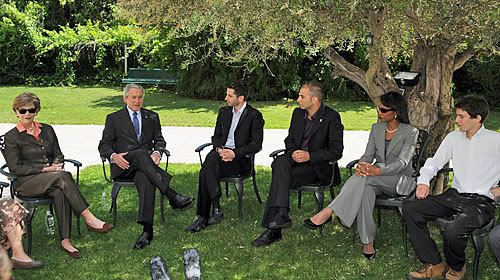
JERUSALEM -- Seated under an olive tree with a dozen Israeli students, President Bush was bemoaning the bad rap he gets in the Middle East. Many people believe he hates Muslims, he said, but it's not true.

It was as friendly an audience as Bush could expect in this part of the world, so Henriette Chacar's comeback gave him pause. "I think it comes out that you don't like Muslims because in most of your speeches you tend to relate extremism to Muslims," said the 16-year-old Israeli Arab, who is Christian.

Without bristling, Bush conceded the point.

"Actually, what I say is you're not a religious person if you're a murderer," he replied. "But you're right. I've got to do a better job of making it clear when I talk about Islam [that] I talk about a peaceful religion."

The exchange Friday was part of an unusually frank and lively discussion between an unscripted Bush and a diverse group of young Israelis as he ended a 48-hour visit to Israel. It showed a reflective, self- critical side of a leader in his final year in office, but also a gap in his awareness of the rigid social norms that underlie the region's conflict and reinforce division.

At one point, Bush asked whether Arabs and Jews date, or go to the same dances.

"No dances?" he asked, sounding surprised by the answer.

Then he glanced at 17-year-old Jonathan Blumenfeld, who had spoken about his music, and joked: "You should get him to take out his guitar. How much reconciliation there would be on the dance floor."

Manar Saraia put the issue to rest. It's unusual that she has Jewish roommates, but the 22-year-old Israeli Arab Muslim told Bush that her family would not approve if she dated or married a Jew.

"The parents and the children themselves think if we are of different religions that it's hard to live together as a couple," she said.

Bush conversed easily with the students as he sat with them in a circle of wrought iron chairs on the lawn of the Bible Lands Museum. First Lady Laura Bush and Secretary of State Condoleezza Rice joined them.

The student group, representing schools selected by the U.S. Embassy, was a mosaic of native-born Jews, Jewish immigrants from Ethiopia, Argentina and the former Soviet Union, and the two Arab Israeli citizens, members of a minority in Israel that often identifies with Palestinians in the neighboring West Bank and Gaza Strip. They included high school, university and postgraduate students.

Bush had come to Israel to help celebrate the 60th anniversary of the country's founding. And despite little to show for six months of U.S.-backed peace talks, he has pressed at every stop the goal of a partial accord by the end of his presidency, one that would lead to a Palestinian state alongside Israel.

He found support for compromise under the olive tree, where Ron Hasid, a 16-year-old Orthodox Jew, declared that he was willing to give up land to the Palestinians "so they get a good life too." Assaf Irony, 27, called for more cultural programs to bring Israelis and Palestinians together.

But though they shared some of Bush's optimism about peace, the students kept trying to bring his expectations to Earth.

Mor Tzaban, 18, said it is hard to be hopeful when Palestinian rockets fired from Gaza keep landing on her town in the Negev desert. Danny Glushenkov, 26, said Hamas, the militant Islamic group running Gaza, "is the main obstacle."

"Optimism doesn't mean ignoring the truth," Bush replied. Later he said, "I think why people are fighting is there's a group of people that refuse to accept a Jewish state . . . a refusal to admit a certain reality."

That brought a fresh retort from Chacar, the Arab teen, who said Israel for too long had refused to recognize the Palestinians' identity and rights.

"We can't wipe out a whole section of history," she said. "The Palestinian people did exist."

"Did exist and do exist," Bush answered, forecasting a Palestinian state. "It's going to happen."

The president went around the circle for 45 minutes, giving each Israeli a chance to speak. When Aviad Tamir, 25, said he aspired to a public service career and asked for advice, Bush said, "You don't have to lose your soul. . . . Have a core set of principles that you won't change."

Bush left a good impression.

"I don't think he's so popular with young people in America," Tamir said. "But from us he received a lot of warmth. You could tell he enjoyed it."

Even Bush's young Arab critic gave him a thumbs-up.

"He accepted my criticism. He didn't make me feel out of place," said Chacar, who last year served as Israel's ambassador to a high school Model United Nations assembly. "Communication is the key to solving this conflict. To have him communicating with us, it gave us some hope."

boudreaux@latimes.com

Sunday, May 11, 2008

Iran and Hezbollah creates chaos in Lebanon.

These are the kinda guys Obama wants to sit down and talk with.

BEIRUT (Reuters) - Hezbollah gunmen battled supporters of the government on Sunday on the fifth day of a campaign by the Iranian-backed group that has dealt a severe blow to Washington's allies in Lebanon.

The fighting in Aley, a town in the mountains overlooking the capital, and nearby villages killed at least eight people.

Hezbollah, which is also backed by Syria, and its allies have in recent days routed pro-government gunmen in Beirut in Lebanon's worst civil strife since the 1975-1990 civil war.

The drive by Hezbollah to take control of strategic locations has increased pressure on the governing coalition, supported by the United States and Saudi Arabia, to accept the opposition's terms for ending 18 months of political conflict.

Hezbollah and allied Druze fighters took control of several villages in the Aley area on Sunday, security sources said. Explosions and gunfire echoed across the pine-covered hills.

The clashes brought the death toll in five days of fighting across Lebanon to 53. At least 150 have been wounded.

Fighting eased and the army began to deploy after Druze leader Walid Jumblatt, whose supporters were fighting Hezbollah, asked a rival Druze leader allied to the Shi'ite group to mediate an end to the fighting.

The battles stopped for several hours, but the two sides clashed again in Mount Barook to the southeast shortly before midnight. Barook separates the Druze heartland of Shouf from the mainly Shi'ite southern end of the Bekaa Valley.

"COEXISTENCE MOST IMPORTANT"

"I tell my supporters that civil peace, coexistence and stopping war and destruction are more important than any other consideration," Jumblatt, a pillar of the U.S.-backed governing coalition, said in an appeal on LBC television.

Jumblatt's call for his Druze rival Talal Arsalan to mediate was a sign of how big a blow the coalition has been dealt by Hezbollah, a political group with a powerful guerrilla army.

The Druze, an offshoot of Islam, make up less than 10 percent of Lebanon's population but have traditionally wielded disproportionately large influence.

Arab League foreign ministers agreed at an emergency meeting in Cairo to send a mission to Beirut to help mediate an end to the Lebanese crisis, led by the Qatari prime minister.

"We want to rescue Lebanon," Arab League chief Amr Moussa told a news conference. He said the ministers condemned the use of violence to achieve political goals.

Lebanon's political stalemate turned violent on Wednesday after the government decided to try to move against a military communications network operated by Hezbollah, and sacked the head of security at Beirut airport, who is close to the group.

Hezbollah called the move a declaration of war, saying the network had played a key role in its war with Israel in 2006.

Hezbollah seized much of west Beirut on Friday, then pulled back to let the army take control of areas they had captured after the army overturned the government's decisions.

However, Hezbollah said it would maintain a campaign of civil disobedience until all its demands were met.

In particular, it wants explicit recognition that it can keep its weapons for use against Israel. It also demands veto power in any new government, and a new electoral law, before allowing the election to the presidency of army chief General Michel Suleiman, who both sides agree should fill the post.

CABINET TO MEET SOON

Prime Minister Fouad Siniora said his cabinet would meet soon to decide on Hezbollah's demands, and on the army's request that the government annul this month's decisions altogether.

Hundreds of soldiers backed by armored vehicles set up roadblocks in Beirut and took up positions on the streets of the mainly Muslim part of the capital.

There were no gunmen in sight but youths maintained barricades on some crucial roads, ensuring Beirut's air and sea ports remained closed.

The United States, which considers Hezbollah a terrorist group, a threat to Israel and a weapon in the hands of its arch-foe Iran, had welcomed the end of the Beirut fighting.

Iran blamed the United States and Israel for the escalation in Lebanon and said it backed an internal solution to the political deadlock.

The governing coalition accuses Hezbollah of seeking to restore the influence of neighboring Syria, which was forced to withdraw its troops from Lebanon in 2005.

Thursday, May 8, 2008

Welcome home, heroes!


Omg. So sweet.

USS Michael Murphy

I didn't hear this from the news- I've been busy lately but thank God I ran into it at Pat Dollard's website! This just made me tear up a bit!


Secretary of the Navy Donald C. Winter announced today at a ceremony in Lake Ronkonkoma, N.Y., the name of the newest Arleigh Burke-class guided-missile destroyer will be Michael Murphy. Designated as DDG-112, the name honors Lt. Michael Murphy who was posthumously awarded the Medal of Honor for his heroic actions during Operation Red Wing in Afghanistan on June 28, 2005.

Navy SEAL (Sea, Air, Land) Lt. Michael P. Murphy lead a four-man team tasked with finding a key Taliban leader in the mountainous terrain near Asadabad, Afghanistan, when they came under fire from a much larger enemy force with superior tactical position. Mortally wounded while exposing himself to enemy fire, Murphy knowingly left his position of cover to get a clear signal in order to communicate with his headquarters. While being shot at repeatedly, Murphy calmly provided his unit’s location and requested immediate support for his element. He returned to his cover position to continue the fight until finally succumbing to his wounds.

Michael Murphy will be one of the U.S. Navy’s most advanced, state-of-the-art warships in the fleet. With the combination of Aegis, the vertical launching system, and advanced anti-submarine warfare system, advanced anti-aircraft missiles and Tomahawk cruise missiles, the Arleigh Burke-class continues the revolution at sea. Utilizing a gas turbine propulsion system, Michael Murphy will be able to operate independently or as part of carrier strike groups, surface action groups, amphibious ready groups, and underway replenishment groups.

Michael Murphy will be the 62nd Arleigh Burke-class destroyer. The 9,200 ton ship is being built by Bath Iron Works, a General Dynamics Company and will be 509.5 feet in length, have a waterline beam of 59 feet, a crew size of 323 (23 officers and 300 enlisted) and she will make speed in excess of 30 knots.

Saturday, May 3, 2008

MAKE-UP: L'Oreal True Match Super Blendable Makeup

I finally meet my true match!


This product ended my hunt for the perfect foundation (at least for now!). It blends well with my skin and has good coverage: I don't feel the need to pump out a gallon of liquid foundation to cover the occasional flaw (such as a pimple, etc.) on my face. It runs smoothly on your skin and stays on all day. It's also inexpensive, which is a huge bonus!
Anyway, I tried on a cool sheet of pearl mask yesterday and I gotta say it works. It kept my face fresh and luminous throughout the entire shitty day. I also had a big date that night, and even if it didn't turn out as well as I hoped it would, I still looked fabulous. =D

President Bush proves 'em wrong!

He was right about The Surge and he is right about the economy.


President Bush is right; His critics are wrong (yet again!)
From Blogs For Victory:

President George W. Bush may turn out to be the top economic forecaster in the country.

About a month ago he told reporters, “We’re not in a recession, we’re in a slowdown.” At a White House news conference a few weeks later, despite the fact that reporters pressed him to use the “R” word, Mr. Bush refused. And on Friday, after the most recent jobs report — which produced a much-smaller-than-expected decline in corporate payrolls, a huge 362,000 increase in the more entrepreneurial household survey (the best gain in five months), and a historically low 5 percent unemployment rate (4.95 percent, to be precise) — the president told reporters: “This economy is going to come on. I’m confident it will.”

We’re in the midst of the most widely predicted and heralded recession in history. Problem is, so far it’s a non-recession recession. Score one for President Bush. In an election year, it could be a big one.

First-quarter GDP growth came in at 0.6 percent. It wasn’t the widely predicted decline, and economists expect that number to be revised up. GDP growth for the fourth quarter of 2007 was also up slightly, while the prior two quarters averaged over 4 percent growth.

My pal Jimmy Pethokoukis quotes Stanford professor Robert Hall, who heads the recession-dating committee at the National Bureau of Economic Research: “It seems unlikely that we would ever declare a peak-date when real GDP continued to rise.”

Interesting — isn’t it? — just how durable and resilient our low-tax, free-market, capitalist economy truly is. Hit by soaring food and energy prices, a bad housing downturn, and a Wall Street credit crunch, the economy continues to expand, albeit slowly.

Over the past 7+ years I’ve watched President Bush be relentlessly attacked - mostly on the left, but quite a bit on the right, too. These attacks have tended to an incredible cruelty - no slander has been too extreme for President Bush’s critics…he is hated, by those who hate him, with a white-hot passion which entirely unhinges reason. Through it all, though, President Bush has kept his temper, refused to lash back and - most importantly - gets proven right again and again. Some of the criticism of President Bush won’t be proved wrong until some years after he leaves office, but I do believe that the only thing which will mar President Bush’s record is Campaign Finance Reform…everything else is working just as advertised.

President Bush is the man who has never lied to us; who has always told us how hard things will be; who has always done the right thing no matter what the risk to his political prospects - he is the man we all say we’re always looking for in politics, and just as soon as we got him, half the country went nuts with hatred of the man…no surprise; the true and the good are always welcome in the abstract, despised in the concrete. We’re going to miss President Bush come January, no matter who wins in November - even if the new President does a wonderful job, I doubt much we’re going to get a man with President Bush’s precise mix of raw courage and common sense for quite some time.

Europe ready to throw the bums out?

PatDollard.Com: British Election Day Hardball … A Lesson For American Voters
Elections: U.K. voters resoundingly rejected the Labour Party in local elections last week. It was no capricious shift, but a citizen revolt against trendy carbon and nanny-state taxes that empower only bad government.

For Labour, it was the worst election in 40 years. In a massive turnout, the Conservative Party took 256 seats in parliament, along with control of 12 town councils and 44% of the vote. Labour and moderate Liberal Democrats got to split the remains, and even the Liberal Democrats ,with 25%, won more than Labour.

Best of all, London’s 5.5 million voters threw out Labour’s biggest bum: Marxist Mayor Ken Livingstone — a man so detested he forced Labour to spend the bulk of its campaign cash to defend his re-election after eight years in power to the neglect of other districts. Nice going, Red Ken.

The “very big moment,” as Tory chief David Cameron put it, echoed conservative victories in France, Germany, Sweden and Italy and signaled Britain’s alignment with them. The reason was also largely the same — costly, overweening and unresponsive government that does what big governments do best: fail.

In Britain, the burden was intolerable. Labour has savaged the poor, battered Brits with tax after tax, pushing the government’s tax-take to its highest level ever.

At a time of high oil prices, Labour taxed motor fuel and, for good measure, threw on a $16 daily “congestion tax” in the city of London. It also made a $5 billion raid on company pensions, which had been the best of Europe, and left British pensioners poorer.

Prime Minister Gordon Brown also imposed a 10% payroll tax that was so ill-received it drove angry fishmongers in the Labour stronghold of Bury (now turned Tory) to yell “Brown Out” until the tax was withdrawn.

In London, green taxes were tacked onto everything from renewable-energy schemes to plastic bags. This month, Londoners are bracing for a $50-a-day tax to be slapped on those driving SUVs or luxury cars.

Labour officials were amazingly clueless about the burden these green taxes placed on ordinary Britons and merrily proposed more.

“If someone drops litter, they should be arrested,” Livingstone threatened during his campaign, thinking his resolve would impress rather than infuriate voters with its ecologically correct pettiness in a city otherwise awash in real crime.

Every tax and intrusion imposed by Labour in recent years was justified as being for voters’ “own good.” Ending global warming, reducing carbon footprints, lowering carbon emissions and raising public funding of renewable energy — all were excuses used to hit the voters’ pocketbook with more taxes.

Yet none of these taxes improved the quality of life. Instead, just a few of them — the same ones the green lobby wants here — showed British voters this was a puritanical scheme to reduce the quality of life and substitute a Roundhead feeling of virtue as its own reward.

“In other words, don’t even think about enjoying yourself,” wrote Malcolm Davis on Reuters’ site.

But in the meantime, crime rose, state services declined, the bureaucrats proliferated, the National Health Service deteriorated and British purchasing power evaporated. “Many feel the government is creating a green fear for monetary gain,” Mark Hodson of Opinium Research told the Independent newspaper.

Worse yet, government’s only strength seemed to be in harassing its own citizens. Britain, for instance, had been covered with security cameras — which no doubt would be used by Livingstone to nab litterbugs — but have done little to prevent terrorism. It’s telling that last year a car full of bombs was detected not by anti-terror cameras, but by over-active tow trucks looking for illegally parked cars.

“Don’t vote for a joke, vote for London,” said Livingstone, urging Brits to turn away Tory mayoral candidate Boris Johnson. Amid rising green taxes, an increasingly intrusive state and government harassment, Brits took him up on his recommendation.

PatDollard.Com: U.S. Poised To Strike “Al Quds In Iraq” Base In Iran

About time!

US drawing up plans for a surgical strike in Iran
The US military is drawing up plans for a “surgical strike” against an insurgent training camp inside Iran if Republican Guards continue with attempts to destabilise Iraq, western intelligence sources said last week. One source said the Americans were growing increasingly angry at the involvement of the Guards’ special-operations Quds force inside Iraq, training Shi’ite militias and smuggling weapons into the country.

Despite a belligerent stance by Vice-President Dick Cheney, the administration has put plans for an attack on Iran’s nuclear facilities on the back burner since Robert Gates replaced Donald Rumsfeld as defence secretary in 2006, the sources said.

However, US commanders are increasingly concerned by Iranian interference in Iraq and are determined that recent successes by joint Iraqi and US forces in the southern port city of Basra should not be reversed by the Quds Force.

“If the situation in Basra goes back to what it was like before, America is likely to blame Iran and carry out a surgical strike on a militant training camp across the border in Khuzestan,” said one source, referring to a frontier province.

They acknowledged Iran was unlikely to cease involvement in Iraq and that, however limited a US attack might be, the fighting could escalate.

Although American defence chiefs are firmly opposed to any attack on Iranian nuclear facilities, they believe a raid on one of the camps training Shi’ite militiamen would deliver a powerful message to Tehran.

British officials believe the US military tends to overestimate the effect of the Iranian involvement in Iraq.

But they say there is little doubt that the Revolutionary Guard exercises significant influence over splinter groups of the radical cleric Moqtada al-Sadr’s Mahdi Army, who were the main targets of recent operations in Basra.

The CBS television network reported last week that plans were being drawn up for an attack on Iran, citing an officer who blamed the “increasingly hostile role” Iran was playing in Iraq.

The American news reports were unclear about the precise target of such an action and referred to Iran’s nuclear facilities as the likely objective.

According to the intelligence sources there will not be an attack on Iran’s nuclear capacity. “The Pentagon is not keen on that at all. If an attack happens it will be on a training camp to send a clear message to Iran not to interfere.”

President George W Bush is known to be determined that he should not hand over what he sees as “the Iran problem” to his successor. A limited attack on a training camp may give an impression of tough action, while at the same time being something that both Gates and the US commander in Iraq, General David Petraeus, could accept.

Best Lip Gloss Evaaar.


I love DuWop's limp plumpers. I'm pretty addicted to them and they're a hundred times better than your normal lip gloss because it makes your lips feel spicy and tingly. Venom Flash is one of my favorites- I love the cinnamon scent and the subtle gold shimmer. Five thousand and one thumbs up.